
Chef Juliette
John Dory (St. Pierre)
John Dory has the delicacy of sole and the firmness of turbot. A light flouring, a quick butter sauté, and nut-brown beurre noisette show exactly why looks never mattered.
A cooking platform built around craft, culture, and the stories behind what we eat.
Created by Chef Juliette
Based on No. 1160, Queue de Bœuf à la Cavour, from Le Guide Culinaire (1907) by Auguste Escoffier
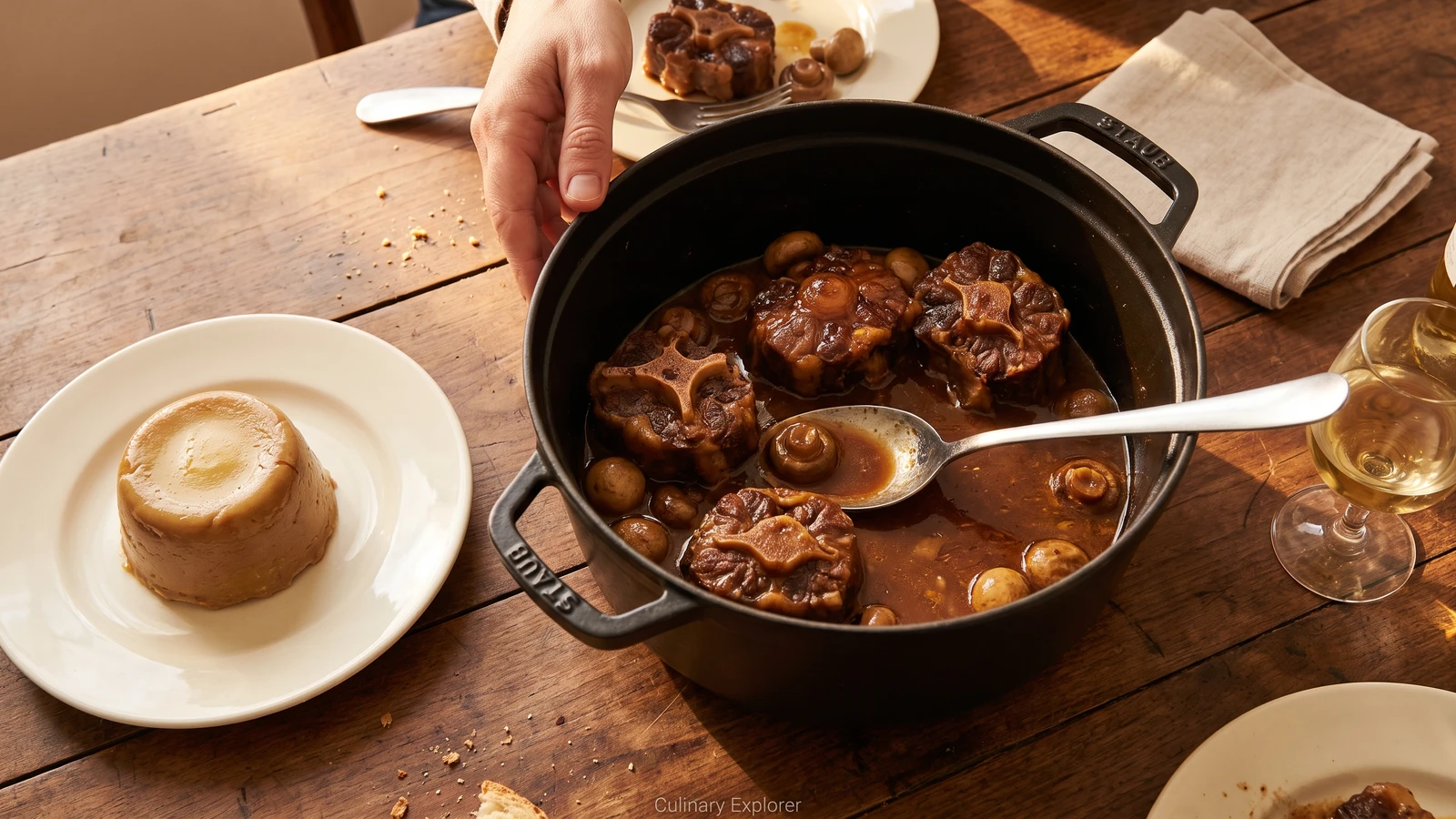
Brown stock, white wine, and patience turn oxtail into a silken braise, with small mushrooms in the glossy liquor and chestnut purée alongside. The reduction is the dish, so give it its time.
Queue de Bœuf à la Cavour (oxtail braised with mushrooms and chestnut purée) teaches one lesson before the pan is hot: a braising liquor becomes a sauce by subtraction. Remove every trace of grease, reduce patiently, then bind it only slightly with fécule, potato starch. Fat concentrates into heaviness, not flavor, and starch cannot give a weak liquor the character that reduction can.
The brigade entry assumed jointed tails arriving from the butcher, brown stock never off the fire, and a saucier free to skim and reduce while another pair of hands prepared the chestnuts. Here, pre-cut oxtail, good gelatin-rich unsalted stock, a low oven, and prepared unsweetened chestnut purée bring it within reach of one cook, one stove, one evening. Buying the purée removes the brigade labor of peeling and sieving chestnuts, not the chestnut itself. Constant stovetop tending and separate service pans are scaffolding; the abundant two-to-one proportion of stock to wine, the long braise, the mushrooms, the reduction, and the separate timbale are the dish and must stay.
When it is right, the meat loosens at a touch, the small mushrooms shine in a sauce with enough body to cling but enough generosity to pool, and the chestnut purée answers the savory liquor with quiet sweetness. The step that decides Queue de Bœuf à la Cavour comes after the braise: degrease completely, then reduce before the fécule touches the pan.
Queue de Bœuf à la Cavour belongs to the codified Parisian grand-kitchen repertoire rather than to a French regional farmhouse table. Its honorific points across the Alps to Camillo Cavour of Piedmont, while its grammar remains French: oxtail braised in brown stock and white wine, finished with mushrooms and served beside chestnut purée. The chestnuts are not scattered into the sauce as a garnish; their molded timbale arrives separately, providing an earthy, gently sweet counterpoint to the concentrated braising liquor.
Quantity
1 oxtail, about 4 lb (1.8 kg)
cut through the joints into 2 to 3-inch (5 to 7.5 cm) sections
Quantity
2 teaspoons (10 ml / 12 g), divided, plus more to taste
Quantity
½ teaspoon (2.5 ml / 1 g)
Quantity
2 tablespoons (30 ml / 28 g)
Quantity
4 cups (960 ml / 960 g)
Quantity
2 cups (480 ml / 480 g)
Quantity
2 cups (480 ml / 225 g)
trimmed and left whole
Quantity
2 tablespoons (30 ml / 28 g)
Quantity
2 teaspoons (10 ml / 6 g)
Quantity
2 tablespoons (30 ml / 30 g)
Quantity
2 cups (480 ml / 500 g)
Quantity
3 tablespoons (45 ml / 42 g)
divided
Quantity
¼ cup (60 ml / 60 g)
for loosening the chestnut purée
| Ingredient | Quantity |
|---|---|
| meaty oxtailcut through the joints into 2 to 3-inch (5 to 7.5 cm) sections | 1 oxtail, about 4 lb (1.8 kg) |
| fine sea salt | 2 teaspoons (10 ml / 12 g), divided, plus more to taste |
| freshly ground black pepper | ½ teaspoon (2.5 ml / 1 g) |
| clarified butter | 2 tablespoons (30 ml / 28 g) |
| unsalted, gelatin-rich brown beef stock | 4 cups (960 ml / 960 g) |
| dry white wine | 2 cups (480 ml / 480 g) |
| small button mushroomstrimmed and left whole | 2 cups (480 ml / 225 g) |
| unsalted butter for the mushrooms | 2 tablespoons (30 ml / 28 g) |
| fécule | 2 teaspoons (10 ml / 6 g) |
| cold water | 2 tablespoons (30 ml / 30 g) |
| prepared unsweetened chestnut purée | 2 cups (480 ml / 500 g) |
| unsalted butter for the chestnut purée and molddivided | 3 tablespoons (45 ml / 42 g) |
| hot water (optional)for loosening the chestnut purée | ¼ cup (60 ml / 60 g) |
Heat the oven to 285°F (140°C). Check the cut faces of the oxtail for loose bone fragments, pat every section thoroughly dry, and season with half the salt and all the pepper. Heat the clarified butter in a heavy 5 to 6-quart cocotte over medium-high heat. Brown the oxtail in two or three uncrowded batches, turning until every meaty face is deep bronze, about 20 to 25 minutes in all. Set the browned sections aside. Keep the fond on the pot floor dark brown, never black; if one patch burns, wipe out that patch before continuing because bitterness only grows during a long braise.
Return the oxtail to the cocotte and pour in the 4 cups of brown beef stock and 2 cups of white wine, preserving the entry's exact two-to-one proportion. Scrape the fond from the pot floor as the liquid warms. The moistening should be abundant, reaching roughly three-quarters of the way up the sections; if a very wide pot leaves them too exposed, move everything to a narrower cocotte rather than changing the ratio. Bring the liquid only to a bare simmer, then cover tightly.
Set the covered cocotte in the oven and braise for 4½ to 5 hours, turning the upper sections once midway through. The liquid should barely tremble. Test a thick section with a skewer: it is ready when the skewer enters without resistance and the meat begins to draw away from the bone at a touch. If it remains tight after 5 hours, give it another 20 to 30 minutes. Tough oxtail is undercooked, not ruined. Ça se rattrape.
While the oxtail finishes, melt the 2 tablespoons of butter in a wide skillet over medium-high heat. Add the whole mushrooms in one layer and cook for 8 to 10 minutes, tossing only occasionally, until lightly browned and their released water has evaporated. Season with a small pinch of the reserved salt and set aside. The entry calls for cooked mushrooms before they join the sauce, so do not drop them raw into the braising liquor.
Lift the tender oxtail out carefully with a slotted spoon and keep the sections intact. Strain the cooking liquor through a fine sieve into a bowl, let it stand for 5 minutes, then remove every visible pool of fat with a spoon or fat separator. Arrange the oxtail and mushrooms in the wiped cocotte. Pour the degreased liquor into a broad saucepan and boil steadily until reduced to about 3 cups (720 ml), glossy and concentrated enough to taste like the finished dish. Do not season yet. If the liquor looks oily as it reduces, stop the boil. Ça se rattrape: let it settle, skim it again, then continue. Fat does not reduce away.
Stir the fécule into the cold water until completely smooth. Bring the reduced liquor to a simmer and whisk in the slurry a little at a time; you may not need every drop. Simmer for 30 seconds, stopping when the sauce lightly coats a spoon but still pours freely. If it tightens too far, loosen it with a spoonful of warm stock or water. If small lumps appear, strain it again. Taste now and add only as much of the remaining salt as the reduction needs.
Strain the lightly thickened liquor over the oxtail and mushrooms in the cocotte, following the original sequence. Set the cocotte over low heat and let everything bubble with the gentlest motion for 10 minutes, basting the exposed meat once or twice. Do not stir vigorously because the meat is ready to leave its bones. The finished sauce should bathe the sections generously, not hold them in a stiff glaze.
While the cocotte completes its final 10 minutes, warm the chestnut purée in a small saucepan over low heat with most of the 3 tablespoons of butter. Beat it smooth with a wooden spoon, adding hot water one spoonful at a time only if it is too stiff to spread. It must remain firm enough to hold its shape. Butter a 2-cup timbale mold, a straight-sided heatproof bowl, pack in the hot purée firmly, and invert it onto a warmed plate. If the purée slumps, return it to the saucepan and cook gently until the excess moisture leaves. Bring the cocotte and chestnut timbale to the table together. À table!
1 serving (about 500g)
Culinary guides, cultural storytelling, and the editorial depth that makes cooking meaningful.
Discover Culinary ExplorerChef Juliette
John Dory has the delicacy of sole and the firmness of turbot. A light flouring, a quick butter sauté, and nut-brown beurre noisette show exactly why looks never mattered.

Chef Juliette
Fresh haddock proves its delicacy in the meunière pan: a fine flour crust, moist pearly flakes, and beurre noisette sharpened with lemon and parsley, ready from one skillet in half an hour.

Chef Juliette
Éperlans à l’Anglaise turns small fish into a lesson in disciplined coating: boned smelts under a close, crisp crumb, pan-fried in clarified butter and finished with bright, half-melted maître d’hôtel butter.

Chef Juliette
Tiny smelts, shallot, mushrooms, white wine, gratin sauce, and fine bread raspings meet a fierce oven, where the fish must turn tender in the same breath the buttered crust bronzes.