
Chef Juliette
John Dory (St. Pierre)
John Dory has the delicacy of sole and the firmness of turbot. A light flouring, a quick butter sauté, and nut-brown beurre noisette show exactly why looks never mattered.
A cooking platform built around craft, culture, and the stories behind what we eat.
Created by Chef Juliette
Based on No. 1157, Langue de Bœuf Flamande, from Le Guide Culinaire (1907) by Auguste Escoffier
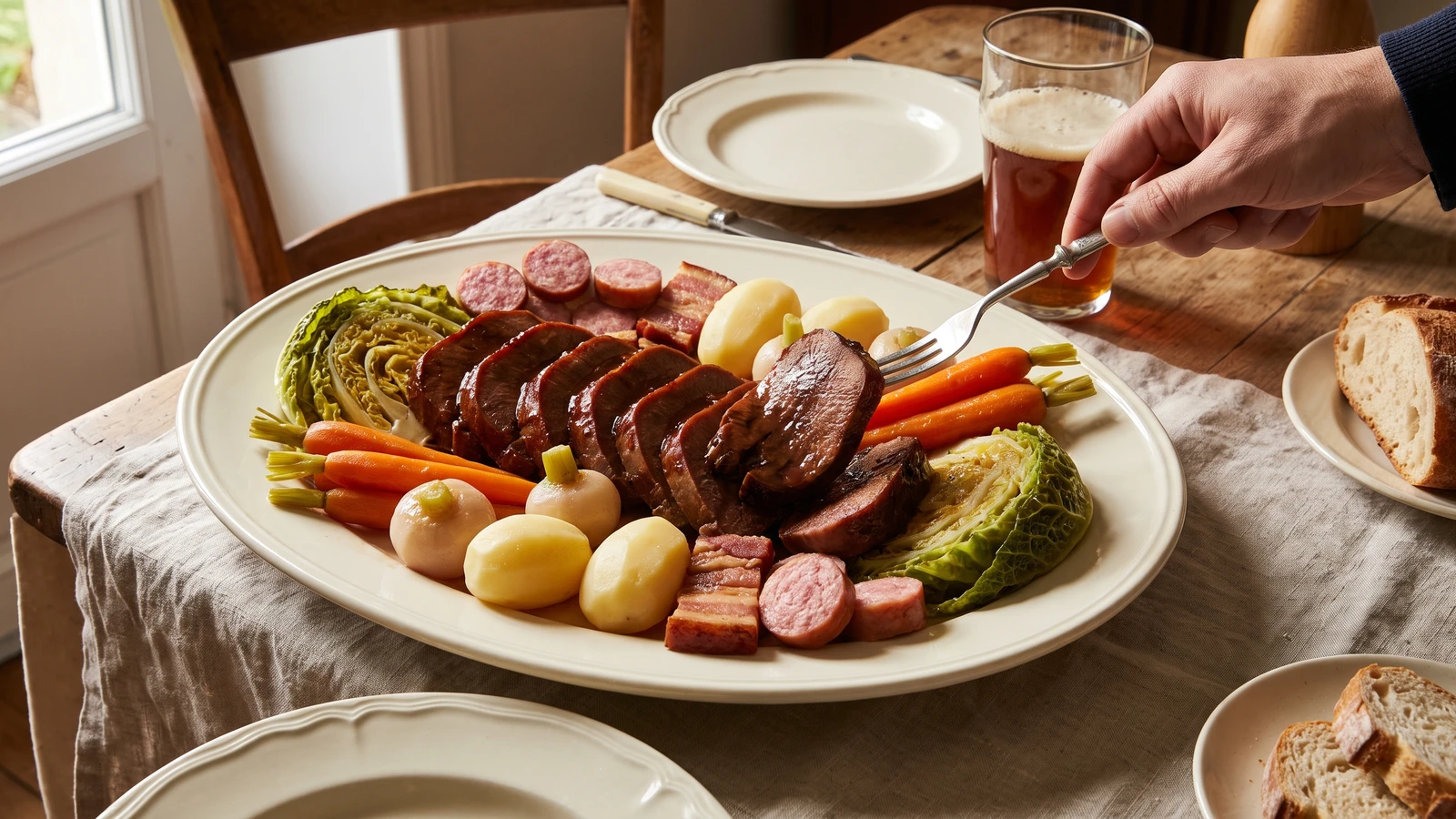
Langue de Bœuf Flamande teaches the generous logic of garnish: tender glazed tongue at the centre, braised cabbage, roots, potatoes, bacon, and sausage gathered around it.
Langue de Bœuf Flamande (Flemish-style ox tongue) teaches the generous architecture of a classical garnish: the centre must earn the abundance around it. Before you touch a pan, know the one true thing about tongue. Time is only a guide; it is ready when a thin skewer enters the thick end with almost no resistance. An underbraised tongue will slice like rubber, and no glaze can flatter it.
The brigade entry assumed a saucier on staff, a stock never off the fire, a salamander for the final shine, and enough hands to tend each vegetable in its own pan. Here, the tongue’s strained braising liquor becomes the glaze, a home broiler replaces the salamander, one Savoy cabbage becomes four braised wedges, and evenly cut roots replace ornamental knife work. The scale and choreography change because four people need supper, not service for forty; the long braise, the last-moment glaze, and every element of the Flemish garnish remain because those are the dish. One cook, one stove, one evening.
When it is right, the tongue lies in overlapping slices under a mahogany gloss, surrounded by soft green cabbage, butter-bright roots, pale potatoes, bacon, and sausage. It is abundant without being fussy. The step that decides everything comes first: hold the braise at a bare tremble and trust the skewer, not the clock.
Langue de Bœuf Flamande belongs to the classical French reading of Flanders, especially the northern table around Lille and the border country toward Belgium, where cabbage, roots, pork, and sausage made a complete cold-weather garnish. In the canon, Flamande names this precise ring of braised cabbage, glazed carrots and turnips, potatoes à l’Anglaise, lean bacon, and sausage around a braised meat, not a generic beer sauce. The preparation moved from the sturdy northern larder into grand kitchens without shedding its abundance; the refinement lies in cooking each element properly, then bringing them together.
Quantity
1 (3 to 3½ pounds / 1.4 to 1.6 kg)
rinsed
Quantity
About 2 gallons (7.6 L / 7.6 kg)
divided
Quantity
4 cups (960 ml / about 960 g)
Quantity
1 (about 8 ounces / 225 g)
quartered
Quantity
1 large (about 4 ounces / 115 g)
cut into chunks
Quantity
2 (about 4 ounces / 115 g)
cut into chunks
Quantity
1
made with parsley stems, thyme, and bay leaf
Quantity
1 teaspoon (5 ml / 2 g)
Quantity
2
Quantity
1 medium (about 1½ pounds / 680 g)
cut through the core into 4 wedges
Quantity
6 ounces (170 g)
cut into 8 rectangles
Quantity
4 medium (about 12 ounces / 340 g)
peeled and cut into thick oblique pieces
Quantity
3 medium (about 12 ounces / 340 g)
peeled and cut into pieces matching the carrots
Quantity
8 (about 1½ pounds / 680 g)
peeled
Quantity
10 ounces (285 g)
cut into ½-inch (1.25 cm) roundels
Quantity
6 tablespoons (90 ml / 85 g)
divided
Quantity
1 tablespoon (15 ml / 12 g)
Quantity
3 tablespoons (45 ml / 54 g), plus more to taste
divided
Quantity
½ teaspoon (2.5 ml / 1 g)
| Ingredient | Quantity |
|---|---|
| fresh ox tonguerinsed | 1 (3 to 3½ pounds / 1.4 to 1.6 kg) |
| cold waterdivided | About 2 gallons (7.6 L / 7.6 kg) |
| unsalted or very low-sodium beef stock | 4 cups (960 ml / about 960 g) |
| large yellow onionquartered | 1 (about 8 ounces / 225 g) |
| carrot for braisingcut into chunks | 1 large (about 4 ounces / 115 g) |
| celery ribscut into chunks | 2 (about 4 ounces / 115 g) |
| bouquet garnimade with parsley stems, thyme, and bay leaf | 1 |
| black peppercorns | 1 teaspoon (5 ml / 2 g) |
| whole cloves | 2 |
| Savoy cabbagecut through the core into 4 wedges | 1 medium (about 1½ pounds / 680 g) |
| lean slab baconcut into 8 rectangles | 6 ounces (170 g) |
| carrots for glazingpeeled and cut into thick oblique pieces | 4 medium (about 12 ounces / 340 g) |
| turnipspeeled and cut into pieces matching the carrots | 3 medium (about 12 ounces / 340 g) |
| small waxy potatoespeeled | 8 (about 1½ pounds / 680 g) |
| fully cooked mild pork sausagecut into ½-inch (1.25 cm) roundels | 10 ounces (285 g) |
| unsalted butterdivided | 6 tablespoons (90 ml / 85 g) |
| granulated sugar | 1 tablespoon (15 ml / 12 g) |
| fine sea saltdivided | 3 tablespoons (45 ml / 54 g), plus more to taste |
| freshly ground black pepper | ½ teaspoon (2.5 ml / 1 g) |
Put the tongue in an 8-quart heavy pot and add 8 cups (1.9 L) of the cold water. Bring slowly to a boil, skim the grey foam, then simmer for 15 minutes. Drain, rinse the tongue under cool water, and wash the pot. This first blanching is useful scaffolding, not ceremony: it clears away blood and surface proteins so the braising liquor can become a clean glaze later.
Return the tongue to the clean pot. Add the beef stock, 6 cups (1.4 L) water, onion, braising carrot, celery, bouquet garni, peppercorns, cloves, and 1 teaspoon (6 g) salt. The liquid should cover the tongue by about 1 inch (2.5 cm); add a little more water if the pot is unusually wide. Bring it just to a simmer, skim once more, then cover and hold at the barest tremble for 3 to 3½ hours. Turn the tongue halfway through. It is ready only when a skewer enters the thick end with almost no resistance and the skin lifts when nicked. If either test fails, give it another 20 minutes and test again. Ça se rattrape.
Lift the tender tongue onto a board and let it stand only until your hands can manage it. Cut a shallow line through the skin, then pull the skin away while the tongue is still warm; trim the coarse gristle and any loose tissue from the root end without carving away good meat. If the skin clings stubbornly, the tongue needs more cooking, not a stronger hand. Return it to the braise for 15 to 20 minutes. Strain the cooking liquor through a fine sieve and skim off the surface fat. Keep the peeled tongue covered with a little strained liquor while you prepare the garnish.
Measure 4 cups (960 ml) of strained braising liquor into a wide saucepan. Bring it to a brisk simmer and reduce it to about 1 cup (240 ml), skimming as needed, until it gleams and coats the back of a spoon with a clear track left by your finger. This reduction replaces the separate meat glaze and the saucier who once tended it. Do not season until it has reduced. If it tightens too far, loosen it with reserved braising liquor, a spoonful at a time.
Lay the bacon rectangles in a cold wide sauté pan and set it over medium heat. Cook slowly until their fat renders and the edges turn bronze, keeping the rectangles supple rather than brittle. Lift them out with a slotted spoon. Add the sausage roundels to the bacon fat and colour them lightly on both cut faces, then reserve them with the bacon.
Bring 6 cups (1.4 L) water to a boil with 1 tablespoon (18 g) salt. Lower in the cabbage wedges and blanch for 5 minutes, then drain carefully so the cores continue holding the leaves together. Melt 2 tablespoons (28 g) butter in the bacon pan, settle in the cabbage, and add 2 cups (480 ml) strained braising liquor. Cover and simmer gently for 25 to 30 minutes, turning once, until a knife slips through the core. Uncover for the final few minutes so the liquor reduces to a light sheen. Once the cabbage is covered, start the roots and potatoes; their cooking times overlap without requiring a brigade.
Put the carrots in a medium saucepan with 3 tablespoons (43 g) butter, the sugar, ½ teaspoon (3 g) salt, and 1½ cups (360 ml) water. Cover with a lid set slightly ajar and simmer for 5 minutes, then add the turnips. Continue until both vegetables are just tender, about 12 to 15 minutes more. Remove the lid and roll the vegetables through the reducing liquid until the water is gone and the butter and sugar leave a clear, bright glaze. If the pan dries before the roots are tender, add water by the tablespoon. Burnt sugar is a verdict; a dry pan caught in time is merely a request for water.
Set the potatoes in a saucepan with 6 cups (1.4 L) cold water and 1 tablespoon (18 g) salt. Bring to a gentle boil and cook until a knife enters cleanly, about 15 to 20 minutes. This is à l’Anglaise, cooked plainly in water, and the simplicity matters against the rich tongue and pork. Drain them before they split, return them to the dry warm pan for 1 minute, and roll the pan gently so their surfaces dry without breaking.
Heat the broiler and set a rack about 6 inches (15 cm) below it. Pat the warm tongue dry, place it on a broiler-safe tray, and brush it generously with the reduced glaze. Broil for 45 to 60 seconds, brush again, and repeat until the surface is mahogany-coloured and lacquered, watching continuously because the final coat catches quickly. The home broiler is the honest equivalent of the salamander. If an edge darkens too fast, lower the tray and brush that spot with fresh glaze. Whisk the remaining 1 tablespoon (14 g) butter into the glaze off the heat, then taste for salt and pepper.
Carve the tongue crosswise into slices about ½ inch (1.25 cm) thick and overlap them down the centre of a heated oval platter. Spoon over enough buttered glaze to make them shine without flooding the platter. Surround the tongue with the braised cabbage wedges, glazed carrots and turnips, potatoes à l’Anglaise, bacon rectangles, and sausage roundels, keeping each element recognizable rather than stirring everything together. Serve the remaining glaze in a warm jug. This is generosity with discipline. À table!
1 serving (about 900g)
Culinary guides, cultural storytelling, and the editorial depth that makes cooking meaningful.
Discover Culinary ExplorerChef Juliette
John Dory has the delicacy of sole and the firmness of turbot. A light flouring, a quick butter sauté, and nut-brown beurre noisette show exactly why looks never mattered.

Chef Juliette
Fresh haddock proves its delicacy in the meunière pan: a fine flour crust, moist pearly flakes, and beurre noisette sharpened with lemon and parsley, ready from one skillet in half an hour.

Chef Juliette
Éperlans à l’Anglaise turns small fish into a lesson in disciplined coating: boned smelts under a close, crisp crumb, pan-fried in clarified butter and finished with bright, half-melted maître d’hôtel butter.

Chef Juliette
Tiny smelts, shallot, mushrooms, white wine, gratin sauce, and fine bread raspings meet a fierce oven, where the fish must turn tender in the same breath the buttered crust bronzes.