Culinary Explorer

A cooking platform built around craft, culture, and the stories behind what we eat.
Discover Culinary Explorer
Langue de Bœuf Bourgeoise

Langue de Bœuf Bourgeoise

Created by Chef Juliette

Based on No. 1155, Langue de Bœuf Bourgeoise, from Le Guide Culinaire (1907) by Auguste Escoffier

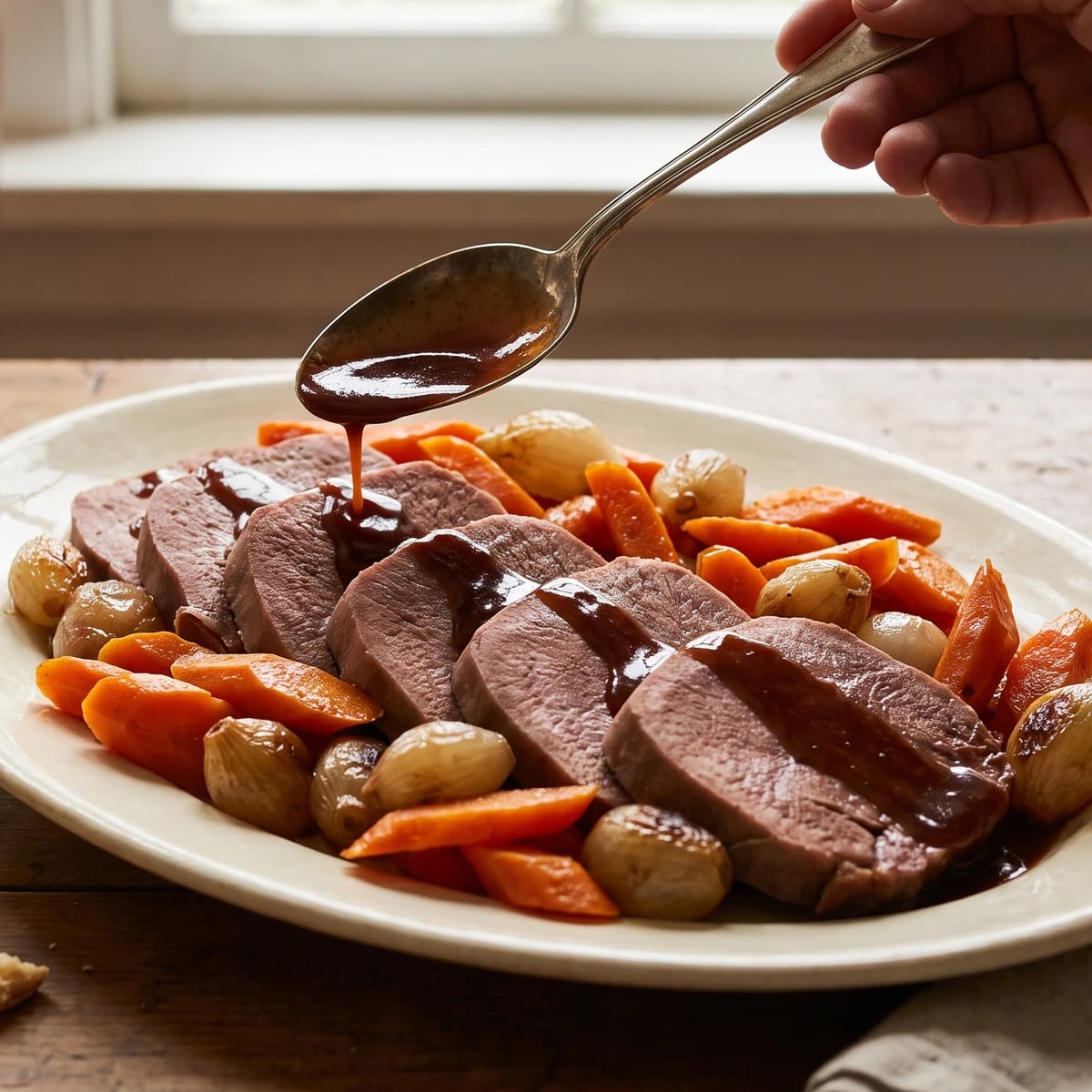
Langue de Bœuf Bourgeoise turns a humble tongue into a generous braise, tender slices glossed with their own cooking liquor and ringed by olive-cut carrots and onions browned honestly in butter.

Main Dishes
French
Comfort Food
Make Ahead
Dinner Party
45 min
Active Time
4 hr cook4 hr 45 min total
Yield4 servings

Langue de Bœuf Bourgeoise (braised ox tongue in the bourgeois household manner) teaches the central law of braising: connective tissue yields to gentle time, while boiling only roughens the meat and muddies the liquor. Know one thing before touching the pan. If the thick end resists a skewer, it needs more gentle cooking. It hasn't failed.

The original entry speaks in brigade shorthand. It assumes a braisière, stock never off the fire, several pans already working, and a saucier ready to strain and reduce the cuisson (cooking liquid). Here, one fresh tongue, a snug cocotte, good unsalted stock, and an ordinary saucepan do the same work for four people. One cook, one stove, one evening.

The separate sauce station is brigade scaffolding and can go. The carrots tournées en olives (turned into olive shapes), their two-stage cooking, the onions browned in real butter, and the glossy reduction must stay, because they are the dish. Hold the braise at a bare tremble and trust the skewer, because that gentle final third decides everything.

Langue de bœuf bourgeoise belongs to cuisine bourgeoise, the disciplined French household table, especially the Parisian table from which carefully garnished braises passed into bistros. Its service follows bœuf à la mode: the braised cut is sliced, glazed with reduced cuisson, and encircled by carrots and small onions. The olive in olive-cut carrots names the tournage, not a Provençal flavoring; no olives belong in the pot.

The technique, the tradition, and the story behind every dish.

Discover Culinary Explorer

Ingredients

fresh, unsmoked beef tongue

Quantity

1 tongue, 2½ to 3 pounds (1.1 to 1.4 kg)

cold water

Quantity

3 quarts (2.8 L / 2.8 kg), plus more as needed

fine sea salt

Quantity

2 teaspoons (10 ml / 12 g), plus more to taste

divided

whole black peppercorns

Quantity

2 teaspoons (10 ml / 6 g)

freshly ground black pepper

Quantity

1 teaspoon (5 ml / 2 g)

unsalted butter

Quantity

6 tablespoons (90 ml / 85 g)

divided, with 1 tablespoon held for optional sauce rescue

yellow onion

Quantity

1 medium (about 1½ cups / 225 g)

coarsely chopped

carrot for the braise

Quantity

1 medium (about 1 cup / 120 g)

coarsely chopped

celery

Quantity

2 stalks (about 1 cup / 110 g)

coarsely chopped

garlic

Quantity

2 cloves

lightly crushed

bouquet garni

Quantity

1 bouquet

3 parsley stems, 2 thyme sprigs, and 1 bay leaf, tied together

unsalted beef stock

Quantity

4 cups (950 ml / 950 g)

large carrots for the garnish

Quantity

4 large (about 4 cups / 500 g before turning)

peeled and cut into 16 olive shapes

small pearl onions

Quantity

16 onions (about 1½ cups / 225 g)

peeled

all-purpose flour (optional)

Quantity

2 teaspoons (10 ml / 5 g)

for sauce rescue

Equipment Needed

  • 7 to 8-quart stockpot
  • 5½ to 6-quart heavy lidded cocotte
  • 10-inch skillet
  • Medium saucepan
  • Sharp paring knife
  • Fine-mesh sieve
  • Skewer or thin carving fork

Instructions

  1. 1

    Blanch the tongue

    Rinse the tongue under cold water and place it in a stockpot. Add enough of the measured cold water to cover it by 2 inches (5 cm), bring slowly to a boil, then lower the heat and simmer for 20 minutes. Drain, rinse away the grey foam, and wash the pot. This blanching gives you a cleaner cuisson later; the skin will still be firm, so don't fight it yet.

  2. 2

    Begin the braise

    Heat the oven to 300°F (150°C). Melt 2 tablespoons of the butter in a snug cocotte over medium heat. Add the chopped onion, carrot, and celery, then cook for 8 to 10 minutes, stirring occasionally, until their edges are golden and the pot floor carries a bronze fond. Add the garlic for the final minute. Pour in one-quarter of the stock and scrape up every browned trace, then settle in the blanched tongue with the bouquet garni, peppercorns, ground pepper, and half the measured salt. Add the remaining stock and enough fresh water to reach two-thirds of the way up the tongue. Bring the liquid only to a tremble, cover, and place the cocotte in the oven.

    Use a pot that holds the tongue closely. A vast stockpot demands too much liquid and leaves you with a weak sauce; a snug cocotte concentrates what the tongue and vegetables give it.
  3. 3

    Braise two-thirds

    Braise for about 2 hours, turning the tongue after the first hour and adding a little hot water if the liquid falls below halfway. Judge the two-thirds point by touch: a skewer should enter the tip readily while the thick root end still offers distinct resistance. If the skin clings tightly or the centre feels nearly raw, give it another 20 to 30 minutes before proceeding. If the liquid has boiled hard, lower the oven, skim the surface, and continue gently. Ça se rattrape.

  4. 4

    Prepare the garnishes

    While the tongue braises, simmer the olive-cut carrots in a saucepan of water seasoned with the remaining measured salt. Cook them for 6 to 8 minutes, until a knife enters the outer flesh but meets a firm core; they must be about two-thirds cooked, because their last third belongs in the braise. Drain them carefully. Melt 2 tablespoons of butter in a skillet and roll the pearl onions through it over medium heat until they are evenly copper-gold, about 8 minutes. If the butter threatens to blacken before the onions colour, add a tablespoon of water and lower the heat. Keep the onions whole.

    The carrot olives need consistent thickness more than perfect facets. Save the clean trimmings for soup or stock; the classical cut asks for discipline, not waste.
  5. 5

    Peel and surround

    Lift the tongue onto a board once it reaches the two-thirds point. As soon as it is cool enough to hold with a clean towel, slit the skin along the underside and peel it away, working from the thick end toward the tip. Trim off the coarse root gristle and any loose fat without carving into the meat. If the membrane refuses to release, return the tongue to the braise for 15 minutes and try again; forcing it now only tears away good meat. Return the peeled tongue to the cocotte, then surround it with the carrots and the browned onions, including their butter.

  6. 6

    Finish the braise

    Cover and continue braising at the same gentle tremble for 45 to 75 minutes. Turn the tongue once and baste the vegetables with the cuisson. It is ready when a skewer passes through the thick end with scarcely more resistance than through softened butter. If the carrots or onions become tender first, lift them out with a slotted spoon and keep them covered; return them only for the final warming. Patience, not boiling, makes the tongue tender.

  7. 7

    Reduce the cuisson

    Transfer the tongue, carrots, and onions to a warm platter and cover loosely. Strain the cuisson into a saucepan without pressing the spent aromatics, let it settle for 5 minutes, and skim away the surface fat. Boil steadily until reduced to about 1½ cups and glossy enough to coat the back of a spoon. If the flavour becomes full before the sauce gains body, don't reduce it into saltiness. Knead 2 teaspoons of softened butter with the optional flour to make a beurre manié, whisk it into the simmering sauce a little at a time, and cook for 3 minutes. Remove the pan from the heat and monter au beurre, whisk in 1 tablespoon of cold butter, until the sauce gleams. If the butter pools, whisk in a teaspoon of cold water off the heat.

  8. 8

    Slice and serve

    Rest the tongue whole for 10 minutes, then slice it crosswise about ¼ inch (6 mm) thick. Overlap the slices down the centre of the warm platter, ring them with the carrots and onions, and spoon over enough sauce to glaze everything without drowning it. Bring the remaining sauce separately and serve at once. À table!

Chef Tips

  • Buy a fresh, unsmoked tongue. A cured or pickled tongue carries salt and curing spice into the sauce, which makes a good dish but not this one. If cured tongue is all you have, soak it in several changes of cold water and omit the measured salt.
  • Unsalted stock matters because the cuisson reduces considerably. A straightforward prepared stock with a clean beef flavour is perfectly honest here; the tongue supplies enough gelatin to give the finished sauce its proper gloss.
  • Turn the garnish carrots before the braise begins if you prefer an unhurried stove. Each should be a plump, elongated olive about 1½ inches (4 cm) long, large enough to survive its final cooking without collapsing.
  • Serve with pommes purée or plain buttered noodles, something quiet that catches the sauce. A supple Cabernet Franc or a medium-bodied red Bordeaux has enough freshness for the tongue without bullying the carrots.

Advance Preparation

  • The completed tongue can be made up to 2 days ahead. Cool it promptly with enough strained cuisson to keep it moist, cover, and refrigerate the vegetables separately. Lift off the cold fat, reheat the tongue gently in its liquid, then reduce and finish the sauce before serving.
  • The carrots can be turned and par-cooked, and the pearl onions peeled, 1 day ahead. Keep them covered and refrigerated, then brown the onions in butter shortly before they enter the braise.
  • Leftovers keep for 3 days under refrigeration. Reheat slices gently in the sauce over low heat; a hard boil tightens meat that the long braise worked patiently to soften.

Frequently Asked Questions

Nutrition Information

1 serving (about 440g)

Calories
825 calories
Total Fat
63 g
Saturated Fat
29 g
Trans Fat
3 g
Unsaturated Fat
27 g
Cholesterol
320 mg
Sodium
1100 mg
Total Carbohydrates
21 g
Dietary Fiber
5 g
Sugars
9 g
Protein
44 g

Note: Chef personas and recipes are created with AI assistance. Cook with care: follow safe food-handling practices, check doneness with a thermometer when needed, and adapt for allergies and your kitchen.

Where cooking meets culture.

Culinary guides, cultural storytelling, and the editorial depth that makes cooking meaningful.

Discover Culinary Explorer

More from Relevés and Entrées - Tournedos

Browse the full collection