
Chef Juliette
Châteaubriand, Fillet Steak, Tournedos
One tenderloin heart, three classical portions: roast Châteaubriand for carving, bifteck de filet for one, tournedos two to a plate, all with braised endives and a red-wine pan jus.
A cooking platform built around craft, culture, and the stories behind what we eat.
Created by Chef Juliette
Based on No. 1147, Pièce de Bœuf à la Cuiller, from Le Guide Culinaire (1907) by Auguste Escoffier
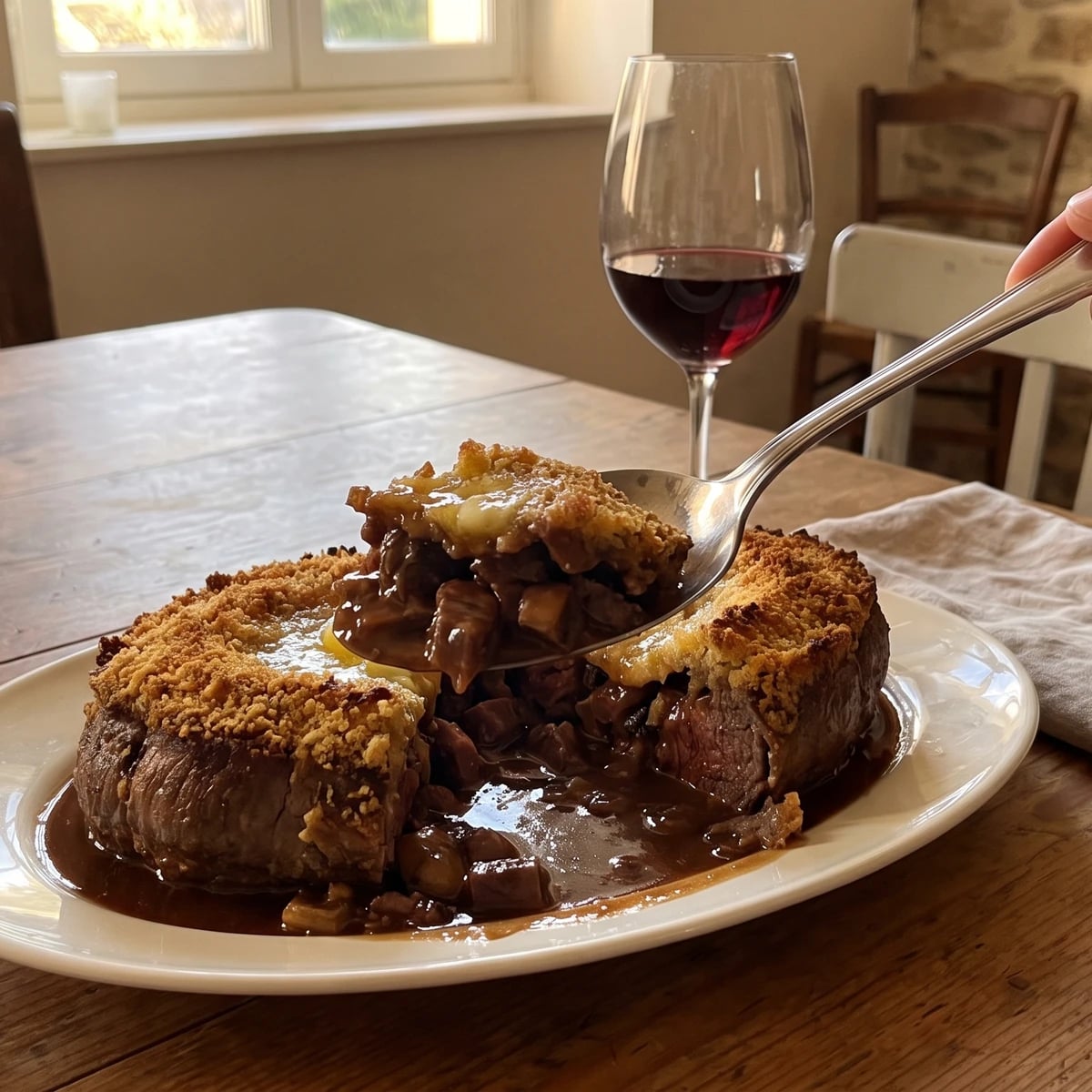
Beef braised until a spoon can part it, cooled and hollowed into an edible case, then crusted with Parmesan crumbs and refilled with tongue, sweetbread, mushrooms, and glossy sauce.
Pièce de Bœuf à la Cuiller (beef tender enough for a spoon) teaches a precise contradiction: the meat must surrender at the table, yet leave the braise with enough structure to be cooled, hollowed, crusted, and filled. Gentle heat is the one true thing. Rush the pot and the fibres tighten into string before the collagen softens; let the liquor barely tremble and the beef becomes yielding without disintegrating.
The original assumed a saucier on staff, a stockpot never off the fire, cooked salted tongue and braised sweetbread waiting, and oven heat fierce enough to do a salamander's work. At home, a compact marbled chuck roast replaces lean meat threaded with fat by a larding needle; its own seams protect it, while a close-fitting Dutch oven and a brief hot finish handle the rest. Repeated transfers, muslin straining, and many coats of glaze are brigade scaffolding and can go. The gentle braise, slight pressure, half-inch walls, Parmesan crumb case, and rich garnish are the dish and must stay. One cook, one stove, one evening.
The stopping point matters most. Remove the beef while a skewer still meets slight resistance, because cooling firms the gelatin enough for carving. If it has gone fully yielding, chill it completely and patch any torn wall with a little chopped interior before applying the egg and crumbs. Ça se rattrape.
Pièce de Bœuf à la Cuiller belongs to the formal service of France's grand kitchens, centered on Paris, rather than to a single provincial larder: its edible architecture turns a braised joint into a generous centerpiece. À la cuiller names the promised tenderness, but the hollowed breadcrumb-and-Parmesan case is equally essential; without that construction, the preparation is simply braised beef with garnish. The source entry records it as a curiosity, evidence that its elaborate mode of service became uncommon even while braising remained central to the French canon.
Quantity
1 roast, 3½ pounds (1.6 kg)
compact, well marbled, and square or oval
Quantity
1 home-scale preparation Ordinary Braisings (No. 247), scaled for a 3½-pound (1.6 kg) beef piece
Quantity
2
beaten
Quantity
1¼ cups (300 ml / 125 g)
Quantity
¾ cup (180 ml / 60 g)
finely grated
Quantity
4 tablespoons (60 ml / 57 g)
melted
Quantity
¾ cup (180 ml / 115 g)
cut into ¼-inch (6 mm) dice
Quantity
1 cup (240 ml / 170 g)
cut into bite-size pieces
Quantity
2½ cups (600 ml / 225 g)
quartered
Quantity
1½ to 2 cups (360 to 480 ml / 380 to 505 g)
Quantity
as needed
| Ingredient | Quantity |
|---|---|
| boneless beef chuck roastcompact, well marbled, and square or oval | 1 roast, 3½ pounds (1.6 kg) |
| Ordinary Braisings preparation with its cooking liquor | 1 home-scale preparation Ordinary Braisings (No. 247), scaled for a 3½-pound (1.6 kg) beef piece |
| large eggsbeaten | 2 |
| fine dry breadcrumbs | 1¼ cups (300 ml / 125 g) |
| Parmesanfinely grated | ¾ cup (180 ml / 60 g) |
| unsalted buttermelted | 4 tablespoons (60 ml / 57 g) |
| cooked salted beef tonguecut into ¼-inch (6 mm) dice | ¾ cup (180 ml / 115 g) |
| braised veal sweetbread slicescut into bite-size pieces | 1 cup (240 ml / 170 g) |
| button mushroomsquartered | 2½ cups (600 ml / 225 g) |
| Sauce Demi-Glace | 1½ to 2 cups (360 to 480 ml / 380 to 505 g) |
| fine salt and freshly ground black pepper | as needed |
Trim away only hard exterior gristle, leaving the soft fat and marbling that protect the beef during its long cooking. Shape the roast into a compact square or oval and tie it firmly at 1-inch (2.5 cm) intervals. The shape is practical, not decorative: even sides let you carve a sound case with walls of equal thickness.
Braise the tied beef using Ordinary Braisings (No. 247), placing it in a heavy pot that only just holds it and adding enough moistening liquor to cover it almost entirely. Hold the covered pot in a 300°F (150°C) oven at the barest tremble, turning and basting the exposed surface about every 40 minutes. Begin testing after 2¾ hours. Remove the beef when a skewer reaches the centre with slight but distinct resistance, usually after 3 to 3½ hours and around 188 to 192°F (87 to 89°C) internally. It must be tender, but not yet collapsing. If the liquor begins boiling hard, lift the pot from the oven, uncover it for two minutes, then continue at a lower setting. Ça se rattrape.
Lift the beef carefully from its liquor and reserve ½ cup (120 ml / 125 g) of that liquor for adjusting the filling. Keep the roast tied and place it on a shallow tray. Cover it with parchment, set a small board or second tray on top, and add a 2-pound (900 g) weight. Rest for 20 minutes, then refrigerate under the weight for 60 to 75 minutes, until firm enough to carve. Slight pressure gives the case clean, regular sides; excessive weight squeezes out the juices, so don't flatten it.
Remove the twine. Mark a border ½ inch (1.25 cm) inside the upper edge, then cut straight down without piercing the bottom. Lift the centre out in sections with a sturdy spoon, leaving a ½-inch (1.25 cm) wall around every side and across the base. Reserve and coarsely chop all the extracted meat. If a wall tears, press a strip of cold chopped beef against the damaged place from inside and chill it for 10 minutes; the crumb coating will brace the repair.
Heat the oven to 450°F (230°C). Pat the outside of the case dry. Combine the breadcrumbs and Parmesan, brush the exterior and upper rim with beaten egg, then press on the crumb mixture in an even layer. Dab the melted butter over the crumbs with a pastry brush, lifting rather than sweeping so the coating stays put. Set the case open-side up on a rack over a rimmed sheet pan and bake for 12 to 18 minutes, until the crust is deep butter-gold and crisp. If it remains pale, give it 60 seconds under the broiler, the home salamander, and watch without looking away.
While the case crusts, bring 1½ cups (360 ml / 380 g) of Sauce Demi-Glace to a bare simmer in a wide sauté pan. Add the mushrooms and cook gently until tender and the sauce has returned to a coating consistency, about 6 minutes. Fold in the chopped braised beef, salted tongue, and sweetbread, then heat for another 4 to 5 minutes without boiling. The sauce should bind the garnish, not drown it. If it is thin, lift out the solids and reduce the sauce alone; if it is too tight, loosen it spoonful by spoonful with the reserved braising liquor. Taste before adding salt, because the tongue, Parmesan, and demi-glace have already spoken.
Transfer the crusted case to a warmed oval platter with two broad spatulas. Spoon in the garnish generously, mounding it just above the rim, and finish with enough sauce to gloss the exposed filling while keeping the crumb case crisp. Present it whole and serve with a broad spoon, letting the first portion break through the tender wall. À table!
1 serving (about 650g)
Culinary guides, cultural storytelling, and the editorial depth that makes cooking meaningful.
Discover Culinary Explorer
Chef Juliette
One tenderloin heart, three classical portions: roast Châteaubriand for carving, bifteck de filet for one, tournedos two to a plate, all with braised endives and a red-wine pan jus.

Chef Juliette
Tournedos Algérienne teaches timing: crisp sweet-potato croquettes and tender oil-stewed tomatoes must be ready before lean fillet meets clarified butter, sears fast, and goes straight to the table.

Chef Juliette
Tournedos crowned over crisp tartlets of wine-braised choucroute and lean ham: a hot, quick grill for the fillet, a dry, buttery foundation below, and Alsace carried through the whole plate.

Chef Juliette
Tender tournedos meet a Provençal ring of golden aubergine and sautéed tomato, each steak crowned with fried onion. The lesson is timing: prepare the garnish, then give lean fillet one hot, quick pan.