
Chef Juliette
John Dory (St. Pierre)
John Dory has the delicacy of sole and the firmness of turbot. A light flouring, a quick butter sauté, and nut-brown beurre noisette show exactly why looks never mattered.
A cooking platform built around craft, culture, and the stories behind what we eat.
Created by Chef Juliette
Based on No. 1144, Grilled Sirloin Steaks and Ribs of Beef, from Le Guide Culinaire (1907) by Auguste Escoffier
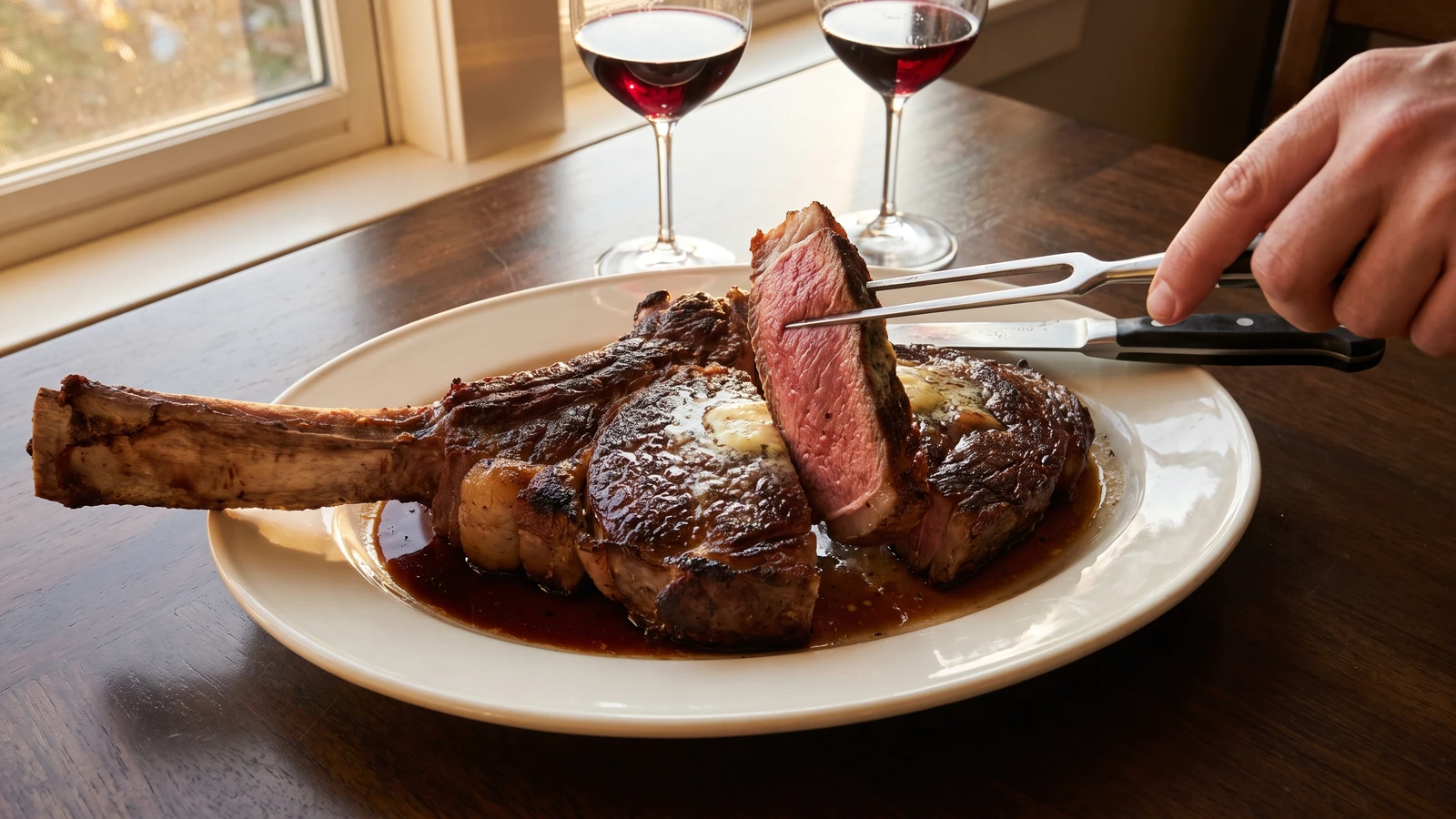
Contre-filet et côte de bœuf grillés teaches the law of a thick cut: fierce color first, gentler heat through the center, then a full rest before butter and carving.
Contre-filets et côtes de bœuf grillés (grilled sirloin steaks and ribs of beef) teaches the law of the thick cut: its outside needs fierce heat, but its center needs time away from it. The source's two-to-three-pound ceiling isn't a flourish. Go larger and the exterior chars before the middle is ready; go much thinner and you lose the generous, evenly rosy slices that make this a shared dish.
The old instruction leaves nearly all its craft inside the word grillés. It assumed a grillardin, the grill cook, tending a broad coal fire; elsewhere, a saucier and stock never off the fire stood ready for the less-tender rib sent to braise. A salamander, the overhead broiler, isn't the answer for this thick grilled cut because it colors one face while leaving the center to chance. At home, one tender, evenly cut steak of two and a half pounds feeds four, a lidded two-zone grill replaces the open range, and an instant-read thermometer replaces brigade intuition. One cook, one stove, one evening, with the grill serving as the old open fire.
The catalogue of garnishes and separate sauce work belongs to the braised branch and can go. For the grillade, the browned crust, melted butter, and resting juices are the sauce. The weight limit, tender cut, controlled fire, and full rest must stay. Build two distinct heat zones before the meat meets the grate; that is the step that decides the dish.
The grillade belongs to the classical rôtisseur's station rather than to one French region: contre-filet came from the loin, while côte de bœuf came from the rib, and both were judged for tenderness and even thickness before reaching the fire. In classical butchery, côte de bœuf means a thick bone-in rib steak, not a rack of short ribs, while entrecôte names the boneless meat associated with the space between the ribs. Bistro and bourgeois tables adopted these large cuts for sharing, but the identity of the dish remained simple: good beef, direct heat, careful resting, and no sauce required to disguise the meat.
Quantity
1 steak (2½ lb / 1.13 kg)
evenly cut, 2½ to 3 inches (6.5 to 7.5 cm) thick
Quantity
2 teaspoons (10 ml / 12 g)
Quantity
1 teaspoon (5 ml / 2 g)
Quantity
3 tablespoons (45 ml / 42 g)
softened
| Ingredient | Quantity |
|---|---|
| thick contre-filet or tender bone-in côte de bœufevenly cut, 2½ to 3 inches (6.5 to 7.5 cm) thick | 1 steak (2½ lb / 1.13 kg) |
| fine sea salt | 2 teaspoons (10 ml / 12 g) |
| freshly ground black pepper | 1 teaspoon (5 ml / 2 g) |
| unsalted buttersoftened | 3 tablespoons (45 ml / 42 g) |
Prepare a lidded grill with one fiercely hot zone and one gentler zone. Bank hot coals over half of a charcoal grill and leave the other half clear, or set one side of a gas grill to high and the other to low. Heat the grates thoroughly, then scrub them clean. The hot side builds the crust; the gentler side brings the thick center to temperature without burning what you've already browned.
Dry every surface of the beef thoroughly. If it wasn't salted in advance, season it evenly with all the fine salt immediately before grilling; hold the pepper until the first crust has formed so it doesn't scorch. Press along the steak with your fingers and check that its thickness is reasonably even. A sharply tapered end will cook first, so point that end toward the gentler side of the fire.
Lay the beef over the hottest part of the grill and leave it alone until it releases cleanly and wears a deep Maillard bronze crust, about 3 to 4 minutes. Turn and brown the second face for another 3 to 4 minutes, then hold the fat edge against the grate with tongs for about 1 minute. If dripping fat causes flames, move the beef to the cool zone at once and close the lid until they subside. Ça se rattrape. Never fight a flare-up by leaving the meat inside it, and don't spray water onto the grill.
Move the beef to the gentler zone and close the lid. Turn it every 4 to 5 minutes so the heat travels evenly, checking the center from the side with an instant-read thermometer and keeping the probe away from bone. Allow roughly 12 to 22 minutes after searing. Pull the beef at 125 to 128°F (52 to 53°C) for a final medium-rare center, or at 135°F (57°C) for medium; a cut this thick commonly rises another 5 to 10°F (3 to 6°C) while resting. If the crust is already dark but the center is lagging, keep it on the gentler side with the lid closed. That is precisely what the second zone is for.
Set the beef on a warm rimmed platter and spread 1 tablespoon (15 ml / 14 g) of the softened butter over its top. Season with the black pepper, then rest it for 12 to 15 minutes under a very loose tent of foil. Don't wrap it tightly, which softens the crust. Resting lets the temperature finish climbing and keeps the juices inside the slices rather than flooding the board.
For a côte de bœuf, run the knife along the bone and set the bone at the edge of the platter. Carve the meat across the grain into slices about ½ inch (1.25 cm) thick. Stir the resting juices with the remaining 2 tablespoons (30 ml / 28 g) butter and spoon them over the slices. If the center proves too rare for your table, return the unsliced portion to the gentler zone for a few minutes; if it went too far, carve it more thinly and coat every slice with the buttered juices. You cannot put pink back, but you can still serve it generously. Never apologize at your own table. À table!
1 serving (about 195g)
Culinary guides, cultural storytelling, and the editorial depth that makes cooking meaningful.
Discover Culinary ExplorerChef Juliette
John Dory has the delicacy of sole and the firmness of turbot. A light flouring, a quick butter sauté, and nut-brown beurre noisette show exactly why looks never mattered.

Chef Juliette
Fresh haddock proves its delicacy in the meunière pan: a fine flour crust, moist pearly flakes, and beurre noisette sharpened with lemon and parsley, ready from one skillet in half an hour.

Chef Juliette
Éperlans à l’Anglaise turns small fish into a lesson in disciplined coating: boned smelts under a close, crisp crumb, pan-fried in clarified butter and finished with bright, half-melted maître d’hôtel butter.

Chef Juliette
Tiny smelts, shallot, mushrooms, white wine, gratin sauce, and fine bread raspings meet a fierce oven, where the fish must turn tender in the same breath the buttered crust bronzes.