
Chef Juliette
John Dory (St. Pierre)
John Dory has the delicacy of sole and the firmness of turbot. A light flouring, a quick butter sauté, and nut-brown beurre noisette show exactly why looks never mattered.
A cooking platform built around craft, culture, and the stories behind what we eat.
Created by Chef Juliette
Based on No. 1142, Porterhouse-steak (Grill), from Le Guide Culinaire (1907) by Auguste Escoffier
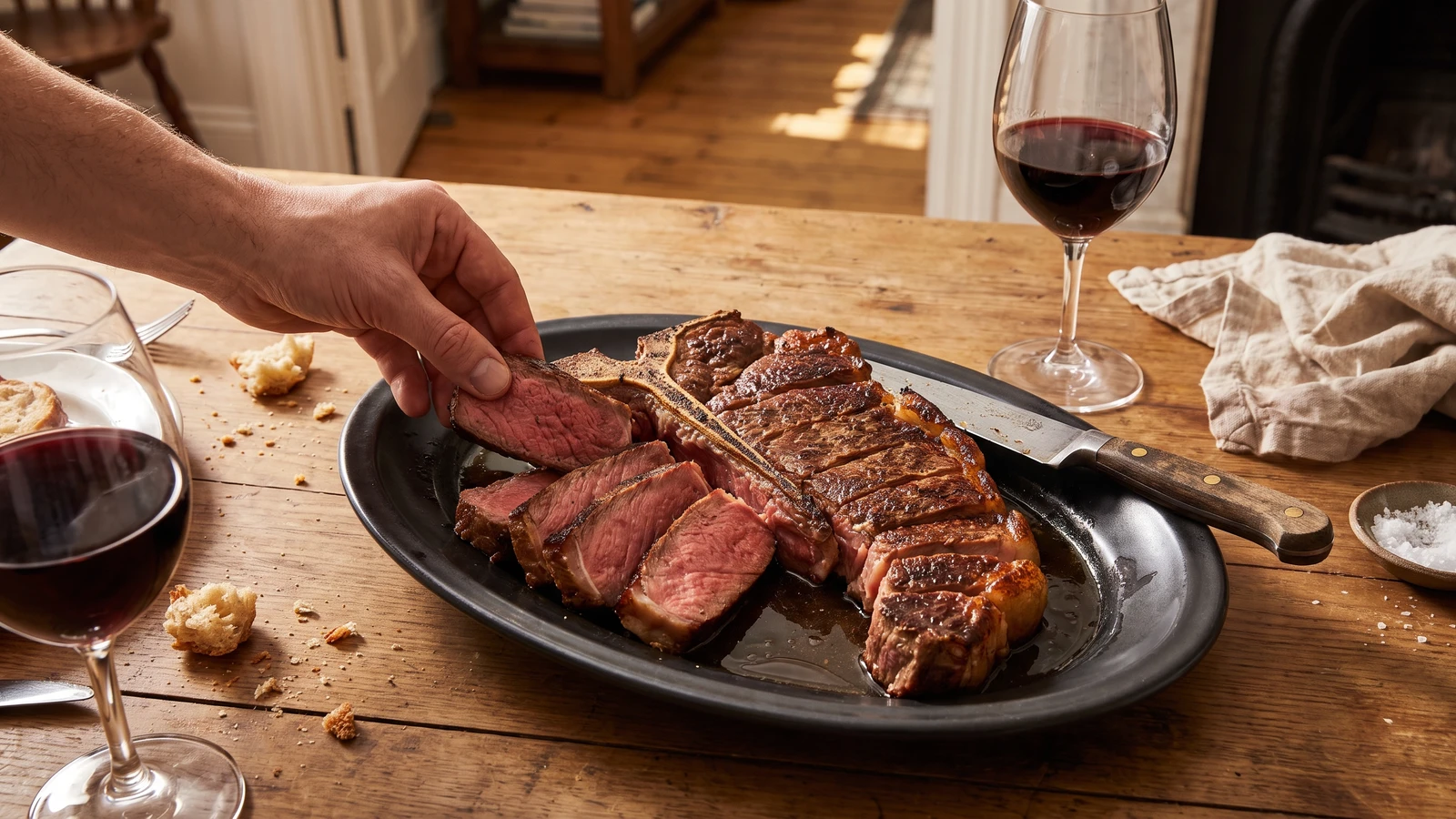
Porterhouse-steak grillé asks for one disciplined fire: hard heat for the bronze crust, a cooler zone for the thick center, then a full rest before the strip and tenderloin are carved.
Porterhouse-steak grillé (grilled porterhouse steak) teaches the governing principle of a thick grill: fierce heat makes the crust, but a cooler zone brings the center home. Build both zones before the beef goes near the grate. With a porterhouse, keep the tenderloin toward the gentler side while the firmer strip takes the stronger heat.
The original recipe assumed a grill station with a deep, even fire and a sirloin already cleared of flank and projecting chine bone. It did not require a saucier, stock never off the fire, or a salamander because the steak was most often served plain. Your honest equivalent is one butcher-trimmed, 3-pound steak, a covered two-zone grill, and an instant-read thermometer. That feeds four without turning dinner into brigade service. One cook, one stove, one evening.
The optional procession of grill sauces and garnishes is scaffolding and can go. The fierce initial grilling and the rest afterward are the dish, and neither can be hurried. Let the meat rest for the full fifteen minutes before carving; that pause, more than any flourish at the table, decides whether the juices remain in the steak.
Porterhouse-steak has no single French provincial home; it entered the classical repertory through Parisian grand-hotel and boulevard grill rooms, where English-speaking steak vocabulary met French butchery and service. Classical French texts used the name for a thick sirloin slice cleared of flank and chine, a broader definition than the porterhouse sold at current American butcher counters, where a generous tenderloin beside the T-shaped bone is expected. Although the steak could carry any garnish or sauce suited to grilled beef, plain service remained the clearest expression of the entry.
Quantity
1 steak, about 3 pounds (1.35 kg) and 2 inches (5 cm) thick
flank tail and projecting chine trimmed
Quantity
2½ teaspoons (12 ml / 15 g)
Quantity
2 teaspoons (10 ml / 4 g)
coarsely crushed
Quantity
1 tablespoon (15 ml / 14 g)
| Ingredient | Quantity |
|---|---|
| porterhouse steakflank tail and projecting chine trimmed | 1 steak, about 3 pounds (1.35 kg) and 2 inches (5 cm) thick |
| fine sea salt | 2½ teaspoons (12 ml / 15 g) |
| black peppercornscoarsely crushed | 2 teaspoons (10 ml / 4 g) |
| neutral high-heat oil | 1 tablespoon (15 ml / 14 g) |
Forty-five minutes before grilling, set the steak on a rack and season every surface, including the fat edge, with the salt. Leave it uncovered while the salt dissolves and works back into the meat. If time is short, salt immediately before grilling instead; the awkward interval is ten to thirty minutes, when salt has drawn moisture out but has not yet reabsorbed it. Pat away any beads of moisture before cooking. Wet beef steams, while a dry surface browns.
Prepare a covered grill with one fierce zone and one gentler zone. On charcoal, bank a full chimney of glowing coals over one half; on gas, preheat one side on high and leave the other side low or unlit. Heat the grate for at least fifteen minutes, aiming for 500 to 550°F (260 to 290°C) over the hot side. Scrub the grate clean. The cool zone is not a precaution added after trouble begins; it is part of the method.
Pat the steak dry once more, rub it thinly with the oil, and press on the crushed pepper. Lay it over the fierce zone with the strip side nearest the strongest heat and the smaller tenderloin pointing toward the cooler side. Grill without moving for 3 to 4 minutes, until the underside is deeply bronzed and releases cleanly, then turn and grill the second face for another 3 to 4 minutes. Hold the fat edge against the grate with tongs for 1 to 2 minutes so it colors and begins to render.
Move the steak to the cooler zone, keeping the tenderloin farthest from the fire and the bone angled toward it. Cover the grill and cook, turning every 3 minutes, until an instant-read thermometer inserted sideways into the thickest part of each muscle, clear of the bone, reads 122 to 126°F (50 to 52°C) for medium-rare, about 8 to 14 minutes more. For medium, pull it at 131 to 135°F (55 to 57°C). If the tenderloin reaches temperature before the strip, shield that smaller muscle loosely with foil and keep the strip toward the heat. The two muscles need attention, not identical treatment.
Transfer the steak to a warm carving board and rest it for a full 15 minutes, loosely covered with foil so the crust does not soften. Its temperature will continue to rise as the juices settle through the meat. If someone cuts too soon, catch every escaped juice on the board and spoon it back over the slices. Ça se rattrape, though only partly; resting is easier than rescue.
Run a sharp knife along both sides of the T-shaped bone to free the strip and tenderloin. Slice each muscle across its grain about ⅜ inch (1 cm) thick, keeping the two cuts separate, then arrange them around the bone on a warm platter. Spoon over the collected carving juices and serve at once, plain and generous. À table!
1 serving (about 220g)
Culinary guides, cultural storytelling, and the editorial depth that makes cooking meaningful.
Discover Culinary ExplorerChef Juliette
John Dory has the delicacy of sole and the firmness of turbot. A light flouring, a quick butter sauté, and nut-brown beurre noisette show exactly why looks never mattered.

Chef Juliette
Fresh haddock proves its delicacy in the meunière pan: a fine flour crust, moist pearly flakes, and beurre noisette sharpened with lemon and parsley, ready from one skillet in half an hour.

Chef Juliette
Éperlans à l’Anglaise turns small fish into a lesson in disciplined coating: boned smelts under a close, crisp crumb, pan-fried in clarified butter and finished with bright, half-melted maître d’hôtel butter.

Chef Juliette
Tiny smelts, shallot, mushrooms, white wine, gratin sauce, and fine bread raspings meet a fierce oven, where the fish must turn tender in the same breath the buttered crust bronzes.