
Chef Juliette
John Dory (St. Pierre)
John Dory has the delicacy of sole and the firmness of turbot. A light flouring, a quick butter sauté, and nut-brown beurre noisette show exactly why looks never mattered.
A cooking platform built around craft, culture, and the stories behind what we eat.
Created by Chef Juliette
Based on No. 1138, Tournedos Villeneuve, from Le Guide Culinaire (1907) by Auguste Escoffier
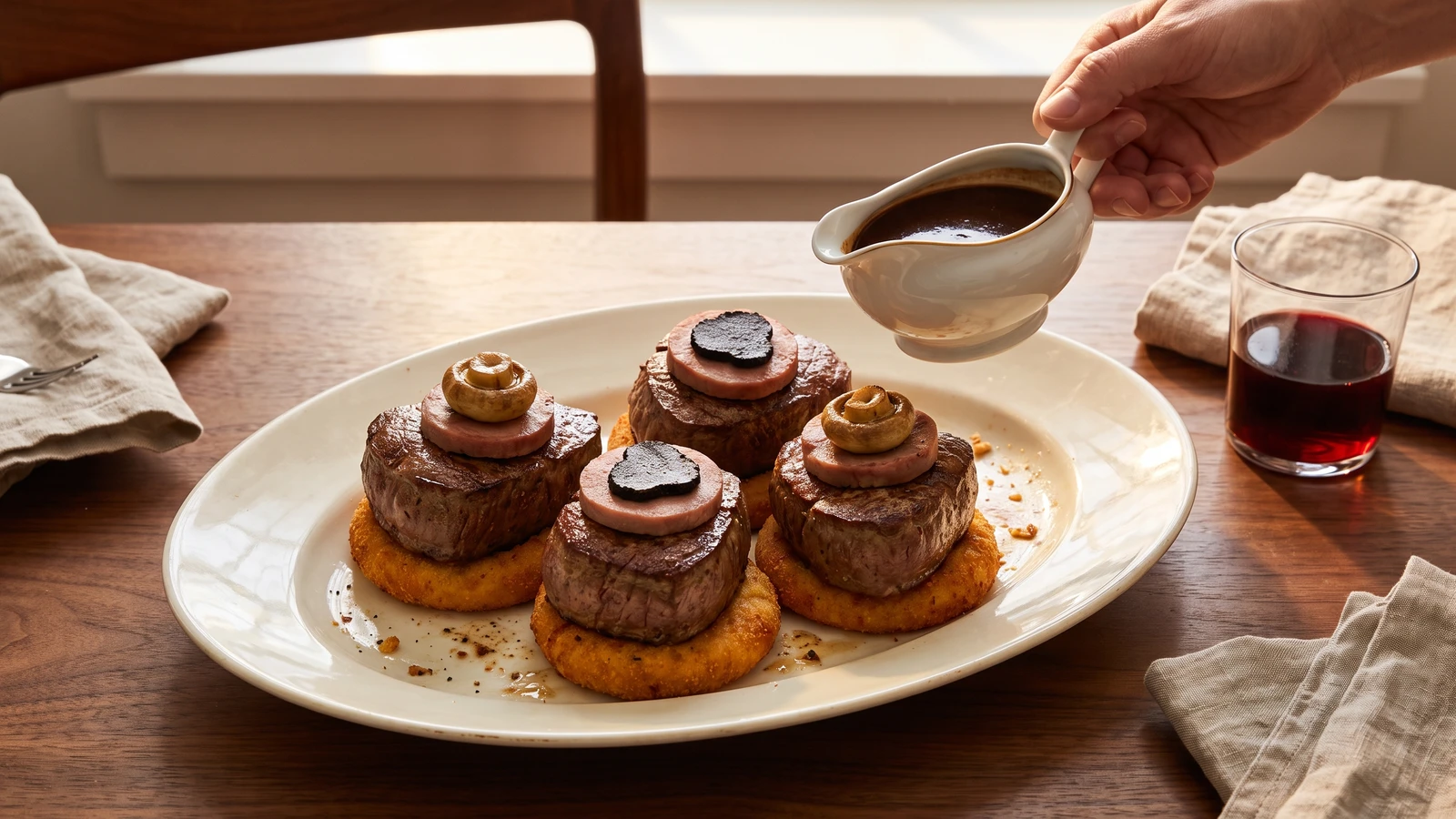
Tournedos Villeneuve makes timing visible: crisp chicken croquette rings, butter-seared beef, tongue, truffle, and fluted mushrooms assembled hot, with glossy Châteaubriand sauce kept proudly apart.
Tournedos Villeneuve (butter-seared beef on chicken croquette rings, crowned with tongue, truffle, and mushroom) teaches orchestration. The one true thing to know before touching the pan is this: every garnish and the sauce must be ready before the beef begins. Once the tournedos meet the butter, the dish moves straight toward the table.
The original assumed a saucier on staff, stock never off the fire for the Châteaubriand sauce, a fry cook handling croquettes at the last moment, and a salamander guarding the hot service. At home, prepare one cup of the finished sauce from its own recipe, use two simple cutters for four croquette rings, and let a low oven and warm platter replace the hot station. The salamander and brigade quantities are scaffolding, so they can go. The butter sear, the last-minute croquettes, the alternating tongue and truffle crown, the central grooved mushroom, and the sauce served apart are the dish, so they stay.
This is one cook, one stove, one evening, but it demands a calm mise en place. Fry the croquettes first, hold them briefly, then sear the tournedos hot and fast. If the butter darkens before the beef bronzes, move the steaks, wipe the pan, and begin again with fresh butter. Ça se rattrape. Timing decides this one.
Tournedos Villeneuve belongs to the formal Parisian dining-room and grand-kitchen repertoire, where a named garnish could define an entire beef preparation. Despite Villeneuve appearing in the title, the surviving formula establishes no firm connection to one particular French town or regional larder; its identity lies in the precise arrangement of chicken croquette, tongue, truffle, mushroom, and Châteaubriand sauce. The dish traveled through professional kitchens in compact shorthand because each supporting preparation was ordinarily waiting at its own station.
Quantity
1½ cups (360 ml / 225 g)
very finely chopped
Quantity
2 tablespoons (30 ml / 28 g)
Quantity
3 tablespoons (45 ml / 24 g)
Quantity
½ cup (120 ml / 123 g)
Quantity
2 tablespoons (30 ml / 30 g)
Quantity
1
Quantity
¼ teaspoon (1.25 ml / 0.6 g)
Quantity
⅛ teaspoon (0.6 ml / 0.25 g)
Quantity
2 teaspoons (10 ml / 12 g)
divided
Quantity
½ cup (120 ml / 60 g)
Quantity
2
beaten
Quantity
1½ cups (360 ml / 150 g)
Quantity
3 cups (720 ml / about 660 g)
Quantity
4, 5 oz (140 g) each
cut about 1½ inches (4 cm) thick
Quantity
4 tablespoons (60 ml / 57 g)
divided
Quantity
¾ teaspoon (3.75 ml / 1.8 g)
Quantity
4 oz (115 g)
thinly sliced
Quantity
1 small, about 1 oz (28 g)
thinly sliced
Quantity
4, about 2 oz (55 g) total
stems trimmed
Quantity
1 tablespoon (15 ml / 14 g)
Quantity
¼ cup (60 ml / 60 g)
Quantity
1 cup (240 ml / about 250 g)
Quantity
2 tablespoons (30 ml / 30 g)
| Ingredient | Quantity |
|---|---|
| cooked chicken breast and thigh meatvery finely chopped | 1½ cups (360 ml / 225 g) |
| unsalted butter for the croquette mixture | 2 tablespoons (30 ml / 28 g) |
| all-purpose flour for the roux | 3 tablespoons (45 ml / 24 g) |
| whole milk | ½ cup (120 ml / 123 g) |
| heavy cream | 2 tablespoons (30 ml / 30 g) |
| large egg yolk | 1 |
| ground white pepper | ¼ teaspoon (1.25 ml / 0.6 g) |
| freshly grated nutmeg | ⅛ teaspoon (0.6 ml / 0.25 g) |
| fine saltdivided | 2 teaspoons (10 ml / 12 g) |
| all-purpose flour for coating | ½ cup (120 ml / 60 g) |
| large eggsbeaten | 2 |
| fine dry breadcrumbs | 1½ cups (360 ml / 150 g) |
| neutral frying oil | 3 cups (720 ml / about 660 g) |
| center-cut beef tenderloin tournedoscut about 1½ inches (4 cm) thick | 4, 5 oz (140 g) each |
| unsalted butter for searingdivided | 4 tablespoons (60 ml / 57 g) |
| freshly ground black pepper | ¾ teaspoon (3.75 ml / 1.8 g) |
| cooked, peeled beef or veal tonguethinly sliced | 4 oz (115 g) |
| whole black truffle, fresh or preservedthinly sliced | 1 small, about 1 oz (28 g) |
| small closed-cap button mushroomsstems trimmed | 4, about 2 oz (55 g) total |
| unsalted butter for the mushrooms | 1 tablespoon (15 ml / 14 g) |
| water for the mushrooms | ¼ cup (60 ml / 60 g) |
| Châteaubriand sauce, prepared from its own recipe | 1 cup (240 ml / about 250 g) |
| cold water for rescuing the sauce (optional) | 2 tablespoons (30 ml / 30 g) |
Melt the croquette butter over medium-low heat, stir in the roux flour, and cook for 2 minutes without letting it color. This is a roux blond, a pale cooked mixture of flour and butter. Add the milk gradually, whisking smooth after each addition, then add the cream. Cook until the sauce becomes a very thick paste that pulls cleanly from the pan. Fold in the chicken, white pepper, nutmeg, and ½ teaspoon of the salt. Remove from the heat, beat in the yolk, then return the pan to its gentlest heat for 30 seconds, stirring constantly. Spread the salpicon de volaille, finely cut chicken bound in thick sauce, ½ inch (1.25 cm) deep on a lined tray and chill for 45 minutes.
Cut four rounds from the firm salpicon with a 3½-inch (9 cm) cutter, then remove each center with a 1⅜-inch (3.5 cm) cutter to make little quoit-shaped rings. Patch any cracks with cold salpicon. Coat each ring first in the coating flour, then beaten egg, then breadcrumbs, pressing the crumbs gently onto every edge. Chill the breaded rings for at least 20 minutes so they keep their shape in the oil.
Using a ½-inch (1.25 cm) cutter, cut 12 neat roundels from the tongue and 12 from the truffle. Keep them covered separately. Flute each mushroom by drawing the tip of a small knife in shallow curved grooves from the center of the cap toward its edge, turning the mushroom between cuts. Put the mushrooms in a small pan with the mushroom butter, the ¼ cup water, and a pinch of the measured salt. Cover and cook gently for 4 minutes, then uncover and roll them through the reducing butter until tender and glossy. Lift them out and keep them warm. Warm the tongue roundels briefly in the remaining butter off the heat; touch the truffle roundels to the warm pan only long enough to release their aroma.
Heat the oven to 225°F (110°C) and warm the serving platter. Warm the prepared Châteaubriand sauce in its own small saucepan at a bare tremble, then cover and keep it beside the heat. Do not boil it. If the butter begins to bead on the surface, take the pan off the heat and whisk in cold water 1 teaspoon at a time until the sauce returns to a single gloss. Ça se rattrape. At this point the croquettes, crowns, mushrooms, sauce, and platter must all be ready; only then should the beef meet the pan.
Heat the frying oil in a deep skillet to 350°F (175°C). Lower in two croquette rings at a time and fry until evenly deep gold, about 2 to 3 minutes, turning once and allowing the oil to recover between batches. Their centers should be thoroughly hot, at least 165°F (74°C). Drain on a rack, not paper, and hold them on the warm platter in the low oven for no longer than 10 minutes. If a breaded seam begins to open, leave the ring undisturbed until that side sets; if it ruptures, lift it out, press the opening with breadcrumbs, let the oil return to temperature, and refry briefly.
Pat the tournedos completely dry and season them with the remaining salt and the black pepper. Heat a heavy skillet until properly hot, add half the searing butter, and set in the beef when the foam subsides. Sear without moving for 2½ to 3 minutes, turn, add the remaining butter, and cook the second side for another 2½ to 3 minutes while spooning the foaming butter over the meat. Brown the edges for about 30 seconds each. Pull the tournedos at 122°F (50°C) for rare or 126°F (52°C) for medium-rare; they will rise as they rest. If the butter turns black before the crust is bronze, move the steaks to a plate, wipe the skillet carefully, add fresh butter, and continue. Burnt milk solids cannot be wished into a good fond.
Rest the tournedos for 5 minutes. Arrange the four hot chicken croquette rings in a circle on the warm platter and set one tournedos squarely on each. Brush the tops lightly with the butter left from the mushrooms. On each tournedos, make a crown of six overlapping roundels, three tongue and three truffle laid alternately, then place one fluted mushroom upright in the center. Work quickly and use warm fingers only where necessary; the geometry should be neat, but this remains food for the table.
Pour the hot Châteaubriand sauce into a warmed sauceboat and send it separately, exactly as the dish requires. Do not flood the croquettes on the platter, because their crisp shell is part of the composition; each diner spoons sauce beside the tournedos after serving. Bring the platter immediately. À table!
1 serving (about 390g)
Culinary guides, cultural storytelling, and the editorial depth that makes cooking meaningful.
Discover Culinary ExplorerChef Juliette
John Dory has the delicacy of sole and the firmness of turbot. A light flouring, a quick butter sauté, and nut-brown beurre noisette show exactly why looks never mattered.

Chef Juliette
Fresh haddock proves its delicacy in the meunière pan: a fine flour crust, moist pearly flakes, and beurre noisette sharpened with lemon and parsley, ready from one skillet in half an hour.

Chef Juliette
Éperlans à l’Anglaise turns small fish into a lesson in disciplined coating: boned smelts under a close, crisp crumb, pan-fried in clarified butter and finished with bright, half-melted maître d’hôtel butter.

Chef Juliette
Tiny smelts, shallot, mushrooms, white wine, gratin sauce, and fine bread raspings meet a fierce oven, where the fish must turn tender in the same breath the buttered crust bronzes.