
Chef Juliette
John Dory (St. Pierre)
John Dory has the delicacy of sole and the firmness of turbot. A light flouring, a quick butter sauté, and nut-brown beurre noisette show exactly why looks never mattered.
A cooking platform built around craft, culture, and the stories behind what we eat.
Created by Chef Juliette
Based on No. 1137, Tournedos Villaret, from Le Guide Culinaire (1907) by Auguste Escoffier
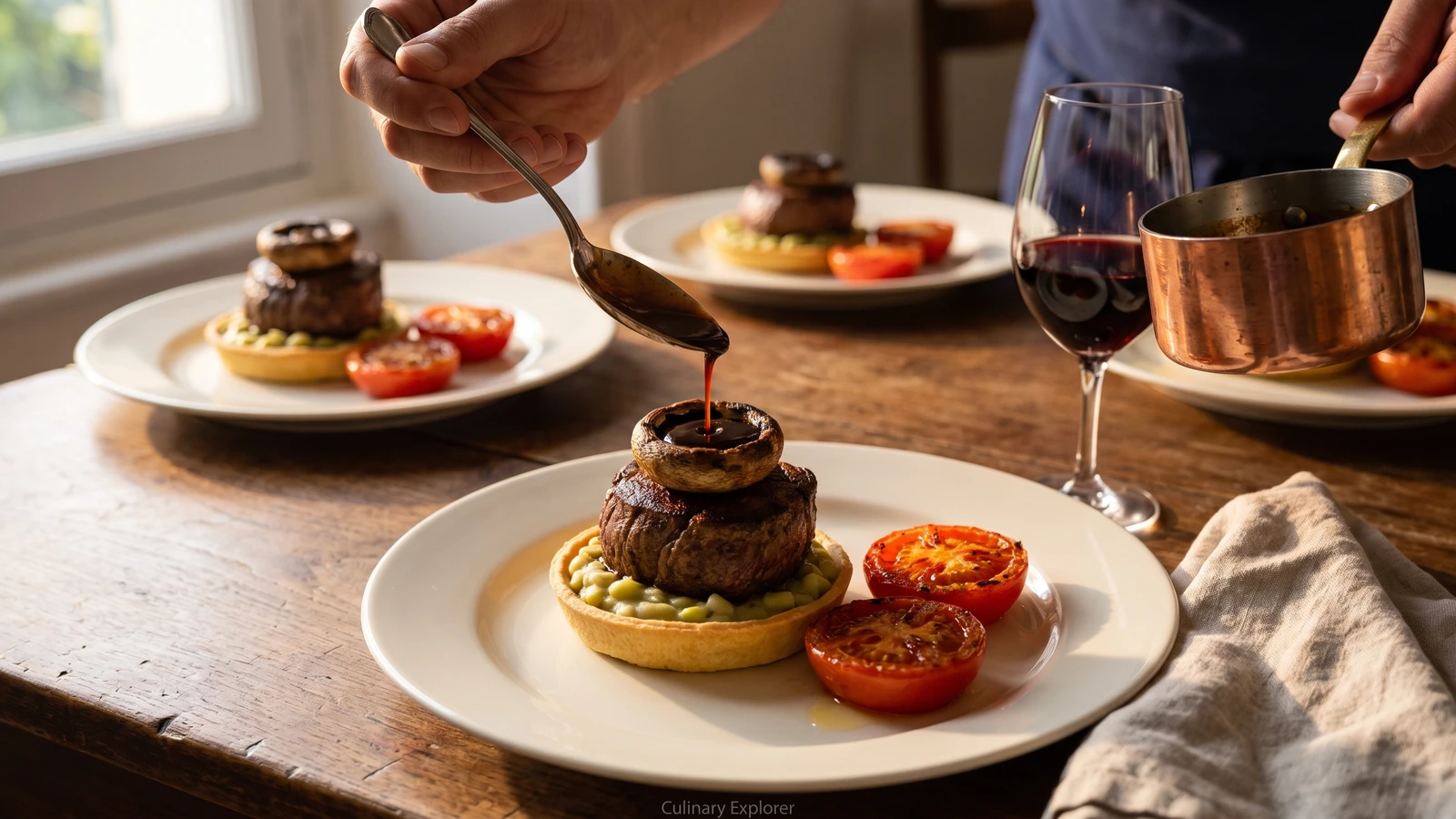
Tender tournedos meet silken flageolet purée, crisp tartlet shells, a sauce-filled mushroom, and a blistered tomato. Everything waits for the beef, because tenderloin must go from fierce heat straight to the table.
Tournedos Villaret (grilled beef tenderloin on a flageolet-purée tartlet) teaches last-minute service: every component waits for the tournedos, and the tournedos waits for nothing. The shell must be crisp, the purée silken, the mushroom and tomato properly grilled, and the Châteaubriand sauce ready to spoon. Then the beef meets fierce heat and goes straight to the plate. That is the one true thing to know before touching a pan.
The original entry assumed a saucier on staff with Châteaubriand sauce at hand, a stockpot never cold behind that sauce, tartlet shells and purée coming from separate stations, and a salamander ready for the garnishes. A home kitchen gets the honest equivalent: four shells baked together, canned flageolets passed smooth with butter, a broiler for the mushroom and tomato, and a cast-iron grill pan for the beef. The Châteaubriand sauce remains a finished preparation from its own entry; it is not casually remade inside this one. This is the brigade scaled down by intent, one cook, one stove, one evening.
The separate stations and long holding are scaffolding, so they go. The architecture does not: tartlet, flageolet purée, tournedos, sauce-filled grilled mushroom, grilled tomato. Have every other component hot and within reach before the beef meets the pan; that final sequence is the dish.
Tournedos Villaret belongs to the codified Parisian grand-kitchen table, where a named garnish fixed not only a sauce but the full arrangement around a cut of beef. Here that arrangement is unusually architectural: flageolet purée in a tartlet below, a grilled tournedos at center, a Châteaubriand-filled mushroom above, and a grilled tomato beside it. The title's biographical story is less certain than the composition, which is why fidelity lies in preserving the stack and its last-minute service, not in inventing a legend for Villaret.
Quantity
1 cup (240 ml / 125 g)
Quantity
6 tablespoons (90 ml / 85 g)
diced
Quantity
1 tablespoon (15 ml / 14 g)
for the tartlet tins
Quantity
2 teaspoons (10 ml / 12 g)
divided
Quantity
1
Quantity
2 to 3 tablespoons (30 to 45 ml / 30 to 45 g)
Quantity
1½ cups (360 ml / 255 g)
well drained
Quantity
2 tablespoons (30 ml / 28 g)
Quantity
¼ cup (60 ml / 60 g), plus more as needed
Quantity
⅛ teaspoon (0.6 ml / 0.3 g)
Quantity
4, 5 to 6 ounces (150 to 170 g) each
cut about 1½ inches (4 cm) thick
Quantity
½ teaspoon (2.5 ml / 1 g)
divided
Quantity
1 tablespoon (15 ml / 14 g)
Quantity
4 (about 7 ounces / 200 g total)
stems removed
Quantity
4 (about 14 ounces / 400 g total)
halved lengthwise
Quantity
2 tablespoons (30 ml / 28 g)
melted
Quantity
½ cup (120 ml / approximately 120 g)
| Ingredient | Quantity |
|---|---|
| all-purpose flour | 1 cup (240 ml / 125 g) |
| cold unsalted butterdiced | 6 tablespoons (90 ml / 85 g) |
| softened unsalted butterfor the tartlet tins | 1 tablespoon (15 ml / 14 g) |
| fine sea saltdivided | 2 teaspoons (10 ml / 12 g) |
| large egg yolk | 1 |
| ice water | 2 to 3 tablespoons (30 to 45 ml / 30 to 45 g) |
| cooked flageoletswell drained | 1½ cups (360 ml / 255 g) |
| unsalted butter for the purée | 2 tablespoons (30 ml / 28 g) |
| hot water | ¼ cup (60 ml / 60 g), plus more as needed |
| ground white pepper | ⅛ teaspoon (0.6 ml / 0.3 g) |
| center-cut beef tenderloin tournedoscut about 1½ inches (4 cm) thick | 4, 5 to 6 ounces (150 to 170 g) each |
| freshly ground black pepperdivided | ½ teaspoon (2.5 ml / 1 g) |
| clarified butter | 1 tablespoon (15 ml / 14 g) |
| large white mushroom capsstems removed | 4 (about 7 ounces / 200 g total) |
| small firm plum tomatoeshalved lengthwise | 4 (about 14 ounces / 400 g total) |
| unsalted buttermelted | 2 tablespoons (30 ml / 28 g) |
| finished Châteaubriand sauce | ½ cup (120 ml / approximately 120 g) |
Rub the flour, cold butter, and ¼ teaspoon of the salt together until the mixture resembles coarse crumbs with a few flat pieces of butter remaining. Add the yolk and 2 tablespoons of the ice water, tossing just until the pâte brisée, the short pastry, holds when pressed. Add the final spoonful of water only if dry flour remains. Flatten into a disc, wrap, and chill for 30 minutes; this rest keeps the shells tender and limits shrinking.
Heat the oven to 375°F (190°C) and butter four 3½-inch (9 cm) tartlet tins. Roll the pastry about ⅛ inch (3 mm) thick, line the tins, and trim the rims neatly. Prick the bases, chill for 15 minutes, then line with parchment and baking weights. Bake for 12 minutes, remove the weights, and bake for another 6 to 8 minutes, until crisp and evenly golden. If a small crack opens, press in a scrap of raw dough while the shell is hot and return it to the oven for 2 minutes. Ça se rattrape.
Warm the drained flageolets with the ¼ cup hot water and 2 tablespoons butter over gentle heat for 5 minutes. Blend until smooth, then press through a fine-mesh sieve; the source asks for a very smooth purée, and the sieve is what delivers it. Season with ½ teaspoon salt and the white pepper. Hold it covered over the lowest heat. If it tightens, beat in hot water a teaspoon at a time; if it becomes loose, stir it over gentle heat until it mounds softly on the spoon.
Heat the broiler to high. Brush the mushroom caps and tomato halves with the melted butter, then season them lightly with salt and half the black pepper. Broil the mushrooms hollow-side down for 3 minutes, turn them hollow-side up, and add the tomatoes cut-side up. Continue until the mushrooms are browned and tender and the tomato surfaces are blistered but still hold their shape, about 4 minutes. Lower the oven to 250°F (120°C) and keep the garnishes warm for no more than 10 minutes.
Set the tartlet shells in the warm oven for 5 minutes and place four plates nearby. Warm the finished Châteaubriand sauce in a small saucepan over the gentlest heat, without boiling. If its butter separates and the surface turns oily, remove the pan from the heat and whisk in 1 teaspoon of cold water until the gloss returns. Keep the purée, shells, garnishes, and sauce within reach before cooking the beef.
Pat the tournedos completely dry, tie them around the middle if they are not holding a neat round shape, and season with 1 teaspoon salt and the remaining black pepper. Heat a cast-iron grill pan or heavy skillet until fiercely hot, then add the clarified butter. Grill the tournedos without crowding, about 3 to 4 minutes on each broad side for medium-rare, browning the edges briefly as well. If the first surface stays pale, lift the beef out, let the pan recover its heat, dry the meat again, and return it for a short, hard sear. Tenderloin cannot be rescued once overcooked, so use a thermometer: remove it at 125 to 130°F (52 to 54°C) for medium-rare. Rest on a warm rack for 4 minutes, no longer.
Fill each hot tartlet shell generously with flageolet purée and set it on a warm plate. Place a tournedos squarely on each tartlet without pressing down. Crown the beef with a grilled mushroom, hollow-side up, and spoon 2 tablespoons of Châteaubriand sauce into each hollow. Set both halves of one grilled tomato beside every tournedos. Carry the plates out immediately. À table!
1 serving (about 415g)
Culinary guides, cultural storytelling, and the editorial depth that makes cooking meaningful.
Discover Culinary ExplorerChef Juliette
John Dory has the delicacy of sole and the firmness of turbot. A light flouring, a quick butter sauté, and nut-brown beurre noisette show exactly why looks never mattered.

Chef Juliette
Fresh haddock proves its delicacy in the meunière pan: a fine flour crust, moist pearly flakes, and beurre noisette sharpened with lemon and parsley, ready from one skillet in half an hour.

Chef Juliette
Éperlans à l’Anglaise turns small fish into a lesson in disciplined coating: boned smelts under a close, crisp crumb, pan-fried in clarified butter and finished with bright, half-melted maître d’hôtel butter.

Chef Juliette
Tiny smelts, shallot, mushrooms, white wine, gratin sauce, and fine bread raspings meet a fierce oven, where the fish must turn tender in the same breath the buttered crust bronzes.