
Chef Juliette
John Dory (St. Pierre)
John Dory has the delicacy of sole and the firmness of turbot. A light flouring, a quick butter sauté, and nut-brown beurre noisette show exactly why looks never mattered.
A cooking platform built around craft, culture, and the stories behind what we eat.
Created by Chef Juliette
Based on No. 1136, Tournedos Victoria, from Le Guide Culinaire (1907) by Auguste Escoffier
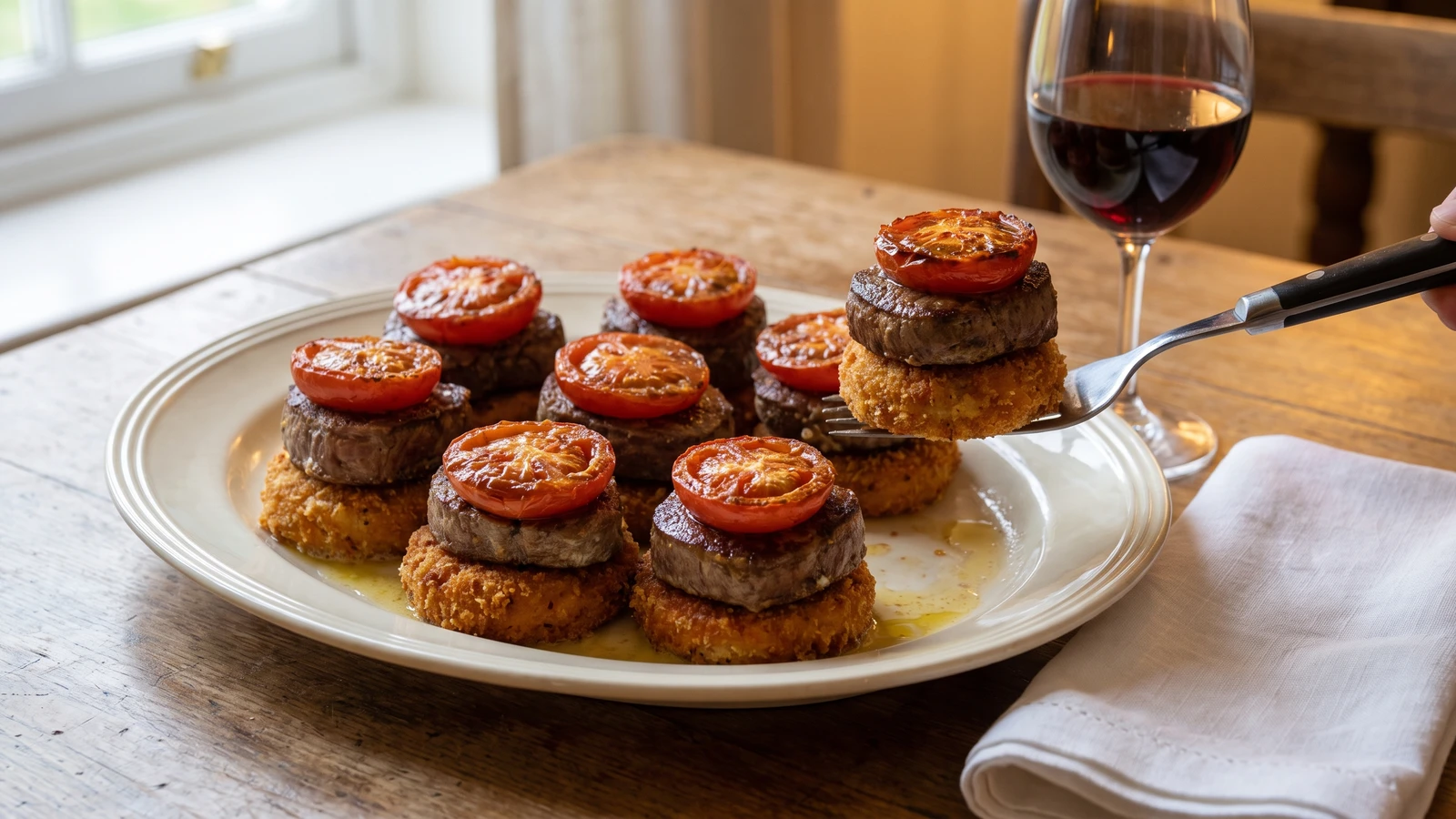
Four butter-seared tournedos stand on crisp, flat chicken croquettes beneath glossy half-tomatoes, a composed French main that teaches heat, timing, and the discipline of keeping each element distinct.
Tournedos Victoria (butter-seared beef fillets on chicken croquettes with tomatoes) teaches one severe, useful truth: tender fillet has almost no forgiveness for weak heat. The pan must be hot enough to bronze the beef in butter before its juices escape. A cool pan gives you gray meat and wet butter, however dear the fillet was.
The source entry assumed a brigade's mise en place, with chicken croquettes already shaped and several hands moving at once. It asks for no saucier, no stockpot kept permanently at the simmer, and no salamander, so we won't invent work for them. At home, you make four croquettes, hold them briefly in a low oven, fry the four tournedos in one broad pan, then toss the tomatoes in fresh butter while the beef rests. One cook, one stove, one evening.
The spare hands and holding arrangements are scaffolding and may go. The structure cannot: crisp chicken below, butter-seared beef in the middle, glossy tomato above. Before you touch the pan, dry the tournedos thoroughly and heat the skillet until the butter foams fiercely without burning. That single moment decides the dish.
Tournedos belong to the Parisian classical dining-room repertoire, where compact rounds from the center of the beef fillet were paired with named garnitures so a menu title could carry an entire assembly. In the Victoria formula, the name means a precise architecture: a flat chicken croquette under the beef and a butter-tossed half-tomato above, not a sauce or a general tomato garnish. The composition traveled readily to the bourgeois dinner-party table because the croquettes could be prepared ahead, leaving only the beef and tomatoes for the last moment.
Quantity
1¼ cups (300 ml / 200 g)
skin and bones removed, very finely chopped
Quantity
½ cup (120 ml / 113 g)
divided between the croquette base, frying, beef, and tomatoes
Quantity
1 tablespoon (15 ml / 8 g)
for the croquette roux
Quantity
⅓ cup (80 ml / 82 g)
Quantity
1
Quantity
½ cup (120 ml / 60 g)
for breading
Quantity
1
thoroughly beaten
Quantity
1¼ cups (300 ml / 75 g)
Quantity
¾ cup (180 ml / 165 g)
for shallow-frying; most will remain in the pan
Quantity
4 tournedos, 5 oz (140 g) each
about 1½ inches (4 cm) thick and tied around the equator
Quantity
2 tomatoes, about 6 oz (170 g) total
halved crosswise
Quantity
2 teaspoons (10 ml / 12 g)
divided
Quantity
1 teaspoon (5 ml / 2 g)
divided
| Ingredient | Quantity |
|---|---|
| cooked chicken meatskin and bones removed, very finely chopped | 1¼ cups (300 ml / 200 g) |
| unsalted butterdivided between the croquette base, frying, beef, and tomatoes | ½ cup (120 ml / 113 g) |
| plain flourfor the croquette roux | 1 tablespoon (15 ml / 8 g) |
| whole milk | ⅓ cup (80 ml / 82 g) |
| large egg yolk | 1 |
| plain flourfor breading | ½ cup (120 ml / 60 g) |
| large eggthoroughly beaten | 1 |
| fine dry breadcrumbs | 1¼ cups (300 ml / 75 g) |
| neutral frying oilfor shallow-frying; most will remain in the pan | ¾ cup (180 ml / 165 g) |
| center-cut beef tenderloin tournedosabout 1½ inches (4 cm) thick and tied around the equator | 4 tournedos, 5 oz (140 g) each |
| small firm tomatoeshalved crosswise | 2 tomatoes, about 6 oz (170 g) total |
| fine saltdivided | 2 teaspoons (10 ml / 12 g) |
| freshly ground black pepperdivided | 1 teaspoon (5 ml / 2 g) |
Melt 1 tablespoon of the butter in a small saucepan over medium-low heat. Stir in the 1 tablespoon flour and cook the roux blanc, the pale butter-and-flour binder, for 90 seconds without letting it color. Whisk in the milk in three additions, cooking until the roux becomes a very thick paste that pulls cleanly from the pan. If it lumps, take it off the heat and whisk hard; pass it through a sieve if necessary before continuing. Let it cool for one minute, beat in the yolk, then fold in the chopped chicken with ¾ teaspoon salt and ¼ teaspoon pepper. Spread the mixture on a plate, cover its surface, and chill for 45 minutes, until firm enough to shape.
Divide the cold chicken mixture into four equal portions. With lightly floured hands or an 8 cm ring, shape each into a flat round about 3¼ inches (8 cm) across and ½ inch (1.25 cm) thick. Set up the panure à l'anglaise, the flour, beaten egg, and breadcrumb coating, in three shallow dishes. Coat each round first in flour, then egg, then breadcrumbs, pressing gently so no bare seams remain. Chill for 15 minutes. If the rounds sag or stick to your hands, they are simply too warm; return them to the cold before breading rather than forcing them into shape.
Heat the oven to 200°F (95°C) and set a wire rack over a sheet pan. Heat the neutral oil in a heavy skillet over medium heat to about 330°F (165°C), then add 2 tablespoons butter. When the butter's foam subsides, fry the croquettes in two batches until deep golden, about 2½ to 3 minutes per side, and until their centers reach 165°F (74°C). If the coating darkens in less than 30 seconds, pull the skillet off the heat briefly; if it sits without a lively fizz, lift the croquette out and restore the heat before continuing. Drain on the rack and hold in the low oven for no longer than 20 minutes.
Pour the frying fat into a heatproof container and wipe the skillet completely clean. Pat the tournedos very dry, tie each around its equator if the butcher has not done so, and season with 1 teaspoon salt and ½ teaspoon pepper. Heat the empty skillet over medium-high heat for 2 minutes, then add 3 tablespoons butter. As soon as it foams vigorously and begins to smell nutty, lay in the beef with at least an inch between the pieces. Sear without moving for about 3 minutes, turn once, lower the heat slightly, and baste with the foaming butter for another 2 to 3 minutes. Remove at 122 to 125°F (50 to 52°C) for medium-rare or 130°F (54°C) for medium, then rest uncovered for 5 minutes.
While the beef rests, wipe any blackened butter solids from the skillet and lower the heat to medium. Add the remaining 2 tablespoons butter. Set the tomato halves cut side down and cook for 60 to 90 seconds, just until their cut faces take a little color, then roll their rounded sides through the butter for another 30 seconds. Season with the remaining ¼ teaspoon salt and ¼ teaspoon pepper. Keep them glossy and intact; once a tomato collapses, no clever plating will persuade it to stand above the beef.
Arrange the four hot chicken croquettes in a circle on a warmed platter. Remove the strings from the tournedos and set one squarely on each croquette. Crown every tournedo with one tomato half, cut side down, and spoon over only the butter clinging to the tomato pan. The croquette catches the beef's juices, which is why the architecture matters. Add no separate sauce and no stray garnish. Carry it to the table at once. À table!
1 serving (about 270g)
Culinary guides, cultural storytelling, and the editorial depth that makes cooking meaningful.
Discover Culinary ExplorerChef Juliette
John Dory has the delicacy of sole and the firmness of turbot. A light flouring, a quick butter sauté, and nut-brown beurre noisette show exactly why looks never mattered.

Chef Juliette
Fresh haddock proves its delicacy in the meunière pan: a fine flour crust, moist pearly flakes, and beurre noisette sharpened with lemon and parsley, ready from one skillet in half an hour.

Chef Juliette
Éperlans à l’Anglaise turns small fish into a lesson in disciplined coating: boned smelts under a close, crisp crumb, pan-fried in clarified butter and finished with bright, half-melted maître d’hôtel butter.

Chef Juliette
Tiny smelts, shallot, mushrooms, white wine, gratin sauce, and fine bread raspings meet a fierce oven, where the fish must turn tender in the same breath the buttered crust bronzes.