
Chef Juliette
John Dory (St. Pierre)
John Dory has the delicacy of sole and the firmness of turbot. A light flouring, a quick butter sauté, and nut-brown beurre noisette show exactly why looks never mattered.
A cooking platform built around craft, culture, and the stories behind what we eat.
Created by Chef Juliette
Based on No. 1134, Tournedos Valentino, from Le Guide Culinaire (1907) by Auguste Escoffier
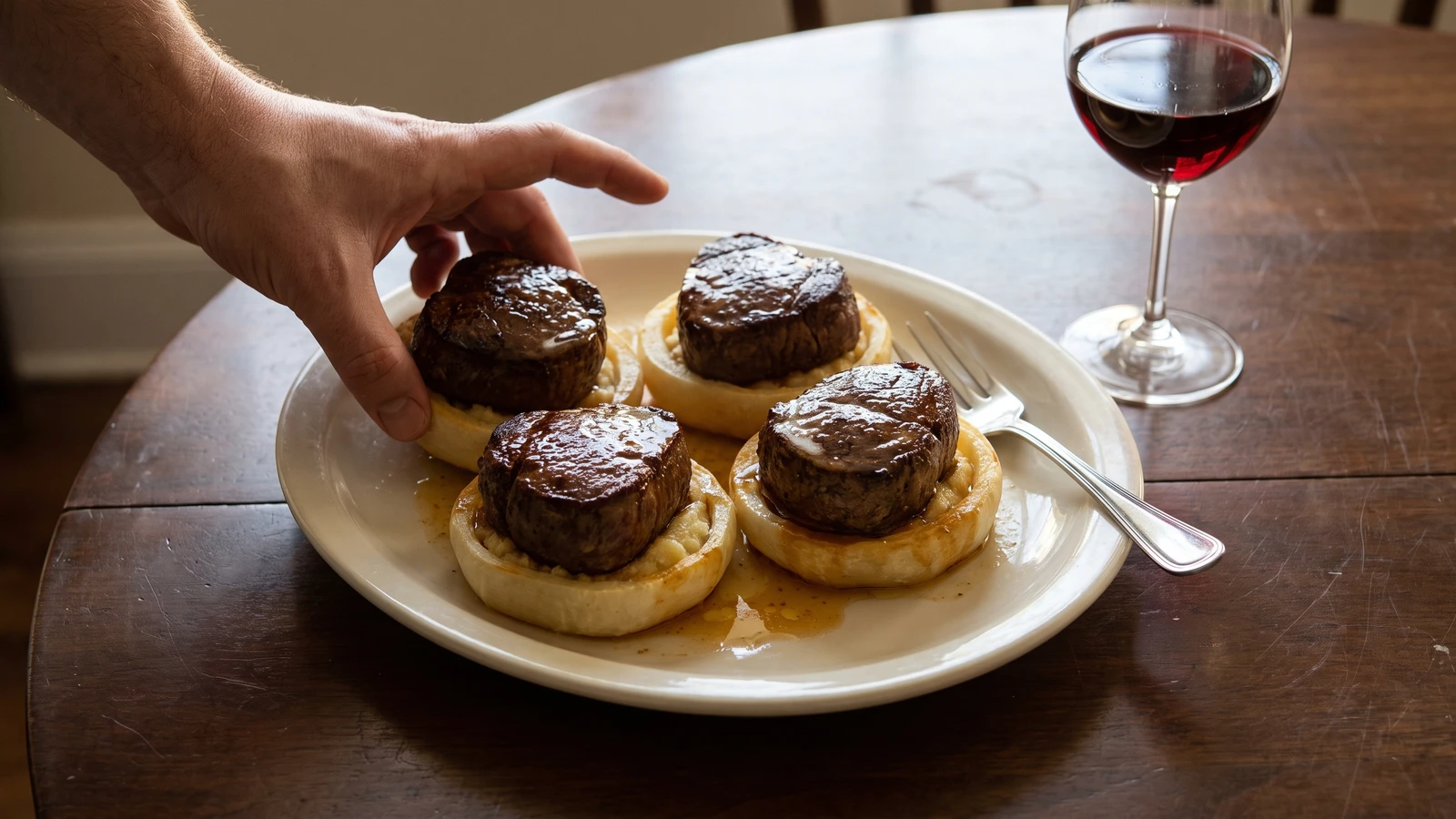
Butter-seared tournedos rise over glazed turnip cases filled with Parmesan semolina, a precise classical composition whose lesson is simple: cook the tenderloin hot and fast, then bring every element together without delay.
Tournedos Valentino (butter-seared beef tenderloin on glazed turnip cases filled with Parmesan semolina) teaches coordination. The one true thing to know before touching a pan is this: tenderloin waits for nothing. The turnips must be tender, glossy, stuffed, and ready before the beef meets the butter, because a lean tournedos dries while a distracted cook searches for the platter.
The grand kitchen surrounding this formula could call on a saucier, stock never off the fire, and a salamander overhead, but Valentino itself uses none of them. Its real brigade luxury was separate hands shaping turnip cases, stirring semolina, glazing vegetables, and frying beef at once. At home, a plain round cutter and teaspoon replace the fancy cutter, four portions replace the service tray, and one sauté pan glazes the turnips before it is wiped clean for the beef. Only scale and equipment change. The original sequence remains intact: parboil, hollow, stuff, glaze, fry in butter, then stack.
Perfect decorative stamping was brigade scaffolding, so it can go. Turnip cases matching the meat, savory Parmesan semolina, a proper butter glaze, and last-minute cuisson, the judgment of doneness, are the dish and must stay. Have every filled case on the warm platter before you sear the tournedos. That is the step that decides the evening.
Tournedos Valentino belongs to the Paris grand-kitchen repertoire, where small rounds of tenderloin were distinguished by their garnitures, the composed accompaniments that completed and named the dish. The Valentino formula is unusual because its identity comes without a separate sauce: glazed turnip and Parmesan semolina carry the composition beneath the beef. Parmesan gives it a cosmopolitan accent, but does not make it an Italian regional preparation; the method remains firmly within the French classical sequence of parboiling, stuffing, glazing, and frying in butter.
Quantity
4, 5 to 6 oz (140 to 170 g) each
cut about 1 1/2 inches (4 cm) thick
Quantity
4, about 10 to 12 oz (280 to 340 g) each
at least 3 1/2 inches (9 cm) wide
Quantity
2/3 cup (160 ml / 165 g)
Quantity
1/4 cup (60 ml / 45 g)
Quantity
1/3 cup (80 ml / 30 g)
finely grated
Quantity
5 tablespoons (75 ml / 71 g)
divided
Quantity
1/2 cup (120 ml / 120 g)
divided
Quantity
2 teaspoons (10 ml / 8 g)
Quantity
1 1/2 teaspoons (7.5 ml / 9 g)
divided
Quantity
1/2 teaspoon (2.5 ml / 1 g)
| Ingredient | Quantity |
|---|---|
| center-cut beef tenderloin tournedoscut about 1 1/2 inches (4 cm) thick | 4, 5 to 6 oz (140 to 170 g) each |
| large round white turnipsat least 3 1/2 inches (9 cm) wide | 4, about 10 to 12 oz (280 to 340 g) each |
| whole milk | 2/3 cup (160 ml / 165 g) |
| fine semolina | 1/4 cup (60 ml / 45 g) |
| Parmesanfinely grated | 1/3 cup (80 ml / 30 g) |
| unsalted butterdivided | 5 tablespoons (75 ml / 71 g) |
| waterdivided | 1/2 cup (120 ml / 120 g) |
| granulated sugar | 2 teaspoons (10 ml / 8 g) |
| fine saltdivided | 1 1/2 teaspoons (7.5 ml / 9 g) |
| freshly ground black pepper | 1/2 teaspoon (2.5 ml / 1 g) |
Tie each tournedos around its middle with butcher's twine so it holds a neat round shape, then return the meat uncovered to the refrigerator while you prepare the turnips. Peel the turnips and cut one round from the widest part of each, exactly 1 1/2 inches (4 cm) thick. Compare the rounds with the tied beef and trim them to the same diameter using a 2 1/2 to 3-inch (6.5 to 7.5 cm) cutter, or trace around a paper circle and use a paring knife. Matching the diameter matters; ornamental perfection does not.
Lower the turnip rounds into a saucepan of gently boiling water and cook for 12 to 16 minutes, until a fine skewer enters with slight resistance at the center. They should be nearly cooked but firm enough to survive hollowing. Drain and cool until they can be handled. Mark a centered circle about 2 inches (5 cm) wide on top of each round, then scoop within that mark using a teaspoon or melon baller, leaving walls about 1/4 inch (6 mm) thick and a base about 1/2 inch (1.25 cm) thick. If a wall splits, don't discard the case. Set the split toward the center of the serving platter and fill it gently; ça se rattrape.
Reserve 2 tablespoons of the milk. Bring the remaining milk to a gentle simmer with 1 tablespoon of the butter and 1/4 teaspoon of the salt. Rain in the semolina slowly while whisking, then lower the heat and stir for 5 to 7 minutes, until it becomes a thick, smooth paste that pulls from the pan and holds the trail of the spoon. Remove it from the heat and beat in the Parmesan. If lumps form or the mixture tightens before the grain is tender, add the reserved milk a spoonful at a time and whisk firmly. Ça se rattrape. Cover the surface directly and keep it warm.
Divide the warm Parmesan semolina among the turnip cases, packing it into the cavities and leveling the tops. Arrange them cavity-side up in a broad sauté pan. Add 6 tablespoons of the measured water around them, keeping the remaining 2 tablespoons in reserve, then add 1 tablespoon of butter, the sugar, and 1/4 teaspoon of salt. Cover and simmer gently for 6 to 8 minutes. Uncover and baste the turnips repeatedly as the liquid reduces to a pale amber glaze, another 5 to 8 minutes. If the sugar catches before the turnips are tender, pull the pan from the heat, add the reserved water, and return it over a lower flame. The finished cases should yield to a knife without collapsing and wear a glossy butter glaze. Transfer them to a warmed platter and cover loosely.
Wipe every trace of sugar from the sauté pan and set it over medium-high heat. Pat the tournedos completely dry, then season them with the remaining 1 teaspoon salt and the pepper. Add 2 tablespoons of butter to the hot pan. When the foam subsides and the butter smells nutty without turning black, add all four tournedos with space between them. Sear without disturbing for 2 to 3 minutes, turn once, and cook the second face for about 2 minutes; use tongs to color the edges briefly. Remove at 125 to 130°F (52 to 54°C) for medium-rare after resting, or cook to 145°F (63°C) and rest for at least 3 minutes when a higher final temperature is needed. If the butter blackens and smells acrid, lift out the beef, wipe the pan, lower the heat, and continue with the final reserved tablespoon of butter. Burnt butter cannot be argued into tasting good.
Rest the tournedos for 3 to 4 minutes, then remove the twine. Arrange the four glazed turnip cases in a circle on the warm platter, semolina facing upward, and place one tournedos squarely on each case. Spoon only the clean amber butter from the pan over the beef, leaving any dark sediment behind. Carry the platter straight to the table while the turnips still gleam and the beef is at its best. À table!
1 serving (about 440g)
Culinary guides, cultural storytelling, and the editorial depth that makes cooking meaningful.
Discover Culinary ExplorerChef Juliette
John Dory has the delicacy of sole and the firmness of turbot. A light flouring, a quick butter sauté, and nut-brown beurre noisette show exactly why looks never mattered.

Chef Juliette
Fresh haddock proves its delicacy in the meunière pan: a fine flour crust, moist pearly flakes, and beurre noisette sharpened with lemon and parsley, ready from one skillet in half an hour.

Chef Juliette
Éperlans à l’Anglaise turns small fish into a lesson in disciplined coating: boned smelts under a close, crisp crumb, pan-fried in clarified butter and finished with bright, half-melted maître d’hôtel butter.

Chef Juliette
Tiny smelts, shallot, mushrooms, white wine, gratin sauce, and fine bread raspings meet a fierce oven, where the fish must turn tender in the same breath the buttered crust bronzes.