
Chef Juliette
John Dory (St. Pierre)
John Dory has the delicacy of sole and the firmness of turbot. A light flouring, a quick butter sauté, and nut-brown beurre noisette show exactly why looks never mattered.
A cooking platform built around craft, culture, and the stories behind what we eat.
Created by Chef Juliette
Based on No. 1131, Tournedos Tivoli, from Le Guide Culinaire (1907) by Auguste Escoffier
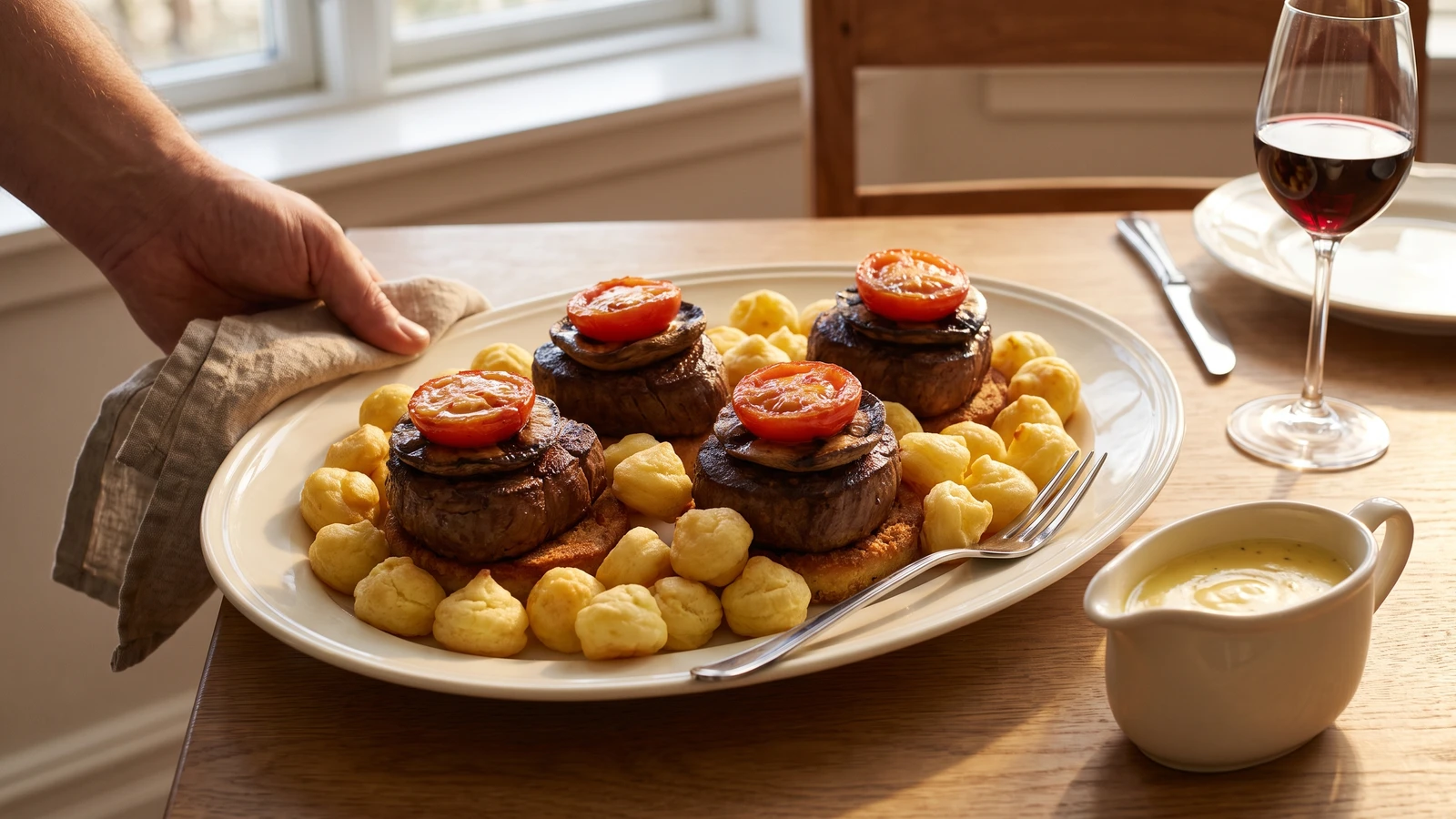
Butter-seared tournedos sit on crisp fried croûtes beneath grilled mushroom and buttered tomato, with round pommes soufflées at the rim and warm Béarnaise apart: grand-kitchen choreography brought under one cook's command.
Tournedos Tivoli (butter-seared beef fillets on fried bread with mushroom, tomato, puffed potatoes, and a warm tarragon-butter emulsion) teaches orchestration. Its one true thing is timing: everything around the beef must be ready before the beef meets the pan. The tournedos cook in minutes, and no splendid crust survives waiting while you remember the tomatoes.
The original kitchen had ten tournedos moving at once, a saucier tending Béarnaise, a fry cook on potatoes, a salamander for the mushrooms, and stock never off the fire, although this plate asks for none. At home, the broiler replaces the salamander, a guarded mandoline replaces the ribbon cutter, one saucepan handles both frying temperatures, and a lukewarm water bath holds the sauce. Ten portions become four while the book's proportion remains exact: one mushroom, one half-tomato, and one potato for every tournedos. The station system and brigade batch were scaffolding and can go. The fried croûtes, hot butter sear, two-stage pommes soufflées, composed garnish, and Béarnaise served apart are the dish and must stay.
This is one cook, one stove, one evening, but it rewards a calm mise en place. Before the tournedos enters the butter, have the Béarnaise warm, the croûtes fried, the mushroom and tomato garnish cooked, and the potatoes through their first frying. That preparation is the step that matters most.
Tournedos Tivoli belongs to the Parisian grand-kitchen repertory, where named garnishes acted as precise formulas for dressing a compact fillet. Despite its place-name, Tivoli is not an Italian regional preparation here; in the French canon it means a fried croûte below, mushroom and buttered tomato above, pommes soufflées around, and Béarnaise apart. The dish traveled naturally to bourgeois dinner tables once one cook learned to stage those former station jobs in sequence.
Quantity
4 (about 1½ lb / 680 g total)
cut about 1¼ inches (3 cm) thick and tied
Quantity
2 teaspoons (10 ml / 12 g)
divided
Quantity
1 teaspoon (5 ml / 2 g)
divided
Quantity
1½ cups (355 ml / 340 g)
divided
Quantity
4 rounds (about 3 oz / 85 g total)
cut slightly wider than the tournedos
Quantity
4 (about 4 oz / 115 g total)
stems removed
Quantity
2 (about 8 oz / 225 g total)
halved lengthwise
Quantity
4 medium (about 1½ lb / 680 g total)
one per tournedos
Quantity
2 quarts (1.9 liters / 1.75 kg)
Quantity
¼ cup (60 ml / 60 g)
Quantity
¼ cup (60 ml / 60 g)
Quantity
2 tablespoons (30 ml / 25 g)
finely chopped
Quantity
1 teaspoon (5 ml / 3 g)
lightly crushed
Quantity
¼ cup (60 ml / 8 g)
separated and leaves chopped
Quantity
1 tablespoon (15 ml / 3 g)
chopped
Quantity
3
Quantity
2 tablespoons (30 ml / 30 g)
divided
| Ingredient | Quantity |
|---|---|
| center-cut beef tenderloin tournedoscut about 1¼ inches (3 cm) thick and tied | 4 (about 1½ lb / 680 g total) |
| fine saltdivided | 2 teaspoons (10 ml / 12 g) |
| freshly ground black pepperdivided | 1 teaspoon (5 ml / 2 g) |
| unsalted butterdivided | 1½ cups (355 ml / 340 g) |
| pain de mie or firm white breadcut slightly wider than the tournedos | 4 rounds (about 3 oz / 85 g total) |
| small flat mushroom capsstems removed | 4 (about 4 oz / 115 g total) |
| small firm plum tomatoeshalved lengthwise | 2 (about 8 oz / 225 g total) |
| mature floury potatoesone per tournedos | 4 medium (about 1½ lb / 680 g total) |
| neutral frying oil | 2 quarts (1.9 liters / 1.75 kg) |
| white wine vinegar | ¼ cup (60 ml / 60 g) |
| dry white wine | ¼ cup (60 ml / 60 g) |
| shallotfinely chopped | 2 tablespoons (30 ml / 25 g) |
| black peppercornslightly crushed | 1 teaspoon (5 ml / 3 g) |
| fresh tarragon leaves and tender stemsseparated and leaves chopped | ¼ cup (60 ml / 8 g) |
| fresh chervilchopped | 1 tablespoon (15 ml / 3 g) |
| large egg yolks | 3 |
| cold waterdivided | 2 tablespoons (30 ml / 30 g) |
Pat the tournedos completely dry, tie them into neat rounds if the butcher has not done so, and season with half the salt and pepper. Leave them at cool room temperature for 30 minutes. Cut the bread rounds just wider than the beef, stem the mushrooms, halve the tomatoes, and set out a warmed oval platter and sauceboat. Once the beef enters the skillet, your attention belongs to it; every supporting part must already be waiting.
Melt 1¼ cups (300 ml / 285 g) of the butter gently without stirring. Skim the white foam, then pour the clear golden butter away from the milky sediment; you should have about 1 cup (240 ml) of clarified butter. Reserve ¼ cup (60 ml) for frying and keep the remaining ¾ cup (180 ml) warm for the Béarnaise. In a small saucepan, combine the vinegar, wine, shallot, peppercorns, and tarragon stems. Boil until only 2 tablespoons remain, then strain, pressing the aromatics firmly. This sharp little reduction is the sauce's backbone.
Pour the oil into a deep, heavy pot, filling it no more than halfway, and heat it to 315°F (157°C). Pare each potato into a smooth cylinder about 2½ inches (6 cm) wide, then use a guarded mandoline to cut crosswise rounds a scant ⅛ inch (3 mm) thick. These are the home equivalent of the original ribbon-cut rounds. Rinse away the loose starch and dry every slice thoroughly between clean towels. Fry in uncrowded batches, moving the slices gently through the oil, until they blister and begin to swell but remain pale, about 3 to 5 minutes. Lift them to a wire rack. If they stay flat, stop: either the oil has cooled or the slices are wet. Blot the remaining rounds, restore the temperature, and test a fresh batch; a slice already crisped flat will not inflate later, but the next batch will.
Set a heatproof bowl over barely simmering water, making certain the bowl does not touch it. Whisk the yolks with the strained reduction and 1 tablespoon of the cold water until pale, thick, and able to hold the trace of the whisk. Lift the bowl whenever it grows too hot to hold comfortably. Off the heat, add the warm clarified butter first drop by drop, then in a fine stream, whisking constantly until the Béarnaise is glossy and softly mounded. Fold in the chopped tarragon and chervil, then season with salt. If it becomes too thick, whisk in warm water a teaspoon at a time. If it separates, don't discard it. Ça se rattrape: place a teaspoon of cold water in a clean warm bowl, whisk in one spoonful of the broken sauce until smooth, then rebuild with the remainder little by little. Hold the finished Béarnaise over lukewarm water for no more than 45 minutes.
Heat 2 tablespoons of the reserved clarified butter in a wide skillet over medium heat. Fry the bread rounds until crisp and deep gold on both sides, about 2 minutes per side, then drain them on a rack. Brush the mushroom caps with a little of the remaining whole butter, season, and broil until browned and tender, about 4 minutes, turning once. Melt 2 tablespoons of whole butter in the skillet and add the tomato halves cut-side down. Toss and baste them in the foaming butter for 1 to 2 minutes, just until glossy and warmed through without losing their shape. Set the mushrooms and tomatoes on the warm platter.
Wipe the skillet clean and heat the remaining 2 tablespoons of clarified butter until shimmering. Lay in the tournedos with space between them and sear without nudging until a dark bronze crust forms, about 2 to 3 minutes. Turn once, add the remaining 2 tablespoons of whole butter, and baste as the second side browns. For medium-rare, remove the beef at 125°F (52°C); it will rise toward 130°F (54°C) while resting. If the butter darkens before the crust forms, lower the heat slightly and add a teaspoon of fresh butter. Rest the tournedos on a rack for 5 minutes, never on the croûtes, which would drink their juices and soften.
While the beef rests, raise the oil to 375°F (190°C). Return the pale potato rounds in small batches. They should balloon into hollow pommes soufflées within 20 to 40 seconds and turn evenly golden; move them gently so both faces color. Drain on a rack and salt at once. If a puffed slice colors unevenly, turn it for another few seconds rather than lowering the heat, because cooler oil makes it greasy.
Arrange the four fried croûtes in a crown on the warm platter and set one tournedos on each. Place a grilled mushroom cap on every fillet and lean one butter-tossed tomato half against it. Ring the crown generously with pommes soufflées, using the full proportion of one potato per tournedos. Pour the warm Béarnaise into its sauceboat and send it separately, exactly as the dish requires. Serve immediately. À table!
1 serving (about 410g)
Culinary guides, cultural storytelling, and the editorial depth that makes cooking meaningful.
Discover Culinary ExplorerChef Juliette
John Dory has the delicacy of sole and the firmness of turbot. A light flouring, a quick butter sauté, and nut-brown beurre noisette show exactly why looks never mattered.

Chef Juliette
Fresh haddock proves its delicacy in the meunière pan: a fine flour crust, moist pearly flakes, and beurre noisette sharpened with lemon and parsley, ready from one skillet in half an hour.

Chef Juliette
Éperlans à l’Anglaise turns small fish into a lesson in disciplined coating: boned smelts under a close, crisp crumb, pan-fried in clarified butter and finished with bright, half-melted maître d’hôtel butter.

Chef Juliette
Tiny smelts, shallot, mushrooms, white wine, gratin sauce, and fine bread raspings meet a fierce oven, where the fish must turn tender in the same breath the buttered crust bronzes.