Culinary Explorer

A cooking platform built around craft, culture, and the stories behind what we eat.
Discover Culinary Explorer
Tournedos aux Morilles

Tournedos aux Morilles

Created by Chef Juliette

Based on No. 1117, Tournedos aux Morilles, from Le Guide Culinaire (1907) by Auguste Escoffier

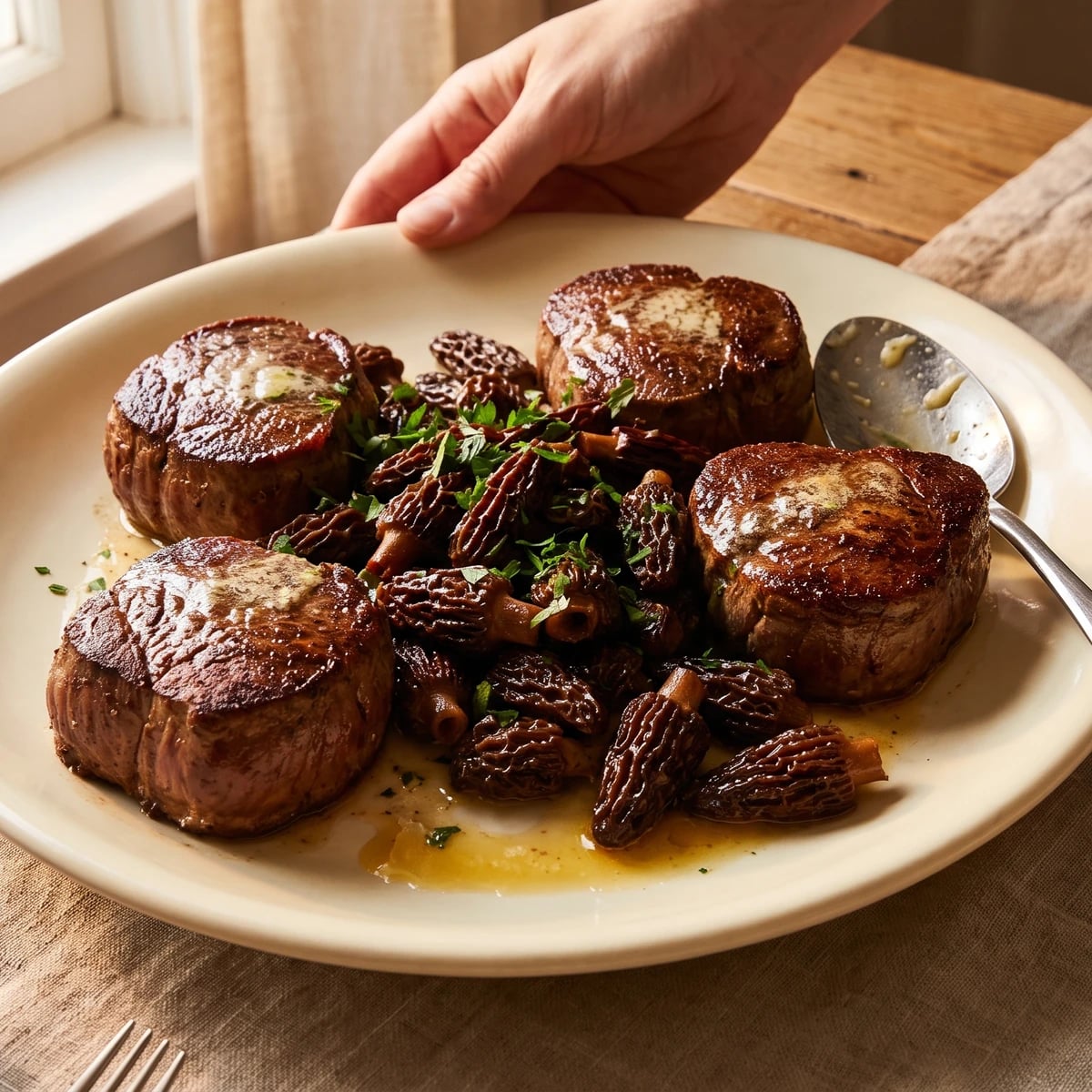
Four butter-seared tournedos form a generous crown around morels tossed until glossy, then parsley falls over the centre: hot, fast cooking that keeps tenderloin bronze outside and rosy within.

Main Dishes
French
Dinner Party
Special Occasion
Date Night
20 min
Active Time
25 min cook45 min total
Yield4 servings

Tournedos aux morilles (beef tenderloin with buttered morels) teaches the discipline of two clocks. Morels need enough gentle cooking to become tender and safe, while tournedos need fierce heat and very little time. Cook the mushrooms first and hold them briefly; once the beef meets the skillet, nothing else should be waiting for your attention.

The original entry assumed a grill or sauté station already hot, identical rounds of trimmed tenderloin, mushrooms cleaned by another pair of hands, and a platter warming for service. It called for either grilling or frying in butter. This home version chooses the skillet and clarified butter because they give one cook steadier heat without scorching the milk solids. There is no saucier's work here, no stockpot, and no salamander. Four tournedos, one heavy pan, one warm platter. The brigade scaffolding can go; the hard sear, butter-tossed morels, crown arrangement, and moderate parsley must stay.

The finished platter is generous rather than fussy: bronze rounds of beef encircling a glossy heap of dark, honeycombed mushrooms, with butter pooling beneath and parsley brightening the centre. Have the morels cooked and waiting before the tournedos touch the pan. That is the step that decides the evening.

Tournedos belong to Parisian dining-room service and the broader classical French canon, where small, thick rounds from the tenderloin were cooked to order and carried promptly to the table. Arranging them in a crown around a central garniture reflects platter service, allowing the host to serve each guest from one composed dish rather than presenting individually decorated plates. Morels connect the preparation to spring tables across the Jura, Franche-Comté, and Savoie, but butter and parsley alone keep this a national classical dish; adding vin jaune or cream would make a different, more regional statement.

The technique, the tradition, and the story behind every dish.

Discover Culinary Explorer

Ingredients

centre-cut beef tenderloin tournedos

Quantity

4, each 6 ounces (170 g) and about 1½ inches (4 cm) thick

trimmed and tied into even rounds

fresh morels

Quantity

5 loosely packed cups (1.2 L / 340 g)

cleaned, dried thoroughly, and halved lengthwise if large

clarified butter

Quantity

3 tablespoons (45 ml / 42 g)

divided

unsalted butter

Quantity

5 tablespoons (75 ml / 71 g)

divided

fine sea salt

Quantity

1½ teaspoons (7.5 ml / 9 g)

divided

freshly ground black pepper

Quantity

1 teaspoon (5 ml / 2 g)

flat-leaf parsley

Quantity

2 tablespoons (30 ml / 8 g)

finely chopped

Equipment Needed

  • 12-inch (30 cm) cast-iron or heavy stainless-steel skillet
  • Instant-read thermometer
  • Kitchen twine
  • Large round oven-safe serving platter

Instructions

  1. 1

    Prepare both clocks

    Heat the oven to 200°F (95°C) and place a large round serving platter inside to warm. Brush the morels carefully; if grit is lodged in their folds, swish them briefly through two changes of cold water, then dry them thoroughly. Keep small morels whole and halve large ones lengthwise. Pat the tournedos dry, check that each is tied into an even round, and leave them unseasoned until the skillet is ready. The morels need patient cooking, while the lean beef needs fierce, brief heat, so they cannot begin together.

  2. 2

    Cook the morels

    Melt 4 tablespoons (60 ml / 57 g) of the unsalted butter in a 12-inch (30 cm) heavy skillet over medium heat. Add the morels and ¼ teaspoon (1.25 ml / 1.5 g) of the salt, then toss until every cap gleams. Cook for 12 to 15 minutes, turning often, until the mushrooms are tender throughout, their edges have browned, and any liquid they released has cooked away. Morels must never be served raw or barely warmed. If the skillet dries before they are tender, add 1 tablespoon (15 ml) of water, lower the heat, and continue cooking until that water disappears. Ça se rattrape. Transfer the morels and their butter to a warm bowl.

  3. 3

    Sear the tournedos

    Wipe loose mushroom fragments from the skillet and heat it over high heat until properly hot. Season the tournedos all over with the remaining salt and the pepper. Add 2 tablespoons (30 ml / 28 g) of the clarified butter, then set in the beef with room between the pieces. Fry without moving for about 3 minutes, until the first face forms a deep Maillard-bronze crust. Turn and cook the second face for 2 to 3 minutes, then hold the edges against the skillet briefly to colour them. Pull the beef at 125 to 130°F (52 to 54°C) for medium-rare, or at your preferred temperature. If the fat blackens or smells acrid, lift out the steaks, wipe the skillet, add the reserved clarified butter, and continue. Burnt butter must leave the pan, but the beef need not be sacrificed.

  4. 4

    Rest and reglaze

    Transfer the tournedos to a warm plate and rest them for 5 minutes, uncovered or tented very loosely so their crust stays firm. Lower the skillet heat, return the morels with their butter, and add the remaining 1 tablespoon (15 ml / 14 g) unsalted butter. Toss for about 1 minute, just until the mushrooms are hot and newly glossy. Do not add cream, stock, or a pan sauce. The original preparation asks for morels tossed in butter, and that restraint is the dish, not missing brigade work.

  5. 5

    Build the crown

    Remove the twine and arrange the four tournedos in a ring on the warmed platter, leaving a generous hollow in the centre. Heap the buttered morels inside that crown and spoon their remaining butter over them. Sprinkle the parsley moderately across the mushrooms, with only a little falling onto the beef. Carry the platter straight to the table. Tenderloin waits badly, and delay turns its rosy centre grey. À table!

Chef Tips

  • Buy true morels from a reliable grower or market. They should smell woodland-fresh, feel firm rather than slimy, and be completely hollow when cut lengthwise. Never forage them unless an experienced mushroom identifier confirms them.
  • Outside the fresh season, use 1½ ounces (40 g) dried morels. Cover them with warm water for 20 minutes, lift them out so the grit stays behind, rinse their folds, squeeze gently, and dry well. Cook them for the full 12 minutes in butter. Save the strained soaking liquor for another dish, but don't add it here because this entry calls for butter-tossed morels, not a sauce.
  • Ask the butcher for centre-cut tenderloin rounds of equal thickness. Tying them is useful rather than decorative: an even cylinder browns at the same pace all around and fits the original crown neatly.
  • The skillet must be large enough to leave space between all four tournedos. If yours is smaller than 12 inches (30 cm), sear in two batches and refresh the clarified butter between them.
  • A restrained red Burgundy suits the earthy morels without overwhelming the tenderloin. Serve the dish with pommes château or a simple potato purée, but keep the platter itself exactly as written.

Advance Preparation

  • Clean and dry the morels up to 6 hours ahead. Refrigerate them loosely covered on a towel so trapped moisture does not soften their folds.
  • Trim and tie the tournedos earlier in the day, then refrigerate them uncovered on a plate. Remove them about 20 minutes before cooking, but season only when the skillet is hot.
  • For dinner-party service, cook the morels up to 30 minutes before searing the beef and keep them in a warm bowl. Toss them through the final spoonful of butter while the tournedos rest.

Frequently Asked Questions

Nutrition Information

1 serving (about 215g)

Calories
560 calories
Total Fat
42 g
Saturated Fat
22 g
Trans Fat
1 g
Unsaturated Fat
16 g
Cholesterol
165 mg
Sodium
975 mg
Total Carbohydrates
5 g
Dietary Fiber
3 g
Sugars
1 g
Protein
40 g

Note: Chef personas and recipes are created with AI assistance. Cook with care: follow safe food-handling practices, check doneness with a thermometer when needed, and adapt for allergies and your kitchen.

Where cooking meets culture.

Culinary guides, cultural storytelling, and the editorial depth that makes cooking meaningful.

Discover Culinary Explorer

More from Relevés and Entrées - Tournedos

Browse the full collection