
Chef Juliette
John Dory (St. Pierre)
John Dory has the delicacy of sole and the firmness of turbot. A light flouring, a quick butter sauté, and nut-brown beurre noisette show exactly why looks never mattered.
A cooking platform built around craft, culture, and the stories behind what we eat.
Created by Chef Juliette
Based on No. 1094, Tournedos à la Florentine, from Le Guide Culinaire (1907) by Auguste Escoffier
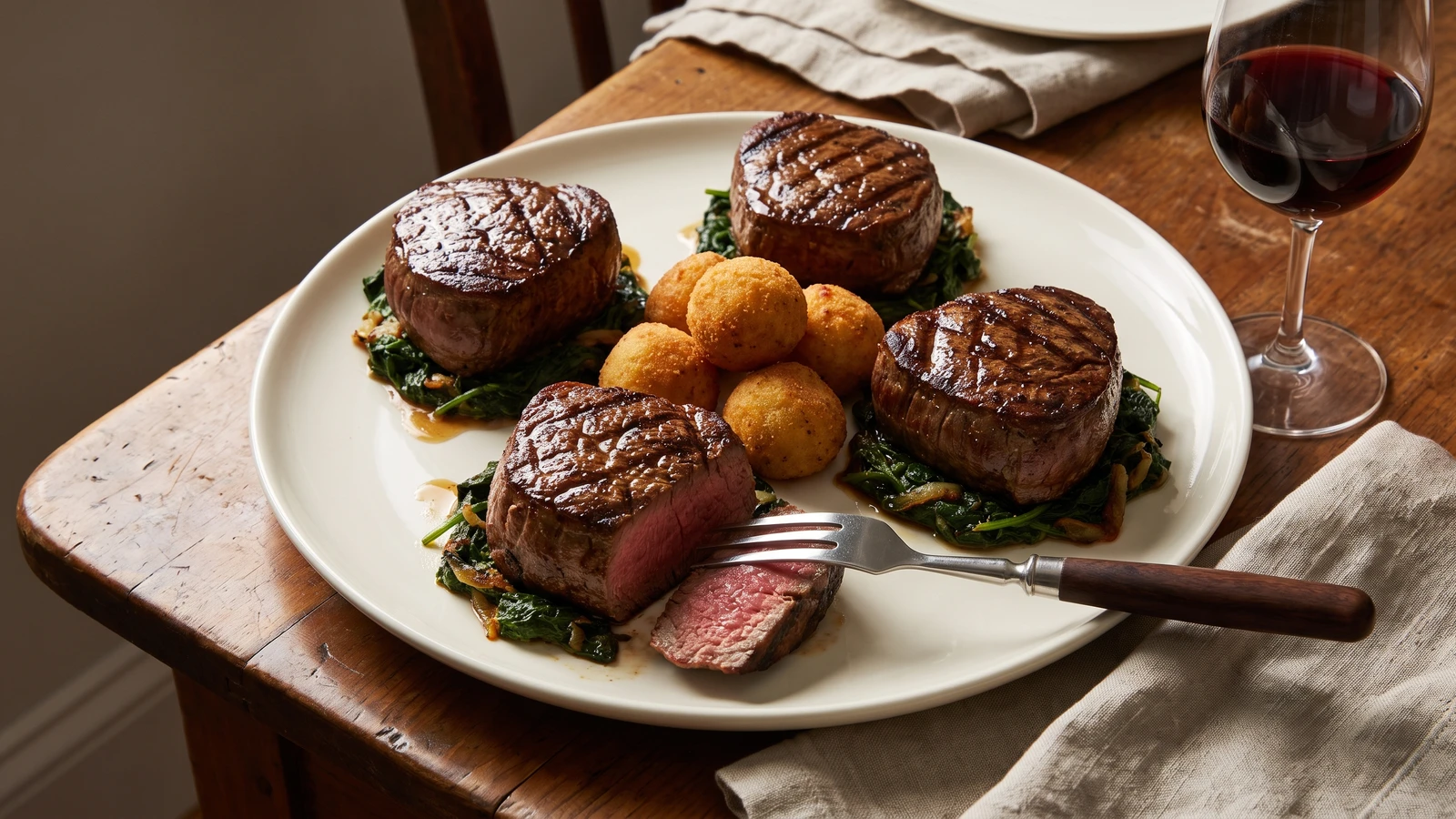
Tournedos à la Florentine teaches service timing: lean beef grilled hot and quick, spinach subrics browned beside it, and walnut-sized semolina croquettes fried moments earlier, all gathered in a generous crown.
Tournedos à la Florentine (grilled beef tenderloin on spinach subrics with semolina croquettes) teaches timing above all. The one true thing is this: tenderloin is lean, so the pan must be fully hot before the beef enters, and the cook must lift it away the instant the center is ready. Linger and it dries. Move with purpose and you get a bronzed surface, a rosy heart, crisp spinach beneath, and little croquettes that yield softly under their crust.
The grand kitchen surrounding this entry had a saucier, stock never off the fire, and a salamander at command, yet this composition calls for none of them. Its real assumption was more troublesome at home: separate hands at the grill, frying pot, and subric pan. Your honest equivalent is staging. Prepare the semolina croquettes and Subrics d’Épinards (No. 2137) first, fry the croquettes shortly before service, then give one burner to the beef and one to the subrics. A small deep saucepan replaces the service fryer. One cook, one stove, one evening.
Here the brigade crown becomes four portions. Only the quantity and choreography have changed. The round tournedos, spinach subrics, walnut-sized croquettes, and crown arrangement are the dish itself and must stay; extra sauce and broiler work would be scaffolding the source never requested. Before you touch a pan, warm the platter and set every component within reach. Heat the grill pan completely before the tournedos meet it, then watch the thermometer, not the clock.
In the Parisian classical repertoire, a tournedos is a compact round cut from the heart of beef tenderloin, while à la florentine tells the diner to expect spinach. This version turns the spinach into subrics, small bound cakes, then gathers semolina croquettes around the beef in the crown arrangement favored by grand service. The familiar claim that every spinach dish owes its name to one Florentine court is too tidy; what is certain is that French menu language made florentine a durable shorthand for spinach.
Quantity
4, 5 oz (140 g) each
about 1½ inches (4 cm) thick, tied if needed
Quantity
4 Subrics d’Épinards (No. 2137)
prepared through shaping, each the same diameter as a tournedos
Quantity
1 cup (240 ml / 245 g)
Quantity
½ cup (120 ml / 85 g)
Quantity
1 tablespoon (15 ml / 14 g)
Quantity
1
Quantity
1¼ teaspoons (6 ml / 7 g)
divided
Quantity
⅛ teaspoon (0.6 ml / 0.25 g)
Quantity
¼ cup (60 ml / 30 g)
Quantity
1
beaten
Quantity
¾ cup (180 ml / 75 g)
Quantity
3 cups (720 ml / 660 g)
or enough to reach 1½ inches (4 cm) in the saucepan
Quantity
2 tablespoons (30 ml / 28 g)
divided
Quantity
¾ teaspoon (4 ml / 1.5 g)
| Ingredient | Quantity |
|---|---|
| center-cut beef tenderloin tournedosabout 1½ inches (4 cm) thick, tied if needed | 4, 5 oz (140 g) each |
| Subrics d’Épinardsprepared through shaping, each the same diameter as a tournedos | 4 Subrics d’Épinards (No. 2137) |
| whole milk | 1 cup (240 ml / 245 g) |
| fine semolina | ½ cup (120 ml / 85 g) |
| unsalted butter | 1 tablespoon (15 ml / 14 g) |
| large egg yolk | 1 |
| fine sea saltdivided | 1¼ teaspoons (6 ml / 7 g) |
| freshly grated nutmeg | ⅛ teaspoon (0.6 ml / 0.25 g) |
| plain flour | ¼ cup (60 ml / 30 g) |
| large eggbeaten | 1 |
| fine dry breadcrumbs | ¾ cup (180 ml / 75 g) |
| neutral frying oilor enough to reach 1½ inches (4 cm) in the saucepan | 3 cups (720 ml / 660 g) |
| clarified butterdivided | 2 tablespoons (30 ml / 28 g) |
| freshly ground black pepper | ¾ teaspoon (4 ml / 1.5 g) |
Reserve 2 tablespoons of the measured milk and keep it cold. Put the remaining milk in a 2-quart saucepan with the unsalted butter, ¼ teaspoon of the salt, and the nutmeg. Bring it just to the point where small bubbles gather around the rim. Rain in the semolina while whisking constantly, then lower the heat and stir with a wooden spoon for 6 to 8 minutes. It is ready when it forms a very thick, smooth mass that pulls cleanly from the pan. If it tightens unevenly, take it off the heat and beat in the reserved cold milk a little at a time. Let it cool for 2 minutes, then beat in the yolk until the mixture is glossy and uniform. Spread it about ½ inch (1 cm) thick in a shallow dish, press parchment against the surface, and chill for 45 minutes.
Divide the cold semolina mixture into 12 equal portions, about 1 oz (28 g) each, and roll them into balls the size of walnuts. If the mixture clings to your hands or slumps, chill it for another 15 minutes; don't knead in extra flour, which makes a heavy croquette. Roll each ball lightly in flour, then in beaten egg, then in breadcrumbs, pressing just firmly enough to seal the surface. Set them on a rack and chill for at least 20 minutes so the coating holds in the oil.
Heat the oven to 225°F (110°C), place a wire rack over a small tray inside, and warm a broad round serving platter. Set a heavy grill pan over one burner and a wide skillet for the Subrics d’Épinards (No. 2137) over another, but do not heat them yet. Take the tournedos from the cold for 20 minutes, keeping them tied, then dry every surface thoroughly. Have the remaining salt, pepper, clarified butter, tongs, and thermometer beside the stove. Once the frying begins, the dish moves quickly.
Pour the frying oil into a deep saucepan, filling it no more than halfway, and heat it to 350°F (175°C). Fry one croquette first. It should bubble steadily and turn evenly golden in 2 to 3 minutes. If it opens, do not add the rest: the oil is too cool or the croquettes are too warm. Lift it out, bring the oil back to temperature, chill the remaining croquettes for 10 minutes, and patch any bare spot on the opened one with egg and breadcrumbs. Ça se rattrape. Fry the rest in two batches, drain them on the rack, season with a small pinch of the remaining salt, and hold them in the low oven for no longer than 15 minutes.
Raise the grill pan over high heat and the subric skillet over medium-high heat. Brush the tournedos with half the clarified butter and season them with the remaining salt and the pepper. Put the other half of the clarified butter in the skillet. When both pans are properly hot, set the tournedos on the grill pan and the prepared Subrics d’Épinards (No. 2137) in the skillet at the same moment. Cook the subrics according to their own entry until both faces are evenly colored and their centers are set, then transfer them to the warm platter. Grill the tournedos without pressing them, about 2½ to 3 minutes on the first face and 2 to 3 minutes on the second. Begin checking after 5 minutes and lift them at 120 to 125°F (49 to 52°C) for a rosy medium-rare center. If the surface darkens before the center reaches 115°F (46°C), lower the heat to medium and turn the steaks every 30 seconds until ready.
Rest the tournedos on a rack for 5 minutes, then remove their strings. Arrange the four spinach subrics in a ring on the warmed platter and set one tournedos squarely on each. Pile the semolina croquettes in the middle to complete the crown, keeping their browned surfaces exposed rather than burying them beneath the beef. This entry asks for no added sauce; the rich subric and tender croquette belong in the same forkful as the meat. Carry the platter straight to the table. À table!
1 serving (about 300g)
Culinary guides, cultural storytelling, and the editorial depth that makes cooking meaningful.
Discover Culinary ExplorerChef Juliette
John Dory has the delicacy of sole and the firmness of turbot. A light flouring, a quick butter sauté, and nut-brown beurre noisette show exactly why looks never mattered.

Chef Juliette
Fresh haddock proves its delicacy in the meunière pan: a fine flour crust, moist pearly flakes, and beurre noisette sharpened with lemon and parsley, ready from one skillet in half an hour.

Chef Juliette
Éperlans à l’Anglaise turns small fish into a lesson in disciplined coating: boned smelts under a close, crisp crumb, pan-fried in clarified butter and finished with bright, half-melted maître d’hôtel butter.

Chef Juliette
Tiny smelts, shallot, mushrooms, white wine, gratin sauce, and fine bread raspings meet a fierce oven, where the fish must turn tender in the same breath the buttered crust bronzes.