
Chef Juliette
Châteaubriand, Fillet Steak, Tournedos
One tenderloin heart, three classical portions: roast Châteaubriand for carving, bifteck de filet for one, tournedos two to a plate, all with braised endives and a red-wine pan jus.
A cooking platform built around craft, culture, and the stories behind what we eat.
Created by Chef Juliette
Based on No. 1088, Tournedos aux Champignons, from Le Guide Culinaire (1907) by Auguste Escoffier
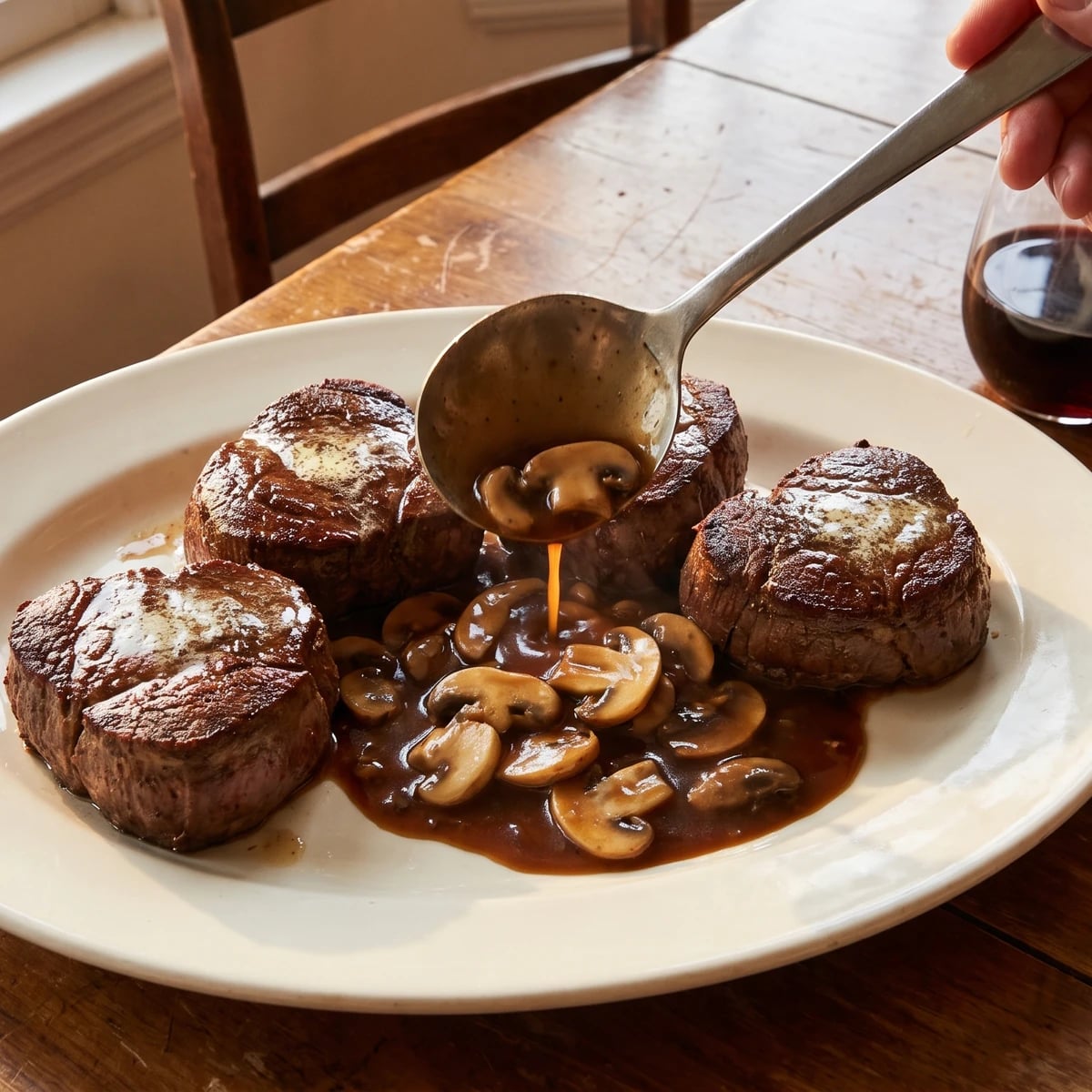
Four butter-seared tournedos in a crown, with their mushroom liquor drawn through the fond into a glossy sauce: a lesson in why one honest pan matters more than ceremony.
Tournedos aux champignons (beef tenderloin medallions with mushrooms) teaches the quickest and most exacting family of pan sauces: the fond beneath the beef must be deeply brown, never black. Before you touch the pan, dry the tournedos thoroughly. Moisture prevents a crust, and without that crust the sauce has nothing to say.
The original entry assumes a saucier on staff, mushroom cooking liquor waiting, a rich brown stock never off the fire, and brigade portions ready to arrange in a crown. Here, four tournedos share one skillet. You make the mushroom liquor yourself, reduce a small measure of stock into the required mushroom sauce, then use the beef pan to unite them. The separate sauce station is brigade scaffolding and can go. Butter-frying the beef, draining the excess fat, deglazing with mushroom liquor, and pouring the mushrooms into the crown are the dish, so every one of those steps stays. One cook, one stove, one evening.
Expect a deep bronze crust, tender rosy beef, and mushrooms gathered in a glossy brown sauce at the center of the platter. Keep your eye on the butter as the tournedos cook. Hazelnut brown gives character; black gives bitterness. That browning is the step that decides everything.
Tournedos belong to Parisian classical service, where thick, round portions cut from the heart of the beef tenderloin were cooked quickly and finished à la minute with a composed sauce. The mushroom garnish suited that table particularly well because champignons de Paris, cultivated around and beneath the capital for generations, supplied both tender mushrooms and their fragrant cooking liquor. The name tournedos attracts several colorful origin stories, but its dependable meaning is practical: a compact tenderloin steak cut across the grain for fast, even cooking.
Quantity
4, each 5 oz (140 g); 20 oz (560 g) total
cut about 1 1/2 inches (4 cm) thick
Quantity
12 oz (340 g)
trimmed and sliced 1/4 inch (6 mm) thick
Quantity
1/2 cup (120 ml / 120 g)
Quantity
5 tablespoons (75 ml / 71 g)
divided
Quantity
1 1/2 cups (360 ml / 360 g)
Quantity
1 teaspoon (5 ml / 6 g)
divided
Quantity
1/2 teaspoon (2.5 ml / 1 g)
| Ingredient | Quantity |
|---|---|
| center-cut beef tenderloin medallionscut about 1 1/2 inches (4 cm) thick | 4, each 5 oz (140 g); 20 oz (560 g) total |
| small white button mushroomstrimmed and sliced 1/4 inch (6 mm) thick | 12 oz (340 g) |
| cold water | 1/2 cup (120 ml / 120 g) |
| unsalted butterdivided | 5 tablespoons (75 ml / 71 g) |
| rich, unsalted brown veal or beef stock | 1 1/2 cups (360 ml / 360 g) |
| fine sea saltdivided | 1 teaspoon (5 ml / 6 g) |
| freshly ground black pepper | 1/2 teaspoon (2.5 ml / 1 g) |
Tie each tournedos around its middle with kitchen twine if it isn't already compact and round. Pat every surface thoroughly dry, then leave the meat at cool room temperature for 20 minutes while you prepare the mushrooms. Do not season yet. Salt sitting briefly on the surface draws out moisture, and wet beef steams where it should brown.
Put the sliced mushrooms in a 2-quart saucepan with the water, 1 tablespoon (15 ml / 14 g) of the butter, and 1/4 teaspoon (1.25 ml / 1.5 g) of the salt. Cover and bring to a gentle simmer over medium heat. Cook for 5 minutes, stirring once, until the mushrooms have softened slightly and released their juices but still hold their shape. Strain them over a bowl without pressing. This liquid is the cuisson de champignons, the mushroom cooking liquor, and it must all be reserved for the pan.
Pour the stock into the saucepan and boil it steadily until reduced by half, about 10 minutes. It should lightly coat a spoon rather than run from it like water. Return the drained mushrooms and simmer for 2 minutes, making a compact mushroom sauce that can wait while the beef cooks. Cover and hold it off the heat. If the stock remains watery after reducing by half, keep reducing before the mushrooms go back in; a weak stock needs more concentration, not flour or cream.
Warm an oval serving platter. Season the tournedos on every side with the remaining salt and the pepper. Heat a heavy 12-inch stainless-steel skillet over medium-high heat, then add 3 tablespoons (45 ml / 43 g) of the butter. When the foam subsides and the butter smells nutty, lay in the beef with space between the pieces. Cook without disturbing for 2 1/2 to 3 minutes, until the undersides wear a dark bronze crust. Turn, add the remaining 1 tablespoon (15 ml / 14 g) butter, and baste as the second side cooks for another 2 to 3 minutes. For medium-rare, remove the tournedos at about 125°F (52°C). Arrange them in a crown on the warm platter and rest them loosely covered.
Pour the cooking butter from the skillet into a heatproof bowl, leaving the brown fond attached to the pan. Return the skillet to medium-high heat and add all the reserved mushroom cuisson. Let it hiss, then scrape the pan floor with a wooden spoon until every mahogany-colored speck has dissolved. Add the warm mushroom sauce and any juices collected beneath the resting tournedos. Boil for 2 to 3 minutes, exactly as the original method asks, until the sauce is glossy and coats the spoon. If it tightens too far, loosen it with a spoonful of water. If it remains thin, lift out the mushrooms and reduce the liquid alone, then return them. Do not keep boiling the mushrooms into submission.
Remove the twine from the rested tournedos. Taste the sauce, correcting the salt only if needed, then spoon the mushrooms and their sauce into the middle of the crown rather than blanketing the beef. The crust stays visible and crisp at the edges, while each diner can take as much sauce as desired. Serve immediately. À table!
1 serving (about 210g)
Culinary guides, cultural storytelling, and the editorial depth that makes cooking meaningful.
Discover Culinary Explorer
Chef Juliette
One tenderloin heart, three classical portions: roast Châteaubriand for carving, bifteck de filet for one, tournedos two to a plate, all with braised endives and a red-wine pan jus.

Chef Juliette
Tournedos Algérienne teaches timing: crisp sweet-potato croquettes and tender oil-stewed tomatoes must be ready before lean fillet meets clarified butter, sears fast, and goes straight to the table.

Chef Juliette
Tournedos crowned over crisp tartlets of wine-braised choucroute and lean ham: a hot, quick grill for the fillet, a dry, buttery foundation below, and Alsace carried through the whole plate.

Chef Juliette
Tender tournedos meet a Provençal ring of golden aubergine and sautéed tomato, each steak crowned with fried onion. The lesson is timing: prepare the garnish, then give lean fillet one hot, quick pan.