
Chef Juliette
John Dory (St. Pierre)
John Dory has the delicacy of sole and the firmness of turbot. A light flouring, a quick butter sauté, and nut-brown beurre noisette show exactly why looks never mattered.
A cooking platform built around craft, culture, and the stories behind what we eat.
Created by Chef Juliette
Based on No. 1087, Tournedos Cendrillon, from Le Guide Culinaire (1907) by Auguste Escoffier
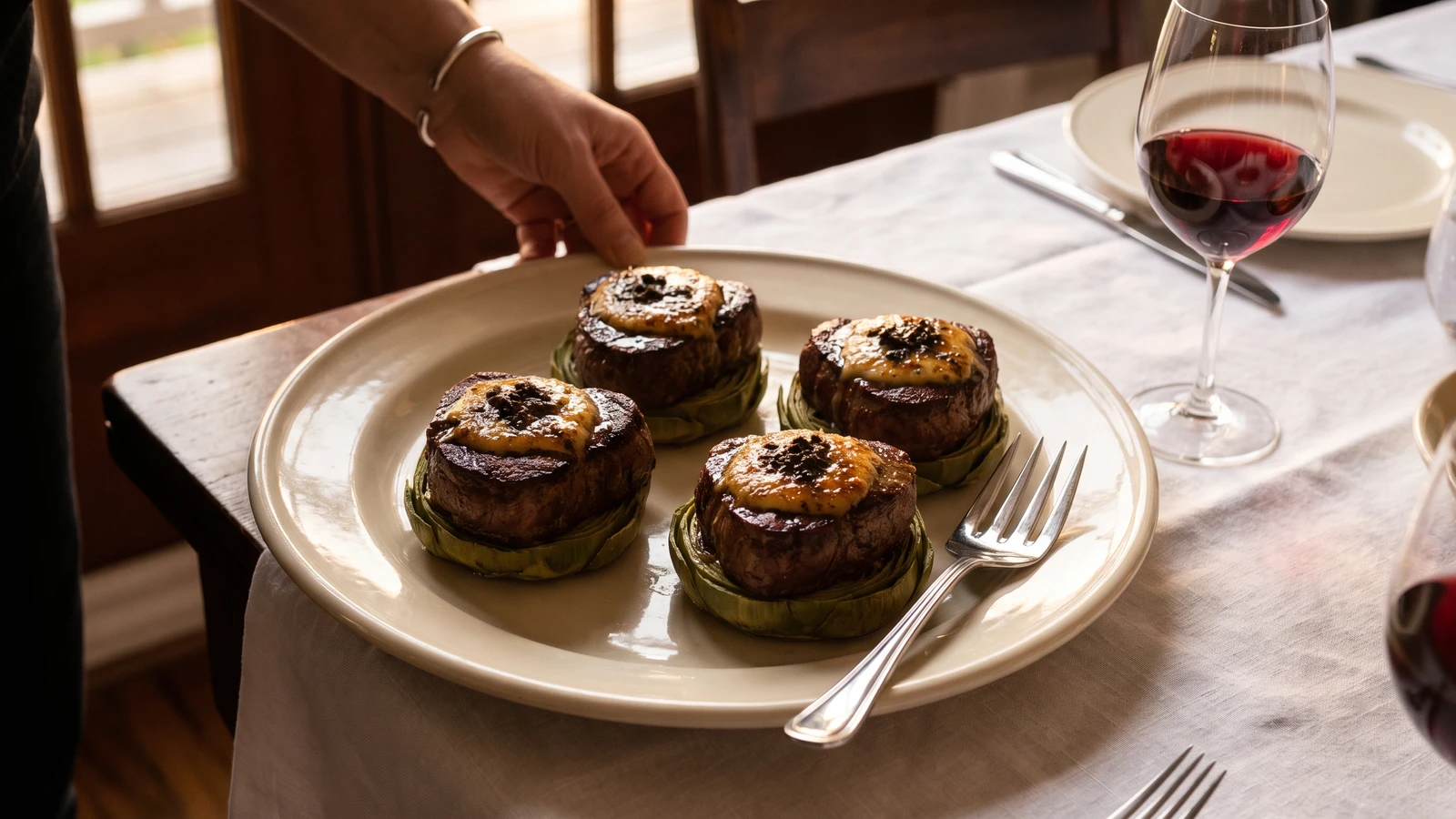
Tournedos Cendrillon places a fierce clarified-butter sear over glazed artichoke bottoms and truffled Soubise, a precise lesson in timing lean beef against a rich, quietly luxurious garnish.
Tournedos Cendrillon (beef tenderloin on artichoke bottoms with truffled Soubise, a silken onion purée) teaches one true thing: tenderloin is lean, so it wants a fiercely hot sear and an early exit. A timid pan dries the meat before it browns. Clarified butter, real heat, no lingering.
The original assumed a saucier with Soubise already warm, a stockpot never off the fire, artichoke bottoms prepared by another pair of hands, and a salamander ready for glazing. At home, a small saucepan makes the Soubise, a blender replaces the tamis, the fine sieve, good preserved artichoke bottoms spare you an hour of turning fresh ones, and the broiler supplies the fierce top heat. Separate stations and prolonged holding were brigade scaffolding, so they go. The prescribed architecture does not: truffled Soubise, artichoke bottom, clarified-butter sear, beef set squarely on top.
This is the canon brought down to four plates, one cook, one stove, one evening. Before the beef touches the pan, have the Soubise finished, the artichokes filled, and the broiler heating. Once the clarified butter shimmers, hot and fast is the whole dish.
Tournedos Cendrillon belongs to the Parisian grand-kitchen repertoire of named tournedos, in which the same small round of beef fillet changed identity through its prescribed garnish. Cendrillon means Cinderella, but the title is poetic rather than regional: its fixed composition is truffled Soubise mounded in artichoke bottoms, fiercely glazed, then crowned with clarified-butter-seared beef. As the preparation passed to formal home tables, the division of labor fell away while that arrangement remained its defining mark.
Quantity
4, 5 ounces (140 g) each
cut about 1 1/2 inches (4 cm) thick and tied around the waist
Quantity
4, about 10 ounces (280 g) total
thawed or drained and patted very dry
Quantity
1, about 10 ounces (285 g)
thinly sliced
Quantity
1 tablespoon (15 ml / 12 g)
Quantity
1/2 cup plus 2 tablespoons (150 ml / 150 g)
divided
Quantity
3 tablespoons (45 ml / 43 g)
divided
Quantity
2 tablespoons (30 ml / 30 g)
Quantity
3 tablespoons (45 ml / 25 g)
drained if preserved and finely chopped
Quantity
3 tablespoons (45 ml / 40 g)
purchased or made from about 4 tablespoons (60 ml / 57 g) unsalted butter
Quantity
1 1/2 teaspoons (7.5 ml / 9 g)
divided
Quantity
3/4 teaspoon (3.75 ml / 1.5 g)
divided
| Ingredient | Quantity |
|---|---|
| center-cut beef tenderloin tournedoscut about 1 1/2 inches (4 cm) thick and tied around the waist | 4, 5 ounces (140 g) each |
| large cooked artichoke bottomsthawed or drained and patted very dry | 4, about 10 ounces (280 g) total |
| large yellow onionthinly sliced | 1, about 10 ounces (285 g) |
| short-grain white rice | 1 tablespoon (15 ml / 12 g) |
| unsalted light chicken stockdivided | 1/2 cup plus 2 tablespoons (150 ml / 150 g) |
| unsalted butterdivided | 3 tablespoons (45 ml / 43 g) |
| heavy cream | 2 tablespoons (30 ml / 30 g) |
| fresh or whole preserved black truffledrained if preserved and finely chopped | 3 tablespoons (45 ml / 25 g) |
| clarified butterpurchased or made from about 4 tablespoons (60 ml / 57 g) unsalted butter | 3 tablespoons (45 ml / 40 g) |
| fine sea saltdivided | 1 1/2 teaspoons (7.5 ml / 9 g) |
| freshly ground black pepperdivided | 3/4 teaspoon (3.75 ml / 1.5 g) |
Take the tournedos from the cold about twenty minutes before cooking. Tie each around its waist with kitchen string so it keeps its round shape, then pat every surface thoroughly dry. Leave them unseasoned for the moment. Check that each artichoke bottom sits level, trimming only a thin shaving from underneath if necessary and never cutting through the cup.
Melt 1 tablespoon (15 ml / 14 g) of the unsalted butter in a small covered saucepan over medium-low heat. Add the onion and 1/4 teaspoon of the salt, cover, and suer, sweat without colouring, for 12 to 15 minutes. The onion should collapse into a translucent mass without taking on brown edges. Stir in the rice, add 1/2 cup (120 ml / 120 g) of the stock, and cover again. Cook at the gentlest simmer for 18 to 20 minutes, until the rice crushes easily and the onion offers no resistance. If the pan catches, add a spoonful of the reserved stock and scrape gently. Ça se rattrape.
Blend the onion and rice mixture until completely smooth, then return it to the saucepan. Stir in the cream and cook uncovered over low heat until the Soubise holds a soft mound rather than running across the pan. Take it off the heat and whisk in the remaining 2 tablespoons (30 ml / 29 g) unsalted butter, a little at a time, then fold in the chopped truffle and 1/4 teaspoon of the pepper. Taste and correct the salt. If the butter beads on the surface, remove the pan from all heat and whisk in 1 teaspoon of warm reserved stock until the purée comes together. Ça se rattrape. Keep it covered and warm, but do not boil it after the truffle goes in.
Set an oven rack about 6 inches (15 cm) below the broiler and heat the broiler to high. Brush a broiler-safe tray and the artichoke bottoms with 1 tablespoon (15 ml / 13 g) of the clarified butter. Season the bottoms lightly with about 1/4 teaspoon of salt, set them cup-side up, and divide the truffled Soubise among them, smoothing each portion into a generous dome. Leave them ready beside the oven. The broiler is the honest home equivalent of the fierce oven or salamander.
Season the tournedos on every side with the remaining salt and pepper. Heat a heavy skillet over medium-high to high heat until properly hot, then add the remaining 2 tablespoons (30 ml / 27 g) clarified butter. When it shimmers, lay in the beef with space between the pieces. Sear without moving for about 2 1/2 minutes, turn, and cook the second side for about 2 minutes. Roll the edges against the pan for 20 to 30 seconds where needed. Check from the side with an instant-read thermometer and pull the meat at 122 to 125°F (50 to 52°C) for medium-rare, or 130°F (54°C) for medium. The temperature will rise as it rests. If the crust is pale but the centre is already near its target, take the meat out. A pale tournedos can still be juicy; an overcooked one cannot be uncooked.
Transfer the tournedos to a rack and rest them for 5 minutes, shielding them loosely rather than wrapping them tightly. Slide the filled artichoke bottoms under the broiler for 2 to 4 minutes, watching without interruption, until the Soubise is glossy and freckled with gold. If the tops colour too quickly, lower the tray at once. They need glazing, not scorching. Warm the serving platter with hot water while they cook, then dry it thoroughly.
Arrange the four glazed artichoke bottoms in a circle on the warm platter. Remove the string from the rested tournedos and set one squarely on each bottom, keeping the golden Soubise visible around the beef. Serve immediately. Do not invent a pan sauce here; the buttered, truffled Soubise is the sauce the preparation requires. À table!
1 serving (about 285g)
Culinary guides, cultural storytelling, and the editorial depth that makes cooking meaningful.
Discover Culinary ExplorerChef Juliette
John Dory has the delicacy of sole and the firmness of turbot. A light flouring, a quick butter sauté, and nut-brown beurre noisette show exactly why looks never mattered.

Chef Juliette
Fresh haddock proves its delicacy in the meunière pan: a fine flour crust, moist pearly flakes, and beurre noisette sharpened with lemon and parsley, ready from one skillet in half an hour.

Chef Juliette
Éperlans à l’Anglaise turns small fish into a lesson in disciplined coating: boned smelts under a close, crisp crumb, pan-fried in clarified butter and finished with bright, half-melted maître d’hôtel butter.

Chef Juliette
Tiny smelts, shallot, mushrooms, white wine, gratin sauce, and fine bread raspings meet a fierce oven, where the fish must turn tender in the same breath the buttered crust bronzes.