
Chef Juliette
Châteaubriand, Fillet Steak, Tournedos
One tenderloin heart, three classical portions: roast Châteaubriand for carving, bifteck de filet for one, tournedos two to a plate, all with braised endives and a red-wine pan jus.
A cooking platform built around craft, culture, and the stories behind what we eat.
Created by Chef Juliette
Based on No. 1078, Tournedos Alsacienne, from Le Guide Culinaire (1907) by Auguste Escoffier
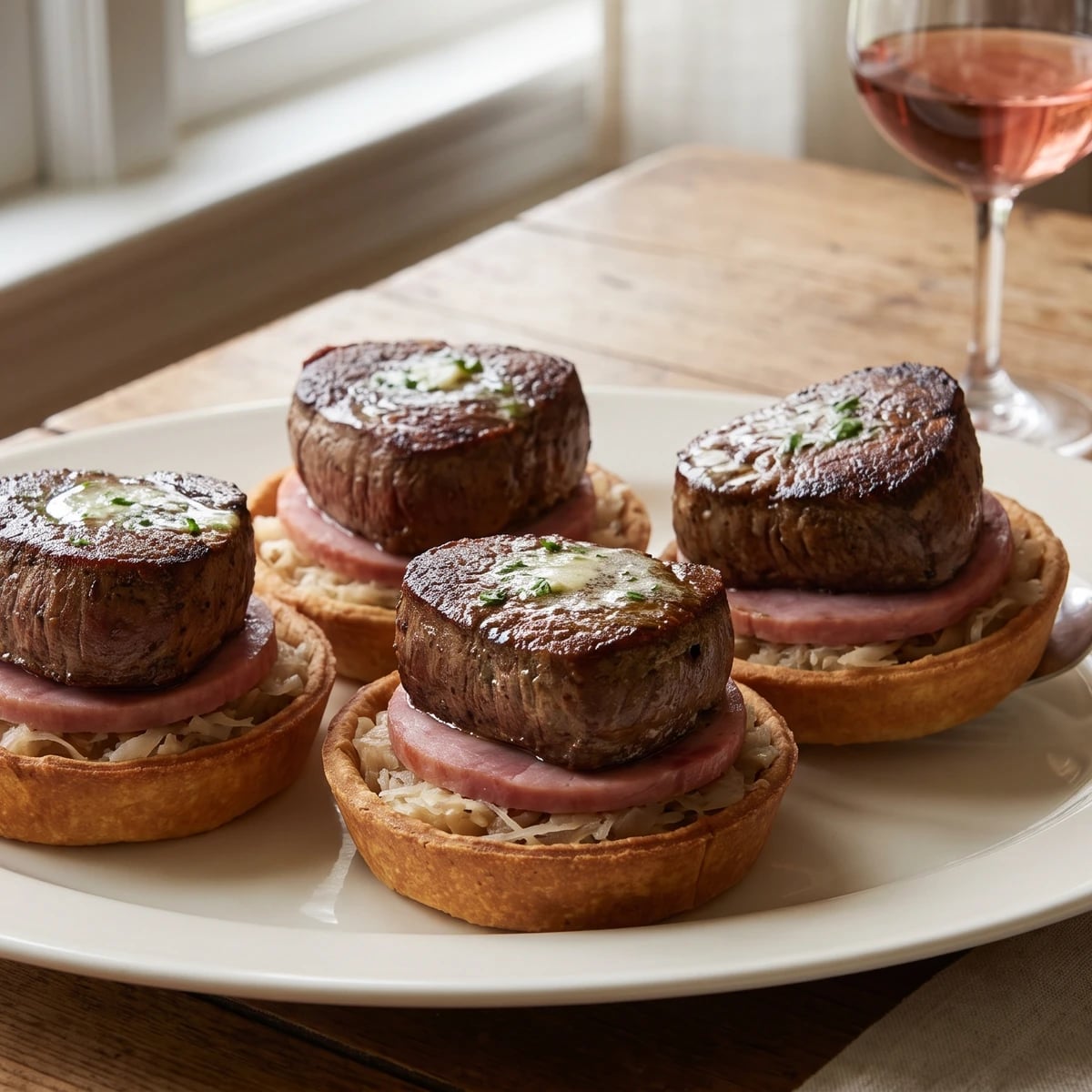
Tournedos crowned over crisp tartlets of wine-braised choucroute and lean ham: a hot, quick grill for the fillet, a dry, buttery foundation below, and Alsace carried through the whole plate.
Tournedos Alsacienne (grilled beef medallions on tartlets of braised sauerkraut and ham) teaches order. The garnish must be hot, dry, and ready before the beef meets the grill, because lean fillet cooks in minutes and forgives no waiting. The tournedos goes to the garnish, never the garnish to the tournedos.
The original entry assumed prepared tartlet crusts, braised choucroute waiting, and a grill cook able to send every medallion together. Around that plate stood the usual brigade scaffolding, a saucier on staff, a stockpot never off the fire, and a salamander ready for finishing, yet this entry calls for neither sauce, stock, nor gratin. At home, four small tartlet pans, one saucepan, a low oven, and a fiercely heated cast-iron grill pan do the work honestly. The quantities are reduced to four servings, and the work is sequenced for one pair of hands. The oven replaces the holding station; no sauce is invented simply because the brigade had a saucier.
That staging is scaffolding and may change. The construction must not: crisp tartlet, well-drained choucroute, an even roundel of lean ham, and tournedos set on top. Have every tartlet hot and ready, then grill the lean fillet fiercely and quickly. That final timing decides the dish.
Tournedos are small medallions cut from beef fillet and belong to the classical service of quickly grilled steaks; Alsacienne names the garnish, not a claim that the composition was common farmhouse fare throughout Alsace. Choucroute traveled from Alsatian household preservation and winstub tables into the grand-kitchen repertory, where regional names became exact combinations of ingredients and presentation. Here its bright acidity and the savor of ham temper the richness of beef and butter, all held on a pastry tartlet in the formal crown arrangement favored by the classical canon.
Quantity
1⅓ cups (320 ml / 160 g)
Quantity
2 tablespoons (30 ml / 16 g)
for rolling
Quantity
10 tablespoons (150 ml / 142 g), divided
keep 6 tablespoons cold and cube them
Quantity
3 to 4 tablespoons (45 to 60 ml / 45 to 60 g)
Quantity
1¼ teaspoons (6 ml / 7 g), divided
Quantity
2 cups (475 ml / 400 g)
well drained
Quantity
½ small (about ⅓ cup / 60 g)
finely sliced
Quantity
⅓ cup (80 ml / 80 g)
Quantity
1
Quantity
4
lightly crushed
Quantity
½ teaspoon (2.5 ml / 1 g), divided
Quantity
4 slices, about ⅛ inch thick (4 oz / 115 g total)
large enough to cut four even roundels
Quantity
4, each 1½ inches thick (5 oz / 140 g each; 1¼ lb / 560 g total)
| Ingredient | Quantity |
|---|---|
| all-purpose flour | 1⅓ cups (320 ml / 160 g) |
| all-purpose flourfor rolling | 2 tablespoons (30 ml / 16 g) |
| unsalted butterkeep 6 tablespoons cold and cube them | 10 tablespoons (150 ml / 142 g), divided |
| ice water | 3 to 4 tablespoons (45 to 60 ml / 45 to 60 g) |
| fine sea salt | 1¼ teaspoons (6 ml / 7 g), divided |
| sauerkrautwell drained | 2 cups (475 ml / 400 g) |
| yellow onionfinely sliced | ½ small (about ⅓ cup / 60 g) |
| dry Alsatian Riesling or Pinot Blanc | ⅓ cup (80 ml / 80 g) |
| bay leaf | 1 |
| juniper berrieslightly crushed | 4 |
| freshly ground black pepper | ½ teaspoon (2.5 ml / 1 g), divided |
| lean cooked hamlarge enough to cut four even roundels | 4 slices, about ⅛ inch thick (4 oz / 115 g total) |
| center-cut beef tenderloin medallions | 4, each 1½ inches thick (5 oz / 140 g each; 1¼ lb / 560 g total) |
Make the pâte brisée (shortcrust pastry). Combine the 1⅓ cups flour with ¼ teaspoon of the salt, then rub in the 6 tablespoons cold butter until the mixture resembles coarse crumbs with a few pea-sized pieces remaining. Add 3 tablespoons ice water and toss with a fork; add the final tablespoon only if dry flour remains. Press the dough together without kneading, flatten it into a disc, wrap, and chill for 30 minutes. The rest relaxes the dough, and the cold butter gives the tartlets their crisp layers.
Heat the oven to 375°F (190°C). Divide the dough into four pieces and roll each on a lightly floured surface to about ⅛ inch thick. Line four 3½-inch tartlet pans, pressing the dough into the corners without stretching it; trim the rims, prick the bases, and chill for 10 minutes. Line with parchment, fill with baking weights, and bake for 14 to 16 minutes. Remove the weights and parchment, then bake for another 7 to 10 minutes, until the bases are dry and the shells are deep gold. If a crack appears when the weights come out, press in a scrap of raw dough and return the shell to the oven. Ça se rattrape. Cool in the pans for 5 minutes, then unmold carefully.
Taste the sauerkraut before cooking. If it is aggressively salty or acidic, rinse it briefly under cold water, then squeeze it very dry. Melt 2 tablespoons of the butter in a saucepan over medium-low heat, add the onion, and cook for 6 to 8 minutes until soft without browning. Add the sauerkraut and toss until every strand glistens. Pour in the wine, add the bay leaf, juniper, and ⅛ teaspoon pepper, then cover and hold at a gentle simmer for 20 minutes. Uncover and cook for 8 to 12 minutes more, stirring often, until no liquid remains on the pan floor. Remove the bay and juniper. If moisture still wells up when the cabbage is pressed, drain it in a sieve and return it to the pan for another minute. Wet choucroute destroys the tartlet; dry it without mercy.
Use an even 3-inch round cutter to stamp four roundels from the lean ham, matching the source entry's precise presentation. Ten minutes before grilling, set the tartlet shells on a baking sheet and warm them for 5 minutes at 325°F (165°C). Keep the choucroute hot over the lowest heat. Arrange the warm shells in a crown on a heated round platter, divide the choucroute among them, and set one ham roundel over each portion. Hold the assembled garnish in the switched-off oven with the door slightly open while the beef cooks, no longer than 8 minutes, or the pastry will soften.
Heat a heavy ridged grill pan over high heat for 8 to 10 minutes. Melt the remaining 2 tablespoons butter gently, skim off the foam, and pour the clear butter away from the milky sediment. Pat the tournedos completely dry, tie their edges with kitchen string if they need help holding a round shape, then season with the remaining 1 teaspoon salt and ⅜ teaspoon pepper. Brush lightly with the clarified butter. Grill without moving for about 3 minutes on the first side and 2 to 3 minutes on the second, turning only once. Begin checking the center early: pull at 122 to 125°F (50 to 52°C) for medium-rare or 131 to 135°F (55 to 57°C) for medium, allowing for carryover during a 5-minute rest. For diners requiring the conservative safety standard, cook to 145°F (63°C) and rest for at least 3 minutes. If the pan was too cool and the beef begins to gray, lift it out, reheat the empty pan until fiercely hot, and return the meat just long enough to bronze. Ça se rattrape, provided the center has not overcooked.
Remove the string and blot the underside of each rested tournedos so its juices do not soak the pastry. Set one tournedos squarely upon each ham-topped tartlet, preserving the source entry's order: tartlet, choucroute, ham, then beef. Brush the tops with the last trace of clarified butter and serve the crown immediately. No sauce is missing. The original calls for none, and adding one would bury the choucroute and soften the crust. À table!
1 serving (about 330g)
Culinary guides, cultural storytelling, and the editorial depth that makes cooking meaningful.
Discover Culinary Explorer
Chef Juliette
One tenderloin heart, three classical portions: roast Châteaubriand for carving, bifteck de filet for one, tournedos two to a plate, all with braised endives and a red-wine pan jus.

Chef Juliette
Tournedos Algérienne teaches timing: crisp sweet-potato croquettes and tender oil-stewed tomatoes must be ready before lean fillet meets clarified butter, sears fast, and goes straight to the table.

Chef Juliette
Tender tournedos meet a Provençal ring of golden aubergine and sautéed tomato, each steak crowned with fried onion. The lesson is timing: prepare the garnish, then give lean fillet one hot, quick pan.

Chef Juliette
Tender fillet browned fast in clarified butter, set on crisp tartlets of creamed maize, crowned with buttered tomato and green capsicum, with glossy Châteaubriand Sauce (No. 71) waiting alongside.