
Chef Juliette
John Dory (St. Pierre)
John Dory has the delicacy of sole and the firmness of turbot. A light flouring, a quick butter sauté, and nut-brown beurre noisette show exactly why looks never mattered.
A cooking platform built around craft, culture, and the stories behind what we eat.
Created by Chef Juliette
Based on No. 1076, Châteaubriand, Fillet Steak, Tournedos, from Le Guide Culinaire (1907) by Auguste Escoffier
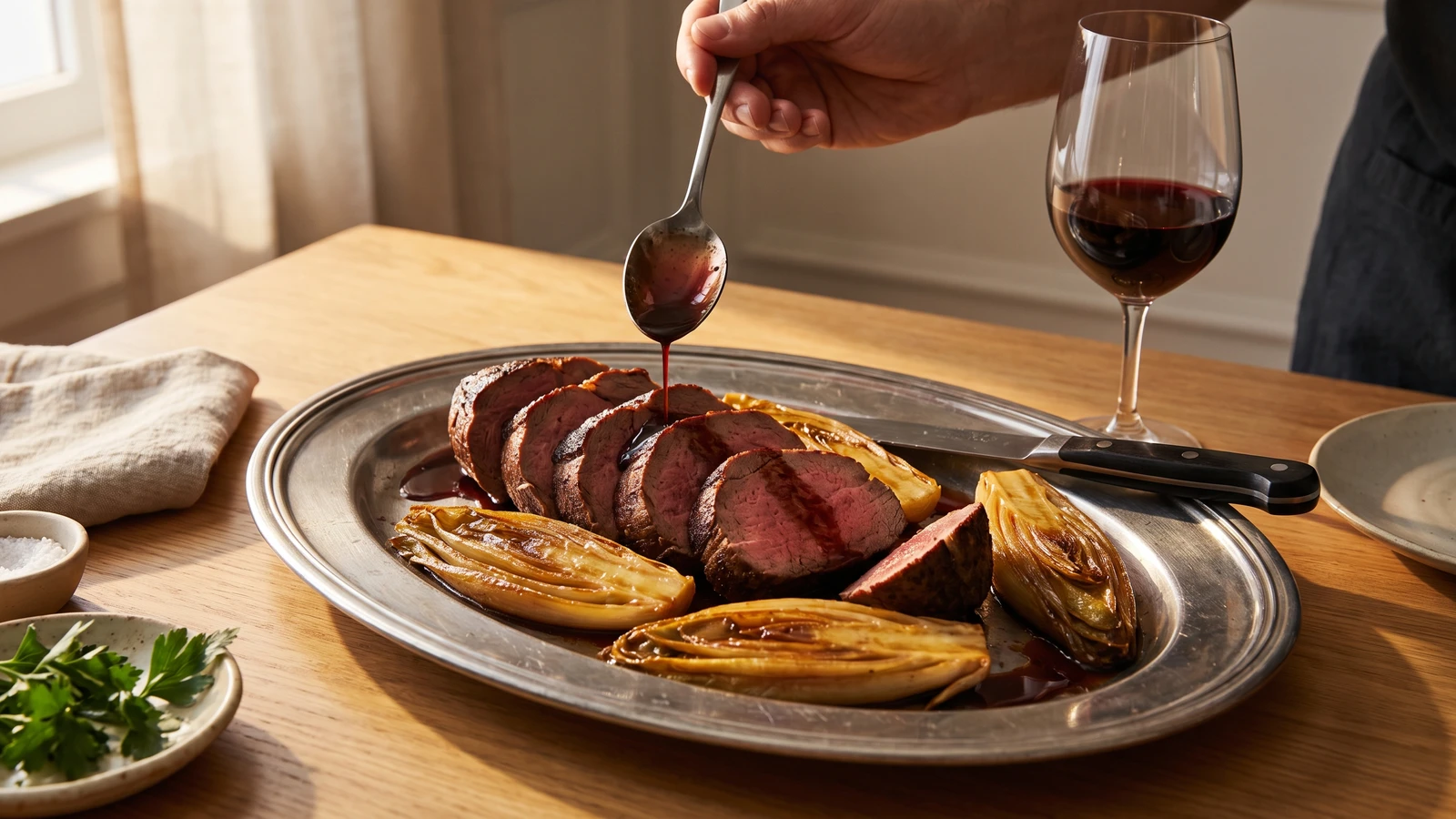
One tenderloin heart, three classical portions: roast Châteaubriand for carving, bifteck de filet for one, tournedos two to a plate, all with braised endives and a red-wine pan jus.
Châteaubriand, bifteck de filet et tournedos (a center-cut tenderloin roast, thick fillet steak, and small round medallions) teach one clean principle: the pan knows thickness, not title. All three come laterally from the thick heart of the fillet. Their tenderness is already given; your work is to build a dark crust without carrying the lean centre past the doneness you meant.
The old service assumed a grill cook handling Châteaubriand, a sauté cook watching the smaller cuts, a saucier with stock never off the fire, and a salamander ready to touch up a waiting garnish. At home, one heavy skillet, an oven, braised endives, and a reduction made from the beef's own fond do the same work. The separate station and last-minute broiler are brigade scaffolding, so they go. The deep sear, measured doneness, proper rest, and garnish adjusted to the size of the meat are the dish, so they stay. One cook, one stove, one evening.
Keep the biftecks 1½ inches thick, make the tournedos half their weight but nearly as thick, and keep the Châteaubriand large enough to carve. Then use a thermometer and pull the meat early. Tenderloin gives almost no warning between rosy and overdone, and that final temperature is the one step that matters most.
Châteaubriand belongs to Parisian grand-kitchen service, while bifteck de filet and tournedos describe portioning as much as separate dishes; all three come from the thick central fillet. The Parisian origin of the name Châteaubriand, and whether it first meant the cut or its full garnish, remains disputed, but the service logic endured: a large roast for carving, a steak for one, and small tied medallions for composed plates. As the cuts traveled to bistros and home tables, garnishes traveled freely among them, increased or rearranged to suit the meat rather than rewritten as new recipes.
Quantity
1 Châteaubriand, 24 to 28 oz (680 to 800 g); 4 biftecks de filet, 6 to 7 oz (170 to 200 g) each and 1½ inches (4 cm) thick; or 8 tournedos, 3 to 3½ oz (85 to 100 g) each and 1¼ inches (3 cm) thick
silver skin removed and tied as directed
Quantity
4 medium (about 24 oz / 680 g)
trimmed and halved lengthwise
Quantity
2 teaspoons (10 ml / 12 g)
divided
Quantity
1 teaspoon (5 ml / 2 g)
divided
Quantity
2 tablespoons (30 ml / 28 g)
divided
Quantity
8 tablespoons (120 ml / 113 g)
divided
Quantity
2 cloves
lightly crushed
Quantity
4 sprigs
Quantity
1 tablespoon (15 ml / 15 g)
Quantity
1 large (about 1½ oz / 40 g)
finely minced
Quantity
½ cup (120 ml / 120 g)
Quantity
1½ cups (360 ml / 360 g)
divided
Quantity
2 tablespoons (30 ml / 8 g)
finely chopped
| Ingredient | Quantity |
|---|---|
| center-cut beef tenderloin, choose one formatsilver skin removed and tied as directed | 1 Châteaubriand, 24 to 28 oz (680 to 800 g); 4 biftecks de filet, 6 to 7 oz (170 to 200 g) each and 1½ inches (4 cm) thick; or 8 tournedos, 3 to 3½ oz (85 to 100 g) each and 1¼ inches (3 cm) thick |
| Belgian endivestrimmed and halved lengthwise | 4 medium (about 24 oz / 680 g) |
| fine sea saltdivided | 2 teaspoons (10 ml / 12 g) |
| freshly ground black pepperdivided | 1 teaspoon (5 ml / 2 g) |
| neutral oildivided | 2 tablespoons (30 ml / 28 g) |
| cold unsalted butterdivided | 8 tablespoons (120 ml / 113 g) |
| garliclightly crushed | 2 cloves |
| thyme | 4 sprigs |
| fresh lemon juice | 1 tablespoon (15 ml / 15 g) |
| shallotfinely minced | 1 large (about 1½ oz / 40 g) |
| dry red wine | ½ cup (120 ml / 120 g) |
| unsalted or low-sodium beef stockdivided | 1½ cups (360 ml / 360 g) |
| flat-leaf parsley (optional)finely chopped | 2 tablespoons (30 ml / 8 g) |
Choose one beef format and keep the dimensions true. Tie the Châteaubriand at 1½-inch intervals to make an even cylinder; tie each tournedos around its circumference so it stays round, and tie a bifteck only if its shape is loose. Season the beef on every surface with about three-quarters of the salt and pepper. Leave it uncovered on a rack in the refrigerator while you begin the endives, then take it out about twenty minutes before cooking and blot it dry again.
Melt 1 tablespoon of the butter with 1 tablespoon of the oil in a wide sauté pan over medium heat. Lay in the endives cut-side down and let them become deep butter-gold, about 5 minutes. Turn them, add the remaining salt and pepper, 2 thyme sprigs, the lemon juice, and ½ cup of the stock. Cover and hold at a bare simmer for 20 to 25 minutes, until a knife enters the thick end easily. If the liquid disappears before they soften, add stock a spoonful at a time; if they darken too quickly, lower the heat. Ça se rattrape. Set them aside in their pan with the braising liquor.
Heat the oven to 425°F (220°C). Set a heavy oven-safe skillet over medium-high heat for several minutes, then add the remaining 1 tablespoon of oil. The oil should shimmer without smoking. Dry the beef once more before it meets the pan. A damp fillet cooks grey; a dry one builds the Maillard bronze that gives this mild cut its backbone.
Lay the beef in the skillet and leave it alone until the first surface releases cleanly. For Châteaubriand, brown the entire circumference in quarter turns for 6 to 8 minutes total, add 2 tablespoons of butter, the garlic, and the remaining thyme, baste well, then roast for 12 to 20 minutes. For biftecks, sauté 3 to 4 minutes on the first side and 2 to 3 minutes on the second, add the butter and aromatics, baste for 1 minute, then use the oven for another 2 to 6 minutes if needed. For tournedos, sauté 2½ to 3 minutes per face, baste briefly, and finish in the oven only if their centres remain too cool. For medium-rare, remove Châteaubriand at 122 to 125°F (50 to 52°C) and the smaller cuts at 125 to 128°F (52 to 53°C). If the crust is ready before the centre, move the beef to the oven immediately; the thermometer, not the clock, decides.
Transfer the beef to a warm platter or rack. Rest Châteaubriand for 12 to 15 minutes, biftecks for 8 to 10 minutes, and tournedos for 5 to 7 minutes, loosely covered. Meanwhile, uncover the endives and return them to medium heat. Add another 1 tablespoon of butter and turn them gently as their braising liquor reduces to a light glaze. If the pan dries before they shine, loosen it with a tablespoon of stock. Pour every resting juice from the beef into a cup for the sauce.
Pour excess fat from the beef skillet while preserving its brown fond. Add the shallot and sauté for 1 minute, then pour in the red wine and scrape the pan clean with a wooden spoon. Reduce the wine to about 2 tablespoons, add the remaining 1 cup of stock and the resting juices, then boil steadily until about ½ cup remains and the taste is concentrated but not salty. If any fond burned black, wipe those flecks away and build the reduction in a clean saucepan; the mahogany fond is flavour, the black fond is bitterness. Remove the pan from the heat and montez au beurre, mount the sauce with the remaining 4 tablespoons of cold butter, whisking in one piece at a time until glossy. If it splits, whisk 1 teaspoon of cold water in a clean pan, then add the broken sauce gradually. Ça se rattrape.
Remove every string. Carve Châteaubriand across the grain into thick slices and arrange it on a warm platter with the endives around it. Place one bifteck and two endive halves on each plate, or set two tournedos slightly overlapping with the same garnish beside them. The garnish remains the same; only its arrangement follows the meat, exactly as the classical formula intends. Spoon the pan jus beneath and around the beef so the crust stays proud, scatter the parsley over the endives, and serve at once. À table!
1 serving (about 330g)
Culinary guides, cultural storytelling, and the editorial depth that makes cooking meaningful.
Discover Culinary ExplorerChef Juliette
John Dory has the delicacy of sole and the firmness of turbot. A light flouring, a quick butter sauté, and nut-brown beurre noisette show exactly why looks never mattered.

Chef Juliette
Fresh haddock proves its delicacy in the meunière pan: a fine flour crust, moist pearly flakes, and beurre noisette sharpened with lemon and parsley, ready from one skillet in half an hour.

Chef Juliette
Éperlans à l’Anglaise turns small fish into a lesson in disciplined coating: boned smelts under a close, crisp crumb, pan-fried in clarified butter and finished with bright, half-melted maître d’hôtel butter.

Chef Juliette
Tiny smelts, shallot, mushrooms, white wine, gratin sauce, and fine bread raspings meet a fierce oven, where the fish must turn tender in the same breath the buttered crust bronzes.