
Chef Juliette
John Dory (St. Pierre)
John Dory has the delicacy of sole and the firmness of turbot. A light flouring, a quick butter sauté, and nut-brown beurre noisette show exactly why looks never mattered.
A cooking platform built around craft, culture, and the stories behind what we eat.
Created by Chef Juliette
Based on No. 1073, Filet de Bœuf Saint-Germain, from Le Guide Culinaire (1907) by Auguste Escoffier
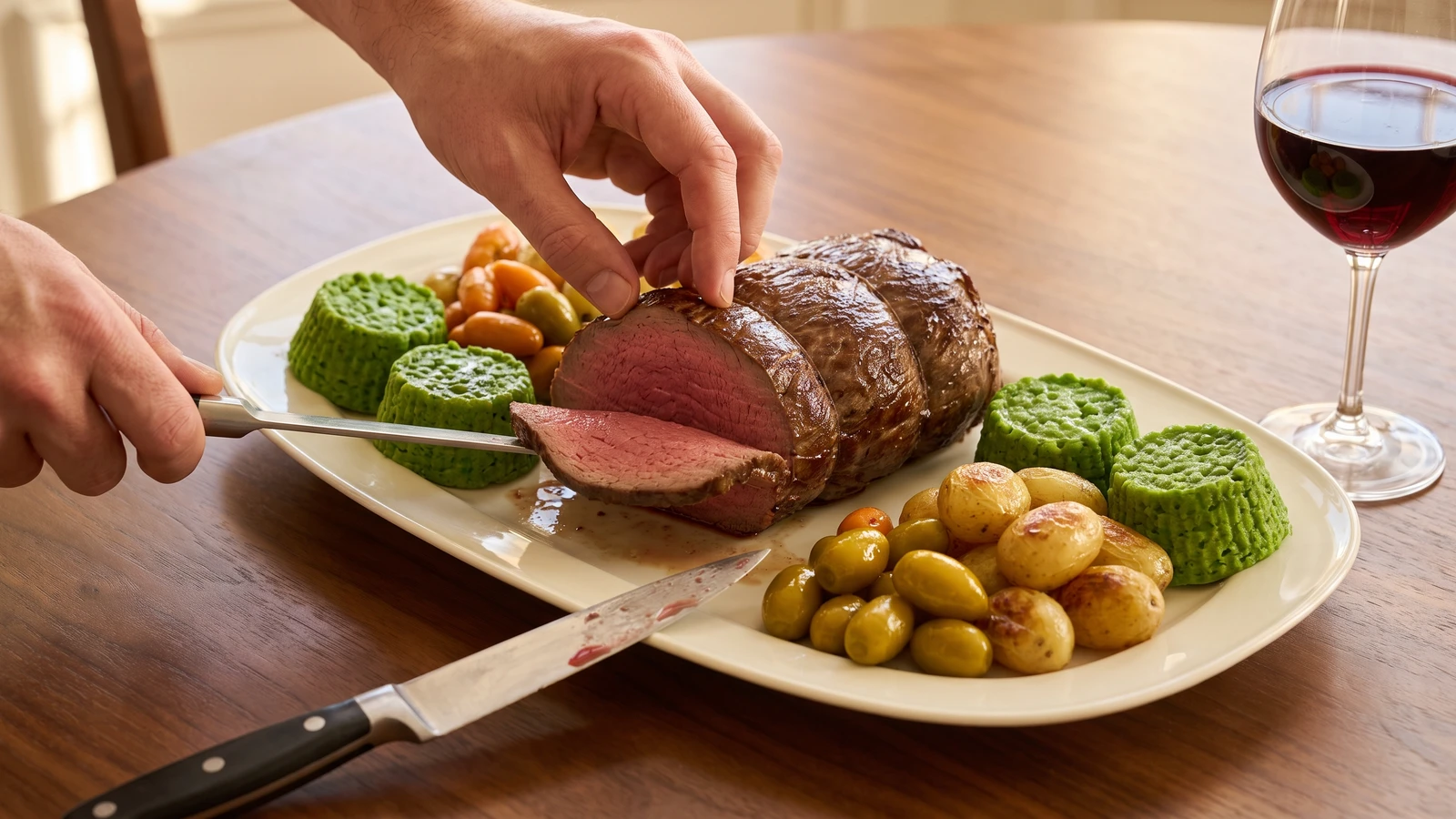
Filet de Bœuf Saint-Germain sets a rosy roast among bright pea timbales, glazed carrots, and buttered potatoes, a lesson in timing three garnishes so each reaches the platter at its best.
Filet de Bœuf Saint-Germain (roasted beef fillet with pea timbales) teaches coordination. The fillet can rest, but a bright pea timbale cannot wait under heat. Before touching a pan, know the order: bring the roast out first, then use its resting time to finish the glazed carrots, brown the potatoes, and unmould the timbales.
The original kitchen assumed a larding needle, dariole moulds, a long platter, and separate hands for the roast and its three garnishes. Unlike many neighboring dishes in the canon, it calls for no saucier, perpetual stockpot, or salamander, so we don't invent them. A narrow skewer replaces the larding needle, small ramekins replace the dariole moulds, and a thermometer gives one cook the margin once supplied by several. The brigade portion becomes a 2-pound center-cut fillet for four. Multiple hands were scaffolding; larding the beef, keeping the pea purée green, and preserving the composed garnish are the dish.
The finished platter should be generous and unmistakable: rosy beef and Maillard bronze at the center, lacquered carrots at the ends, butter-gold potatoes, then two clean rows of green timbales. One cook, one stove, one evening. Time the timbales last, because once they leave their moulds, the dish goes straight to the table.
Filet de Bœuf Saint-Germain belongs to the composed-garnish vocabulary of the Parisian grand kitchen, where Saint-Germain became shorthand for peas, as it does in the soup and purées bearing the same name. The title does not claim that the beef itself comes from Saint-Germain; it identifies the accompaniment, green pea timbales joined by glazed carrots and buttered potatoes. The arrangement passed readily to bourgeois celebration tables because its ceremony comes from careful shaping and timing, not rare ingredients.
Quantity
1 roast (2 lb / 900 g)
trimmed
Quantity
1/3 cup (80 ml / 60 g)
cut into 8 narrow batons and thoroughly chilled
Quantity
8 tablespoons (120 ml / 113 g)
divided
Quantity
3 teaspoons (15 ml / 18 g)
divided
Quantity
1 teaspoon (5 ml / 2 g)
Quantity
5 medium, about 4 cups (950 ml / 570 g)
peeled and turned into olive shapes
Quantity
2 teaspoons (10 ml / 8 g)
Quantity
1 1/2 cups (360 ml / 360 g)
divided
Quantity
24, about 3 cups (710 ml / 500 g)
peeled
Quantity
6 small timbales, about 2 cups (475 ml / 450 g), Moulded Pease Purée for Garnish (No. 2196)
finished and held in their moulds
| Ingredient | Quantity |
|---|---|
| center-cut beef fillet roasttrimmed | 1 roast (2 lb / 900 g) |
| unsmoked pork fatbackcut into 8 narrow batons and thoroughly chilled | 1/3 cup (80 ml / 60 g) |
| unsalted butterdivided | 8 tablespoons (120 ml / 113 g) |
| fine sea saltdivided | 3 teaspoons (15 ml / 18 g) |
| freshly ground black pepper | 1 teaspoon (5 ml / 2 g) |
| carrotspeeled and turned into olive shapes | 5 medium, about 4 cups (950 ml / 570 g) |
| granulated sugar | 2 teaspoons (10 ml / 8 g) |
| waterdivided | 1 1/2 cups (360 ml / 360 g) |
| very small waxy potatoespeeled | 24, about 3 cups (710 ml / 500 g) |
| Moulded Pease Purée for Garnishfinished and held in their moulds | 6 small timbales, about 2 cups (475 ml / 450 g), Moulded Pease Purée for Garnish (No. 2196) |
Remove the beef from the cold 45 minutes before roasting and heat the oven to 425°F (220°C). Have the finished Moulded Pease Purée for Garnish (No. 2196) prepared in six small moulds according to its own entry. Shape the vegetables, measure the butter into three portions, and set out the long platter now. Once the beef begins roasting, the garnishes must move in order.
Use a narrow metal skewer or sharp paring knife to make eight channels through the beef, running parallel to its length. Push a chilled baton of fatback into each channel, distributing them evenly through the roast. If the fat softens and buckles, stop and chill it again for five minutes. Ça se rattrape. Tie the fillet at 1 1/2-inch (4 cm) intervals so it forms an even cylinder, then season it with 1 1/2 teaspoons of the salt and all the pepper.
Put the potatoes in a sauté pan with 4 tablespoons of the butter, 3/4 cup (180 ml) of the water, and 1/2 teaspoon of the salt. Cover and hold them at a gentle simmer, rolling them occasionally, for 12 to 15 minutes. They should be nearly tender when pierced but still pale. Remove the lid and let the water cook away, then take the pan off the heat once only butter remains. The final browning comes later, so the potatoes reach the platter hot.
Heat a heavy oven-safe skillet over medium-high heat and add 2 tablespoons of the butter. When the foam subsides, brown the fillet on every side, including the ends, for 6 to 8 minutes. Put the skillet in the oven and roast for 12 to 18 minutes, basting once, until the center registers 120 to 125°F (49 to 52°C) for medium-rare or 135°F (57°C) for medium. If the butter turns black and smells bitter, transfer the beef to a clean pan with fresh butter before it goes into the oven. Burned butter needn't follow the roast. Rest the beef loosely covered for 15 minutes; carryover heat will raise its center several degrees.
While the beef roasts, arrange the olive-shaped carrots in a single layer in a wide pan. Add 2 tablespoons of the butter, the sugar, 1/2 teaspoon of the salt, and the remaining 3/4 cup (180 ml) water. Cover with a lid set slightly ajar and simmer gently for 12 to 18 minutes, until the carrots are tender but still hold their precise shape. Uncover and roll them through the reducing liquid until each carrot wears a clear butter glaze. If the pan dries before they are tender, add water one tablespoon at a time; if they are tender while liquid remains, lift them out, reduce the glaze, and return them briefly.
Return the potato pan to medium heat while the beef rests. Roll the potatoes through their butter for 5 to 7 minutes, until their rounded surfaces are evenly golden and the centers are tender. Season with another 1/4 teaspoon of salt. If the butter colors faster than the potatoes, lower the heat and add a spoonful of water; the butter will settle, and the potatoes can finish without acquiring a bitter crust.
While the beef rests, lower the oven to 325°F (160°C). If the finished Moulded Pease Purée for Garnish (No. 2196) has been chilled, stand the moulds in a shallow pan of hot water, cover loosely, and warm them for 8 to 12 minutes, just until hot at the center. Remove them from the water immediately, because prolonged heat dulls the green and tightens the eggs. Loosen only the upper rim, invert each mould, and lift it straight up. If one clings, dip its base in hot water for five seconds and invert it again. Do not pry at the sides.
Warm the long platter with hot water and dry it well. Remove the string from the fillet and set the roast lengthwise in the center, spooning its resting juices over the browned surface. Make a generous heap of glazed carrots at each end, then place a heap of buttered potatoes on either side of each carrot group. Arrange three green timbales in a row along each long side of the fillet. Carry it whole to the table and carve there. À table!
1 serving (about 585g)
Culinary guides, cultural storytelling, and the editorial depth that makes cooking meaningful.
Discover Culinary ExplorerChef Juliette
John Dory has the delicacy of sole and the firmness of turbot. A light flouring, a quick butter sauté, and nut-brown beurre noisette show exactly why looks never mattered.

Chef Juliette
Fresh haddock proves its delicacy in the meunière pan: a fine flour crust, moist pearly flakes, and beurre noisette sharpened with lemon and parsley, ready from one skillet in half an hour.

Chef Juliette
Éperlans à l’Anglaise turns small fish into a lesson in disciplined coating: boned smelts under a close, crisp crumb, pan-fried in clarified butter and finished with bright, half-melted maître d’hôtel butter.

Chef Juliette
Tiny smelts, shallot, mushrooms, white wine, gratin sauce, and fine bread raspings meet a fierce oven, where the fish must turn tender in the same breath the buttered crust bronzes.