Culinary Explorer

A cooking platform built around craft, culture, and the stories behind what we eat.
Discover Culinary Explorer
Filet de Bœuf Portugaise

Filet de Bœuf Portugaise

Created by Chef Juliette

Based on No. 1067, Filet de Bœuf Portugaise, from Le Guide Culinaire (1907) by Auguste Escoffier

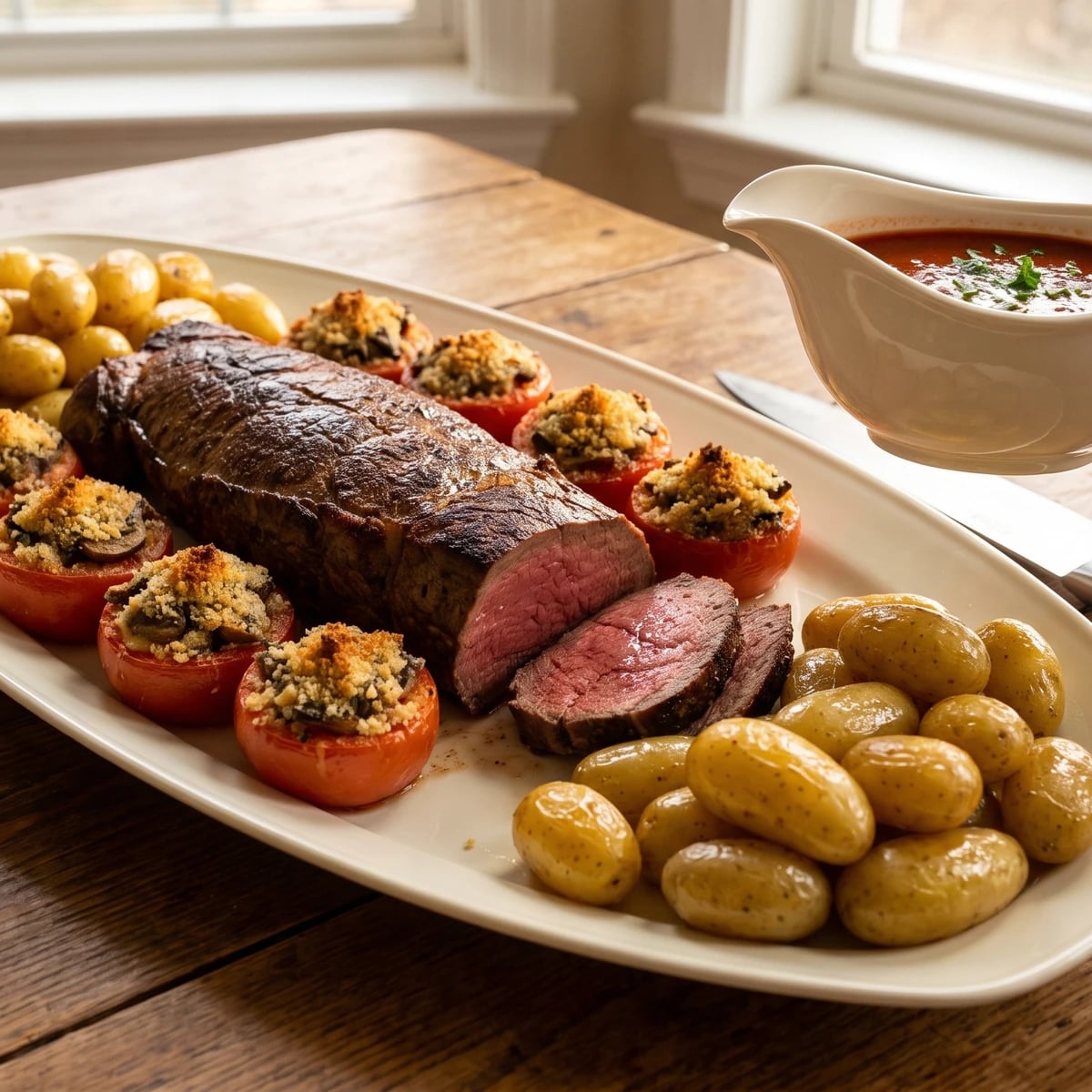
A whole beef fillet, larded and roasted rosy, arrives between rows of stuffed tomatoes and heaps of buttered olive potatoes, with a light Sauce Portugaise passed at the table.

Main Dishes
French
Dinner Party
Special Occasion
55 min
Active Time
1 hr 20 min cook2 hr 30 min total
Yield4 servings

Filet de Bœuf Portugaise (beef fillet with tomato garnish) teaches composition. Tomato must run through the entire service, not appear as a red afterthought: the fillet stays simple, the stuffed tomatoes frame it, and Sauce Portugaise brings tomato, onion, garlic, and parsley together beside it. The one true thing to know before touching a pan is timing. Tenderloin won't wait politely while you finish three garnishes.

The original entry assumed a brigade-sized fillet, a larding needle, a saucier on staff, stock never off the fire, another pair of hands turning potatoes, and a salamander ready to brown the tomatoes. For four, a 2-pound center-cut fillet, fully cured fatback threaded with a narrow knife, good unsalted stock, one saucepan, and the home broiler perform those jobs honestly. What's changed is quantity and choreography, because one pair of hands must manage the service. The brigade staging is scaffolding and goes; larding and roasting the whole fillet, stuffed tomatoes in two rows, olive-shaped potatoes cooked in butter, and a light sauce passed separately are the dish and stay.

When it lands correctly, the platter is generous and unmistakable: bronze-crusted beef with a rosy center, tomatoes still holding their shape beneath browned mushroom crowns, and potatoes gleaming with butter at either end. One cook, one stove, one evening. Before the fillet meets heat, have the tomatoes filled, the potatoes turned, and the Sauce Portugaise reduced. That mise en place decides the evening.

Filet de Bœuf Portugaise belongs to the Parisian grand-kitchen repertory, where à la Portugaise is French culinary shorthand for a garnish led by tomato, commonly joined by onion, garlic, and parsley. It is not a record of a Portuguese household roast; the name reflects the classical French practice of giving geographic names to recognizable garnish families. The composed fillet passed naturally into cuisine bourgeoise, where a whole tender cut, symmetrical vegetables, and sauce served separately made a handsome special-occasion platter.

The technique, the tradition, and the story behind every dish.

Discover Culinary Explorer

Ingredients

center-cut beef tenderloin roast

Quantity

1 roast (2 lb / 900 g)

trimmed of silverskin

fully cured, ready-to-eat fatback

Quantity

6 batons (2 oz / 55 g)

chilled and cut about ¼ inch (6 mm) thick

small ripe tomatoes

Quantity

8 (2 lb / 900 g total)

medium brown mushrooms

Quantity

about 20 (8 oz / 225 g)

very finely chopped

large shallots

Quantity

2 (2½ oz / 70 g)

finely chopped

medium yellow onion

Quantity

1 (5 oz / 140 g)

finely chopped

garlic

Quantity

3 cloves

finely chopped and divided

fresh fine breadcrumbs

Quantity

½ cup (120 ml / 50 g)

good canned whole peeled tomatoes

Quantity

1 cup (240 ml / 230 g)

crushed by hand

tomato paste

Quantity

1 tablespoon (15 ml / 18 g)

unsalted beef stock

Quantity

1¼ cups (300 ml / 300 g)

divided

medium Yukon Gold potatoes

Quantity

8 (2 lb / 900 g total)

water

Quantity

½ cup (120 ml / 120 g)

for the potatoes

flat-leaf parsley

Quantity

5 tablespoons (75 ml / 19 g)

finely chopped and divided

unsalted butter

Quantity

12 tablespoons (180 ml / 170 g)

divided

fine sea salt

Quantity

1 tablespoon (15 ml / 18 g)

divided

freshly ground black pepper

Quantity

1 teaspoon (5 ml / 2 g)

divided

Equipment Needed

  • Narrow boning knife and slim chopstick for larding
  • Kitchen twine
  • 12-inch (30 cm) heavy ovenproof skillet
  • 2-quart (2-liter) saucepan
  • Large sauté pan with lid
  • Rimmed baking sheet or shallow baking dish
  • Instant-read thermometer
  • Long warmed serving platter and sauceboat

Instructions

  1. 1

    Lard and tie fillet

    Keep the fatback very cold so it stays rigid. With a clean, narrow boning knife, make six slim channels lengthwise through the cold fillet, working from alternating ends so the meat isn't split along one line. Push a fatback baton into each channel with the back of a slim chopstick. This replaces the larding needle without changing what larding does: the lean fillet receives small seams of fat from within. Tie the roast at 1½-inch (4 cm) intervals, season it with 1½ teaspoons of the salt and ½ teaspoon of the pepper, and let it stand for 30 to 40 minutes.

    Use only fully cured fatback labeled ready to eat. Raw salt pork pushed into a fillet is not suitable when the beef will be served rosy.
  2. 2

    Hollow the tomatoes

    Cut a shallow lid from each tomato and scoop out the seeds and pulp without piercing the walls. Reserve the pulp and juice for the sauce. Sprinkle the tomato interiors with ½ teaspoon of the salt, then invert them on a rack for 15 minutes. This draining matters: an undrained tomato floods its stuffing and collapses before it reaches the platter.

  3. 3

    Build Sauce Portugaise

    Melt 2 tablespoons of the butter in a 2-quart saucepan over medium-low heat. Add the onion and cook for 8 minutes until soft and translucent, with no browning. Add two-thirds of the garlic and the tomato paste, then stir for 1 minute until the paste darkens slightly. Add the canned tomatoes, the reserved fresh tomato pulp and juice, 1 cup of the stock, ¼ teaspoon of the salt, and ¼ teaspoon of the pepper. Simmer uncovered for 25 to 35 minutes, stirring occasionally, until the Sauce Portugaise is bright, pourable, and just thick enough to coat a spoon lightly. If it tightens too far, loosen it with a spoonful of stock. If the bottom catches, don't scrape it: transfer the clean sauce above it to another pan and leave the scorched layer behind. Ça se rattrape. Hold the sauce off the heat.

  4. 4

    Cook the duxelles

    Melt 2 tablespoons of the butter in a wide pan over medium-high heat. Add the shallots, mushrooms, remaining garlic, ¼ teaspoon of the salt, and ¼ teaspoon of the pepper. Cook, stirring often, until the mushrooms have released their water and the pan is nearly dry, 10 to 12 minutes. This is the duxelles, a finely chopped mushroom filling, and dryness is the test, not the clock. If it still glistens with mushroom liquor, keep cooking. Fold in the breadcrumbs and 3 tablespoons of the parsley, then cool for 5 minutes. Fill the drained tomatoes generously, mounding the duxelles above their rims.

  5. 5

    Turn the potatoes

    Heat the oven to 425°F (220°C), with one rack in the center and another near the top. Peel the potatoes, halve them lengthwise, and tourner them, trimming each half into a smooth long olive with gently tapered ends. Aim for 16 pieces of similar thickness so they cook together; seven perfect sides are less important than equal size. Keep the turned potatoes in cold water while the oven heats, then drain and dry them thoroughly. Save the trimmings for soup or mash. Cooking well is not cooking fancy, but the olive shape belongs to this platter and earns its place.

  6. 6

    Roast fillet and tomatoes

    Melt 3 tablespoons of the butter gently in a 12-inch ovenproof skillet, then pour the clear butterfat into a small bowl, leaving the milky solids behind. Heat the clarified butterfat over medium-high heat. Add the fillet and brown it on every broad surface, about 2 minutes per side, until a deep Maillard bronze crust forms. Transfer the skillet to the center oven rack. Set the stuffed tomatoes upright on a rimmed baking sheet and place them on the upper rack. Roast the tomatoes for 18 to 22 minutes, until tender but still standing. Roast the beef until its center reaches 138 to 140°F (59 to 60°C), usually 18 to 25 minutes after searing; a 15-minute rest should carry it close to 145°F (63°C) while leaving the center rosy. If the tomato stuffing browns before the tomato walls soften, shield the tops loosely with foil.

  7. 7

    Butter-cook the potatoes

    As soon as the beef enters the oven, melt 4 tablespoons of the butter in a wide sauté pan over medium heat. Add the dried potatoes and roll them through the butter until their surfaces begin to turn gold, about 6 minutes. Add the measured water and remaining ½ teaspoon salt, cover, and cook gently for 10 to 12 minutes. Uncover and continue rolling the potatoes as the water evaporates and the butter reappears, until they are tender inside and evenly butter-gold outside. If they color before the centers yield to a knife, add another spoonful of water and cover for 3 minutes. Ça se rattrape.

  8. 8

    Finish sauce and platter

    Move the fillet to a board and rest it loosely covered for 15 minutes. Set its skillet over medium heat, add the remaining ¼ cup stock, and scrape up the fond, the browned film left by the roast. Reduce by half, then strain this concentrated juice into the Sauce Portugaise and return the sauce to a bare simmer. Take it off the heat and monter au beurre, whisking in the remaining 1 tablespoon cold butter, then add the remaining 2 tablespoons parsley. If the sauce looks greasy rather than glossy, whisk in a teaspoon of cold stock and it will come together. Taste for salt and keep it light enough to pour. Remove the strings from the fillet and set it whole on a warm long platter, cutting two or three slices from one end to show the rosy center. Arrange four stuffed tomatoes in a row along each side and pile the buttered olive potatoes at both ends, exactly as the entry intends. Pour the Sauce Portugaise into a warm sauceboat and pass it separately. À table!

Chef Tips

  • Ask the butcher for a center-cut tenderloin of even thickness and a small piece of fully cured, ready-to-eat fatback. Chilled fat threads cleanly; soft fat smears in the channel and makes the work unnecessarily difficult.
  • A thermometer is the fillet's insurance. Tenderloin contains little connective tissue, so extra cooking won't make it more tender; it only drives out moisture. Measure through the side into the true center.
  • Good canned tomatoes are the honest choice when fresh tomatoes lack perfume. Use the fresh ones for the stuffed garnish, where their shape matters, and let preserved tomatoes give the sauce its dependable depth.
  • The potato trimmings are useful food, not waste. Keep them under cold water, then simmer them for mash, bind a soup with them, or brown them beside tomorrow's eggs.
  • Serve a medium-bodied Cabernet Franc from the Loire or a restrained Cabernet-led Bordeaux. The wine needs enough freshness for the tomatoes and enough structure for the beef, but no great weight.

Advance Preparation

  • The Sauce Portugaise base can be cooked up to 2 days ahead, cooled promptly, and refrigerated. Reheat it gently, then add the roast's fond, cold butter, and parsley only at service.
  • The duxelles can be made 1 day ahead. The tomatoes may be hollowed and filled up to 4 hours before cooking; refrigerate them, then let them lose their chill while the beef is prepared.
  • The fillet can be larded, tied, and seasoned up to 12 hours ahead. Keep it covered in the refrigerator and bring it out 40 minutes before searing.
  • The potatoes can be turned up to 4 hours ahead and held under cold water. Drain and dry them thoroughly before they meet the butter, because wet potatoes spit and refuse to brown.

Frequently Asked Questions

Nutrition Information

1 serving (about 720g)

Calories
1035 calories
Total Fat
57 g
Saturated Fat
29 g
Trans Fat
2 g
Unsaturated Fat
26 g
Cholesterol
210 mg
Sodium
2540 mg
Total Carbohydrates
67 g
Dietary Fiber
11 g
Sugars
15 g
Protein
63 g

Note: Chef personas and recipes are created with AI assistance. Cook with care: follow safe food-handling practices, check doneness with a thermometer when needed, and adapt for allergies and your kitchen.

Where cooking meets culture.

Culinary guides, cultural storytelling, and the editorial depth that makes cooking meaningful.

Discover Culinary Explorer

More from Relevés and Entrées - BEEF

Browse the full collection