
Chef Juliette
John Dory (St. Pierre)
John Dory has the delicacy of sole and the firmness of turbot. A light flouring, a quick butter sauté, and nut-brown beurre noisette show exactly why looks never mattered.
A cooking platform built around craft, culture, and the stories behind what we eat.
Created by Chef Juliette
Based on No. 1059, Filet de Bœuf Macédoine, from Le Guide Culinaire (1907) by Auguste Escoffier
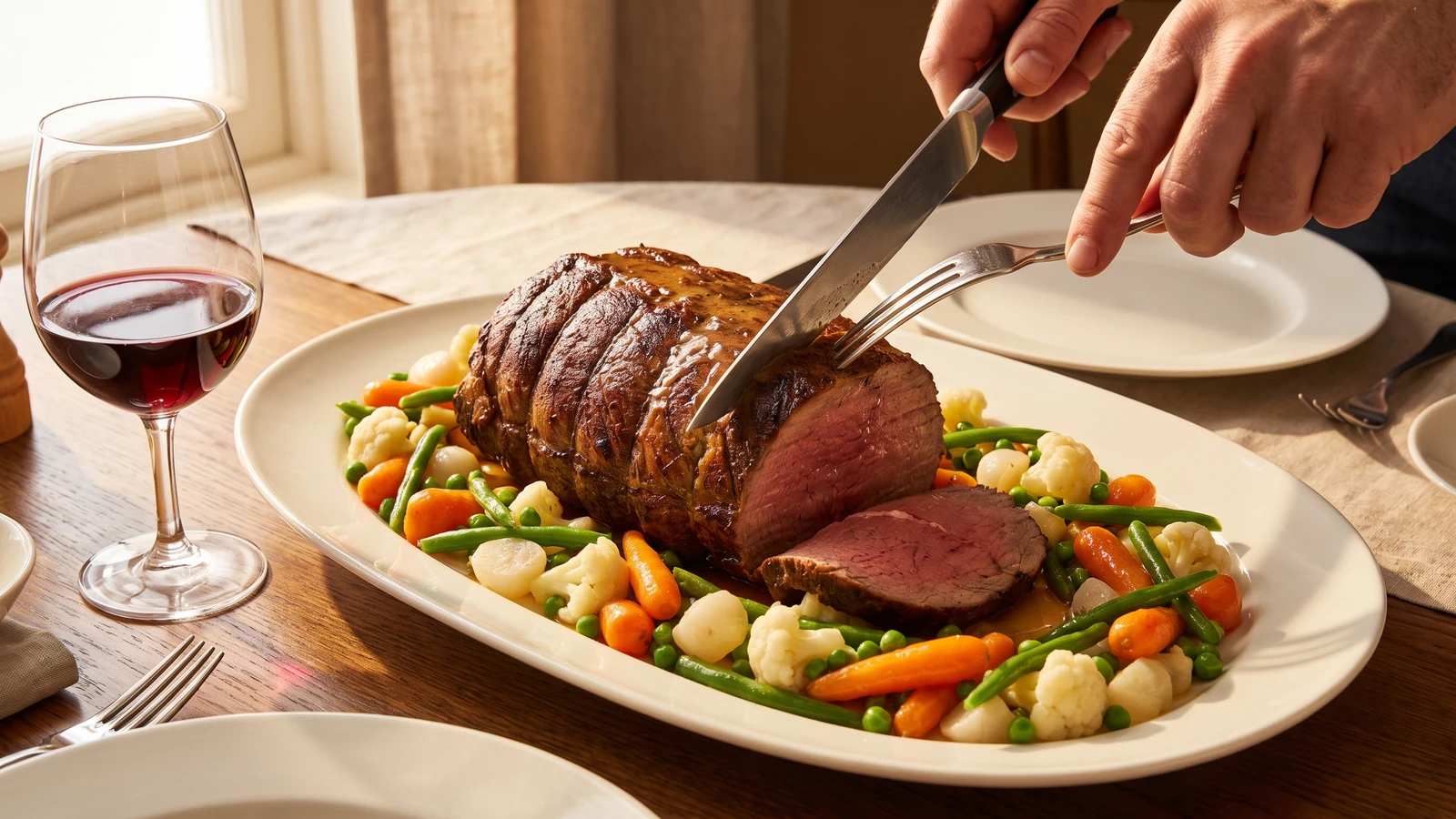
A bronzed beef fillet ringed with carrots, turnips, beans, cauliflower, and peas, each cooked to itself, then mingled in butter: the classical lesson that one garnish becomes another through cut and assembly.
Filet de Bœuf Macédoine (roasted beef fillet with small mixed vegetables bound in butter) teaches that a garnish is technique, not decoration. The one true thing to know before touching a pan is this: Macédoine uses the Jardinière's vegetables, but cuts them small, cooks each to its proper tenderness, and mingles them in butter instead of displaying them in separate heaps. Same ingredients, different grammar.
The brigade entry assumed a roast cook and vegetable cook working in parallel, with a saucier on staff, stock never off the fire, and a salamander within reach. For this preparation, those are scaffolding. Your honest equivalents are an instant-read thermometer, one saucepan used successively for the vegetables, and the roasting skillet's own fond loosened into a light jus. What cannot go is the separate cooking of the vegetables or their final binding with real butter. One cook, one stove, one evening.
At the table, the fillet should be deeply bronzed outside and rosy within, with a shining ring of vegetables that still taste distinctly of carrot, turnip, bean, cauliflower, and pea. Cut the Macédoine evenly before the heat begins. That small, regular cut is the step that decides the dish.
Filet de Bœuf Macédoine belongs to the formal Parisian dining room and the classical French garnish system, where cut and arrangement could give the same market vegetables a different name and purpose. Its relationship to Jardinière is the point: Jardinière presents the vegetables in distinct groups, while Macédoine cuts them small, mingles them, and binds them with butter. Macédoine describes a method rather than a fixed regional larder, so the seasonal vegetables may shift while the even cut and mixed presentation remain.
Quantity
1 roast, about 1¾ pounds (800 g)
trimmed and tied at 1½-inch intervals
Quantity
1 tablespoon plus 1½ teaspoons (22 ml / 27 g)
divided
Quantity
1 teaspoon (5 ml / 2 g)
divided
Quantity
2 tablespoons (30 ml / 28 g)
Quantity
¾ cup (180 ml / 100 g)
peeled and cut into ¼-inch dice
Quantity
¾ cup (180 ml / 115 g)
peeled and cut into ¼-inch dice
Quantity
¾ cup (180 ml / 90 g)
trimmed and cut into ¼-inch pieces
Quantity
1 cup (240 ml / 100 g)
divided into very small even florets
Quantity
¾ cup (180 ml / 100 g)
Quantity
4 tablespoons (60 ml / 57 g)
divided and cut into pieces
Quantity
⅓ cup (80 ml / 80 g)
divided and used as needed
| Ingredient | Quantity |
|---|---|
| center-cut beef tenderloin roasttrimmed and tied at 1½-inch intervals | 1 roast, about 1¾ pounds (800 g) |
| fine sea saltdivided | 1 tablespoon plus 1½ teaspoons (22 ml / 27 g) |
| freshly ground black pepperdivided | 1 teaspoon (5 ml / 2 g) |
| clarified butter | 2 tablespoons (30 ml / 28 g) |
| carrotspeeled and cut into ¼-inch dice | ¾ cup (180 ml / 100 g) |
| small white turnippeeled and cut into ¼-inch dice | ¾ cup (180 ml / 115 g) |
| fine green beanstrimmed and cut into ¼-inch pieces | ¾ cup (180 ml / 90 g) |
| cauliflowerdivided into very small even florets | 1 cup (240 ml / 100 g) |
| fresh or frozen peas | ¾ cup (180 ml / 100 g) |
| cold unsalted butterdivided and cut into pieces | 4 tablespoons (60 ml / 57 g) |
| hot waterdivided and used as needed | ⅓ cup (80 ml / 80 g) |
Pat the tenderloin completely dry. Season it all over with 1 teaspoon (5 ml / 6 g) of the salt and ¾ teaspoon (4 ml / 1.5 g) of the pepper, then leave it at room temperature for 40 minutes. Heat the oven to 425°F (220°C) and set a long serving platter somewhere warm. The tying should make the roast an even cylinder; tuck a thin tail underneath before tying so it does not overcook while the center remains raw.
Prepare the carrots and turnip in true ¼-inch dice, then cut the beans to the same visual scale and divide the cauliflower into equally small florets. The peas remain whole and show you how large every other piece should be. Regularity matters because uneven pieces cannot reach tenderness together; this cut is the dish, not decoration.
Bring a large saucepan of water to a rolling boil and season it with 1 tablespoon (15 ml / 18 g) of the salt. Set a bowl of ice water beside the stove. Cook each vegetable separately in the same boiling water: carrots for 3 to 4 minutes, turnips for about 3 minutes, cauliflower for 2 to 3 minutes, beans for 2 minutes, and peas for 30 seconds if frozen or 1 minute if fresh. Lift each out as soon as it is just tender, cool it in the ice water, then drain it thoroughly on clean towels. If one vegetable softens too far, spread it out at once and add it only for the final 30 seconds of reheating; it will not regain its bite, but it need not collapse into the others.
Heat the clarified butter in a 12-inch ovenproof skillet over medium-high heat until it glistens. Blot the beef once more, then brown it on every side, allowing about 90 seconds per broad surface and turning with tongs rather than piercing it. Transfer the skillet to the oven and roast until the center registers 122 to 125°F (50 to 52°C) for medium-rare or 130 to 135°F (54 to 57°C) for medium, usually 15 to 22 minutes. Begin checking early. A thermometer replaces the brigade cook's practiced touch, and there is no rescue for an overdone fillet.
Move the beef to a board and rest it loosely covered for 12 minutes; a tight foil wrapping softens the crust. Carefully pour away any excess fat from the skillet while leaving the brown fond behind. Set the skillet over medium heat, add ¼ cup (60 ml / 60 g) of the hot water, and scrape until the fond dissolves. Reduce to about 2 tablespoons, add any juices released by the resting beef, then take the pan off the heat and swirl in 1 tablespoon (15 ml / 14 g) of the cold butter. Keep this light jus warm without boiling.
Dry the emptied vegetable saucepan and melt the remaining 3 tablespoons (45 ml / 43 g) of butter over medium-low heat. Add all the drained vegetables and the remaining pepper, then turn them gently for 2 to 3 minutes until hot, mingled, and coated with a bright butter sheen. Taste before adding the remaining ½ teaspoon (2 ml / 3 g) of salt, since the blanching water has already seasoned them. If the butter separates and pools beneath the vegetables, add 1 teaspoon of the remaining hot water and shake the pan until the butter clings again. Ça se rattrape. The finished Macédoine should be bound, never wet or mashed.
Remove the strings and set the fillet lengthwise on the warmed platter, whole as the source intends. Spoon the Macédoine generously around it in one continuous, mingled border rather than separate vegetable heaps. Coat the beef lightly with the jus, carve it into thick slices at the table, and serve the remaining jus alongside. À table!
1 serving (about 310g)
Culinary guides, cultural storytelling, and the editorial depth that makes cooking meaningful.
Discover Culinary ExplorerChef Juliette
John Dory has the delicacy of sole and the firmness of turbot. A light flouring, a quick butter sauté, and nut-brown beurre noisette show exactly why looks never mattered.

Chef Juliette
Fresh haddock proves its delicacy in the meunière pan: a fine flour crust, moist pearly flakes, and beurre noisette sharpened with lemon and parsley, ready from one skillet in half an hour.

Chef Juliette
Éperlans à l’Anglaise turns small fish into a lesson in disciplined coating: boned smelts under a close, crisp crumb, pan-fried in clarified butter and finished with bright, half-melted maître d’hôtel butter.

Chef Juliette
Tiny smelts, shallot, mushrooms, white wine, gratin sauce, and fine bread raspings meet a fierce oven, where the fish must turn tender in the same breath the buttered crust bronzes.