Culinary Explorer
A cooking platform built around craft, culture, and the stories behind what we eat.
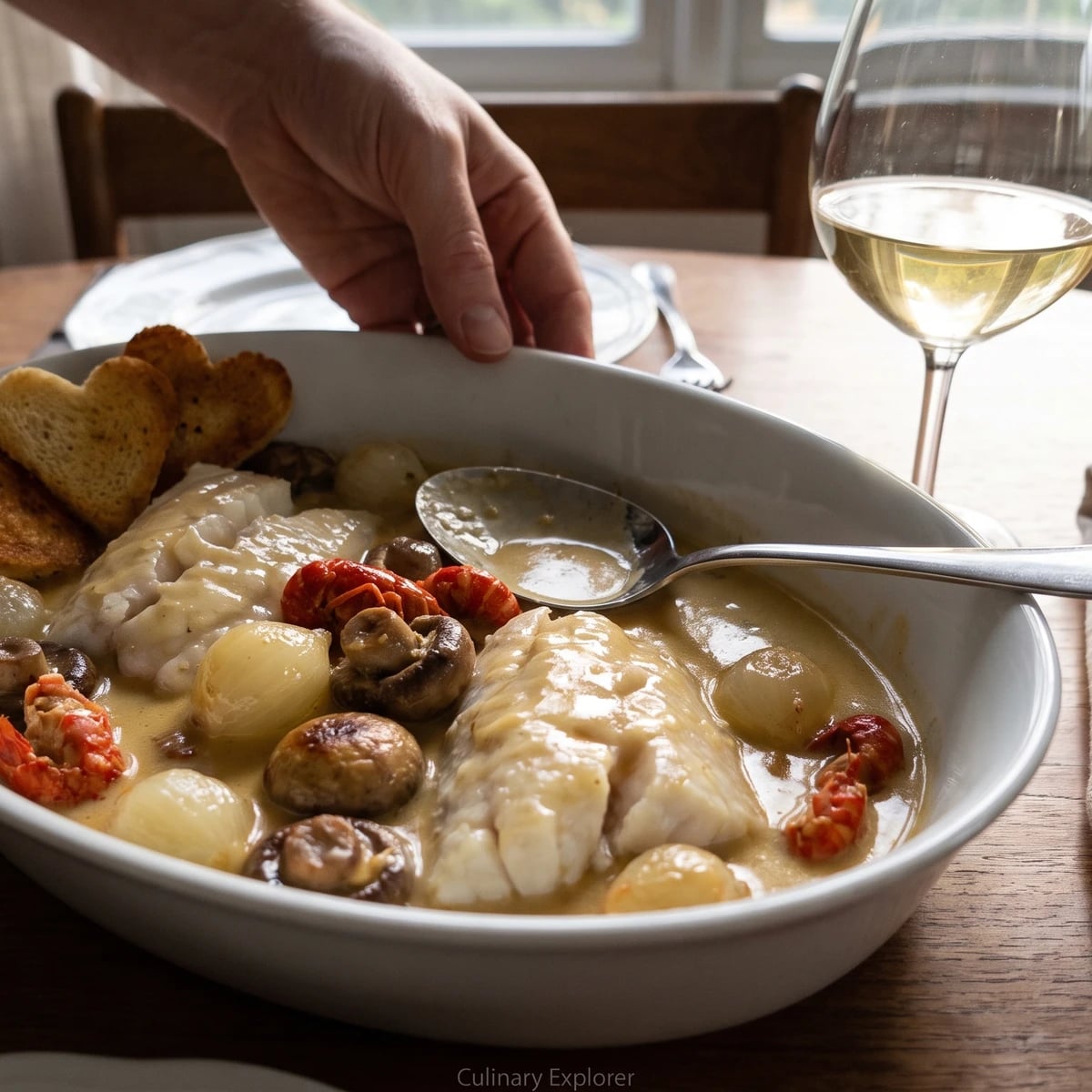
Matelote au Vin Blanc
Created by Chef Juliette
Fish poached gently in white wine, its liquor reduced and joined with fish velouté, then mounted with butter and ringed by crayfish and heart croûtons: company cooking built on control, not fuss.
Matelote au Vin Blanc (mixed fish poached in white wine) teaches one essential discipline: the fish and its sauce run on separate clocks. Lift each piece the moment it is barely cooked, then reduce the liquor without it. Leave the fish in while the wine concentrates and you will have a splendid sauce surrounding dry fish, which is a rather expensive way to learn patience.
The original kitchen assumed mixed river fish arriving whole, fish velouté waiting beside a stockpot that never went cold, a saucier watching the reduction, and other hands cooking onions, mushrooms, crayfish, and croûtons. Here, evenly cut boneless fish replaces an awkward assortment of bony pieces, and the cooked fish waits directly in a warmed deep serving dish instead of passing through another saucepan and a timbale. That extra holding pan was brigade scaffolding. The reduction to a little less than half, the fish velouté, the cold-butter finish, and the ring of crayfish and heart croûtons are the dish itself, so all of them stay. One cook, one stove, one evening.
Have every garnish finished before the fish meets the wine. Once poaching begins, give the pan your full attention and lift the pieces individually as they become opaque and yield under gentle pressure. That moment decides the matelote.
Ingredients
dense fish, such as eel or monkfish
Quantity
1 lb (450 g)
skinned, boned, and cut into 2-inch pieces
firm-flaked fish, such as pike, perch, hake, or halibut
Quantity
1 lb (450 g)
skinned, boned, and cut into 2-inch pieces
fine sea salt
Quantity
1¼ teaspoons (6 ml / 7.5 g)
divided
| Ingredient | Quantity |
|---|---|
| dense fish, such as eel or monkfishskinned, boned, and cut into 2-inch pieces | 1 lb (450 g) |
| firm-flaked fish, such as pike, perch, hake, or halibutskinned, boned, and cut into 2-inch pieces | 1 lb (450 g) |
| fine sea saltdivided | 1¼ teaspoons (6 ml / 7.5 g) |
Where cooking meets culture.
Culinary guides, cultural storytelling, and the editorial depth that makes cooking meaningful.
Discover Culinary Explorer