
Chef Juliette
Grilled Red Mullet
Rouget grillé rewards precision over fuss: cisel the whole fish according to its thickness, turn it over fierce heat, baste steadily, and serve its bronzed skin with melting maître d’hôtel butter.
A cooking platform built around craft, culture, and the stories behind what we eat.
Created by Chef Juliette
Based on No. 1035e, Rouget en Papillote, from Le Guide Culinaire (1907) by Auguste Escoffier
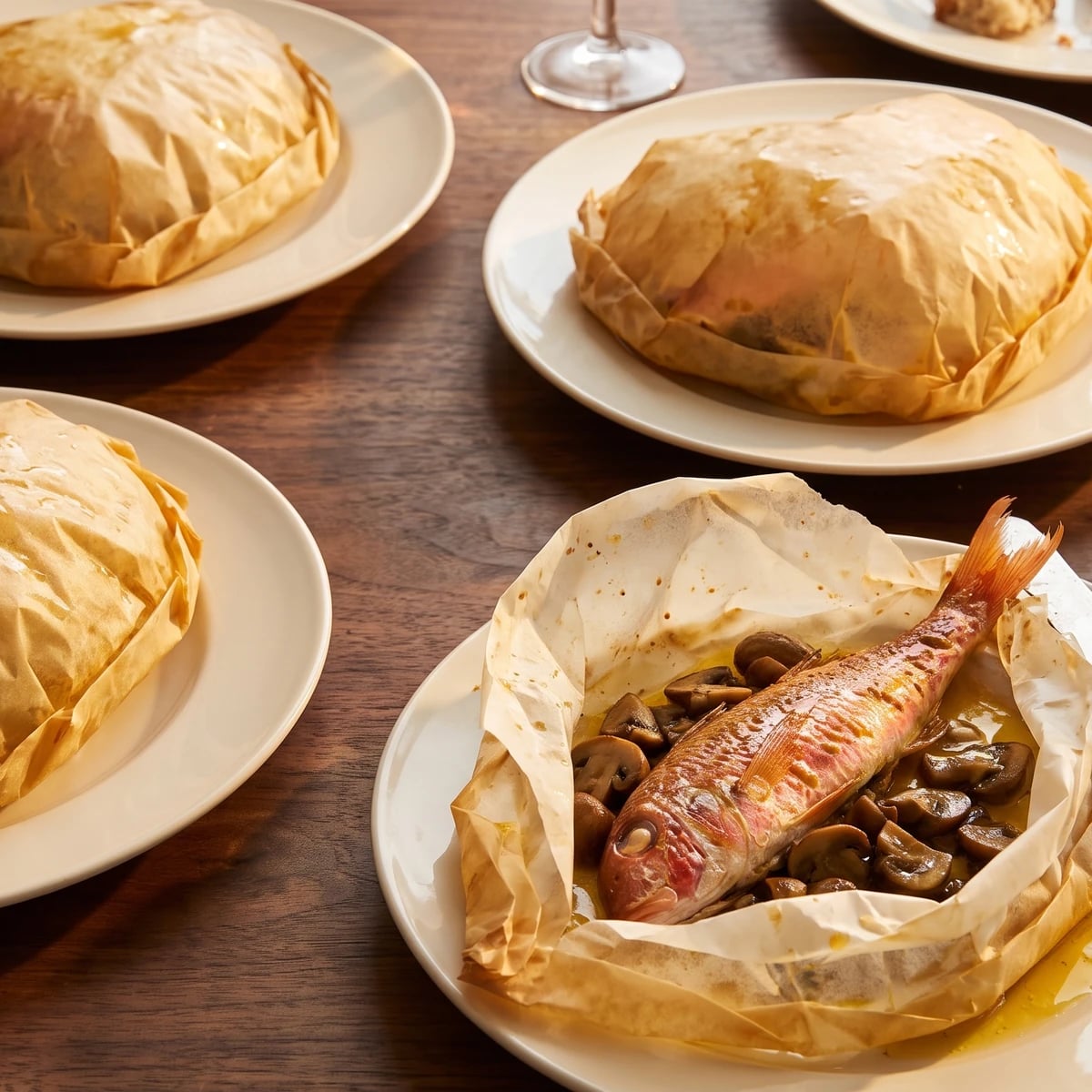
Red mullet grilled to bronze, tucked between thick Duxelles, and sealed in an oiled paper heart that balloons in the oven. Bring it straight to the table and let each guest release its mushroom-rich aroma.
Rouget en Papillote (red mullet in a puffed paper parcel) teaches one uncompromising thing: the seal is part of the cooking. The grilled fish and Duxelles may be impeccable, but if the oiled paper leaks, the packet won't balloon. Pleat tightly, because the held heat lifts the paper and brings the aroma to the table inside it.
The old formula assumed a salamander for fierce overhead grilling, a saucier keeping thick Duxelles ready beside stock never off the fire, and paper robust enough for a practiced hand. At home, the broiler, a small batch of finished Duxelles sauce, and heavy parchment do the same work for four fish. The brigade's holding and elaborate trimming are scaffolding and can go. Grilling first, sandwiching the rouget between two layers of Duxelles, oiling the paper, and giving the sealed packet five hot minutes are the dish and must stay. The packet pattern comes from Côte de Veau Papillote (No. 1259), but its ham and veal do not follow the fish. One cook, one stove, one evening.
The papillote should arrive bronzed at its folds and round as a small cushion, then open to coral-skinned fish and buttery mushrooms. Shape and pleat one empty paper heart before you grill anything. If the seal tears later, ça se rattrape: move the fish into fresh parchment and pleat again. The one step that matters most is the final seam, pressed firmly from the rounded top to the pointed end.
Rouget belongs above all to France's Mediterranean coast, especially Provence, where red mullet's coral skin and iodine-rich flesh make it a prized market fish. In the classical Parisian repertoire, en papillote brought that southern fish into the formal dining room inside a pleated paper parcel, its opening at the table preserving aroma and spectacle together. This formula is easily misunderstood: the rouget is grilled first, then enclosed with Duxelles and returned to the oven only long enough for the paper to souffler, to balloon, not cooked raw from start to finish in the packet.
Quantity
4 fish, about 9 oz (250 g) each and 2.2 lb (1 kg) total
scaled, gilled, gutted, and fins trimmed
Quantity
½ cup (120 ml / 130 g)
prepared as a finished component
Quantity
2 tablespoons (30 ml / 27 g)
divided between the fish and parchment
Quantity
1 teaspoon (5 ml / 6 g)
Quantity
½ teaspoon (2.5 ml / 1 g)
Quantity
4 sheets, each 16 × 18 inches (40 × 45 cm), for the packet pattern of Côte de Veau Papillote (No. 1259)
| Ingredient | Quantity |
|---|---|
| whole red mullet (rouget-barbet)scaled, gilled, gutted, and fins trimmed | 4 fish, about 9 oz (250 g) each and 2.2 lb (1 kg) total |
| somewhat thick Duxelles sauceprepared as a finished component | ½ cup (120 ml / 130 g) |
| neutral oildivided between the fish and parchment | 2 tablespoons (30 ml / 27 g) |
| fine sea salt | 1 teaspoon (5 ml / 6 g) |
| freshly ground black pepper | ½ teaspoon (2.5 ml / 1 g) |
| heavy parchment paper | 4 sheets, each 16 × 18 inches (40 × 45 cm), for the packet pattern of Côte de Veau Papillote (No. 1259) |
Set a rack about 6 inches (15 cm) below the broiler and heat the broiler on high. Keep a heavy baking sheet nearby. As soon as the fish is grilled, you will switch the oven to 450°F (230°C) and heat that empty sheet while assembling the papillotes; the hot surface helps the paper rise promptly.
Use the packet construction recorded for Côte de Veau Papillote (No. 1259). Fold each parchment sheet in half, cut it into a broad half-heart with the fold forming the straight side, then open it into a full heart large enough to hold one fish with a border of at least 1½ inches (4 cm). Brush the inner surface lightly with oil, including the border, but don't leave puddles.
Warm the finished Duxelles sauce gently until it is spreadable and thick enough to sit in a mound. Draw a spoon across the pan: the path should remain visible. If the sauce flows back at once, reduce it uncovered for a few minutes, stirring, then let it cool until merely warm. A loose sauce soaks the seam before the papillote can rise.
Dry each fish thoroughly, including the cavity. Wet skin clings and pales beneath the broiler. Season inside and out with the salt and pepper, then brush the skin sparingly with some of the remaining oil. Keep the trimmed fins and tail clear of ragged points that might puncture the parchment.
Arrange the fish on a lightly oiled broiler-safe rack and grill for 3 to 4 minutes, until the upper skin is bronzed. Turn carefully and grill the second side for 2 to 3 minutes. The flesh beside the backbone should just be turning opaque but not yet flaking fully; it finishes during the five minutes in paper. If the skin clings, wait another twenty seconds before lifting it. Properly browned fish releases more willingly.
Open one oiled heart with its crease running vertically. Spread 1 tablespoon of Duxelles on the lower half, keeping the border clean. Set one rouget on the sauce, parallel to the crease, and cover it with another tablespoon of Duxelles. Fold the empty half over the fish. Starting at the rounded top, make narrow overlapping pleats around the open edge, pressing every fold firmly, then twist the pointed end and tuck it underneath. Repeat with the remaining fish. If the paper tears or a seam refuses to hold, don't patch it with foil. Transfer the fish and sauce to fresh parchment and reseal it. Ça se rattrape.
Set the four parcels on the hot baking sheet and bake for exactly 5 minutes. The parchment should swell into rounded cushions, with deep golden creases and taut upper surfaces. If one parcel stays flat while the others rise, its seam is leaking. Remove the successful parcels at once, pinch the suspect fold closed through a dry kitchen towel, and return only the flat packet for 1 to 2 minutes. Don't overcook three fish while chasing the fourth packet.
Transfer each swollen papillote immediately to a warm dinner plate and serve it unopened. Have each guest tear the parchment near the rounded top, keeping face and hands clear of the first rush of hot air. The flesh should part cleanly from the backbone and look opaque at its thickest point. If it is still translucent there, fold the paper loosely over it and return it to the oven for 2 minutes. The grand entrance is spent, but dinner is saved. À table!
1 serving (about 150g)
Culinary guides, cultural storytelling, and the editorial depth that makes cooking meaningful.
Discover Culinary Explorer
Chef Juliette
Rouget grillé rewards precision over fuss: cisel the whole fish according to its thickness, turn it over fierce heat, baste steadily, and serve its bronzed skin with melting maître d’hôtel butter.

Chef Juliette
Rouget à la Bordelaise teaches the old balance: fierce heat for the fish, gentleness for the sauce, with bronzed red mullet laid over buttery, tarragon-flecked Bonnefoy.

Chef Juliette
Rouget au fenouil turns a paper parcel into an aromatic cooking vessel: red mullet, fennel, lemon, parsley, and pork fat grilled gently until the skin gleams and the flesh releases from the bone.

Chef Juliette
Whole red mullet meets fierce heat, then a glossy Niçoise garnish of reduced tomato, garlic, anchovy, and black olives. The lesson is restraint: bronze the skin, keep the flesh pearly, and let the coast do the rest.