
Chef Juliette
John Dory (St. Pierre)
John Dory has the delicacy of sole and the firmness of turbot. A light flouring, a quick butter sauté, and nut-brown beurre noisette show exactly why looks never mattered.
A cooking platform built around craft, culture, and the stories behind what we eat.
Created by Chef Juliette
Based on No. 1033, Soufflé de Morue, from Le Guide Culinaire (1907) by Auguste Escoffier
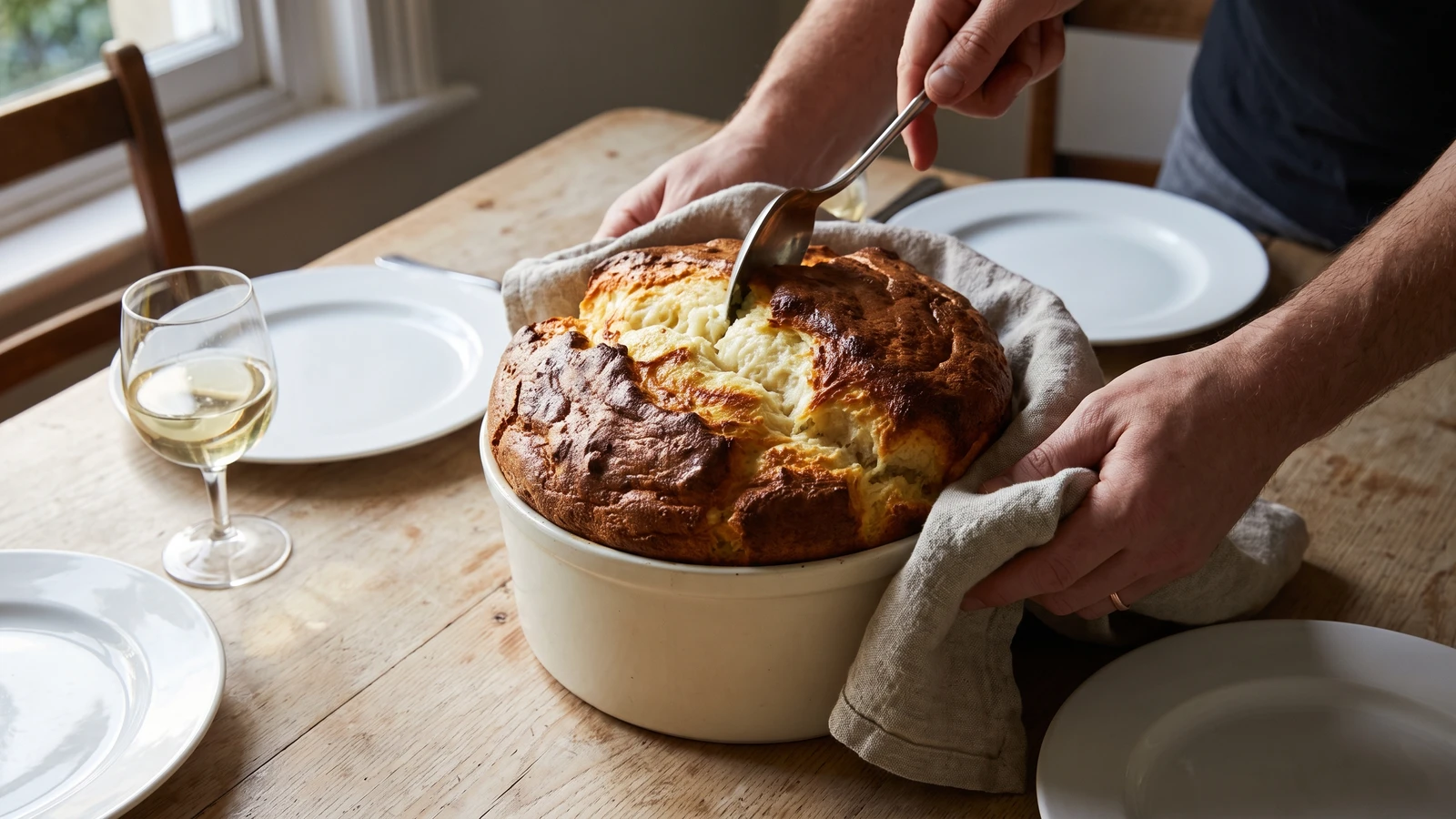
Salt cod, thick Béchamel, and yolks rise under four whipped whites into a bronzed, deeply savory soufflé, a classical lesson in building a strong base and folding with a light hand.
Soufflé de Morue teaches the governing truth of every savory soufflé: whipped whites can lift only a base strong enough to carry them. Before you touch a pan, know the texture you need. The cod and Béchamel must become a smooth paste that holds a furrow, because a loose base rises bravely and then folds into itself.
The source is unusually compact, one-quarter pound of prepared morue, two tablespoons of thick Béchamel, three yolks, and four whites, already the right measure for four. The ratio is untouched. Its few lines assume ready-desalted, freshly poached morue, a saucier's pan of hot Béchamel, and a mortar with spare hands to pound the fish. At home, a small saucepan makes the sauce, and a small food processor replaces the mortar. Separate stations were brigade scaffolding and can go; the exact ratio, the smooth paste, the stiff glossy whites, and the gentle fold are the dish, and they stay. One cook, one stove, one evening.
When it reaches the table, the crown should stand above the dish, bronzed at its ridges and pale, moist, and deeply savory within. The fold decides it. Loosen the cod base with the first portion of whites, fold the rest with broad turns, and stop before the batter loses its buoyancy.
Soufflé de morue belongs to the classical Parisian table, where cooks transformed durable Atlantic salt cod from Newfoundland and Iceland into a delicate hot entrée. Its structure follows the savory soufflé family: a concentrated fish paste bound with Béchamel and yolks, then lightened with whites immediately before baking. It is sometimes confused with brandade, but brandade belongs especially to Nîmes and the Mediterranean South and is built with olive oil, while this preparation follows the butter-and-Béchamel grammar of the national canon.
Quantity
6 ounces (170 g), enough to yield exactly 4 ounces (113 g) prepared
soaked, freshly poached, skinned, boned, and flaked
Quantity
1 tablespoon (15 ml / 14 g)
Quantity
1 tablespoon (15 ml / 8 g)
Quantity
¼ cup (60 ml / 62 g)
warmed
Quantity
4
separated, using 3 yolks and all 4 whites
Quantity
⅛ teaspoon (0.6 ml / 0.3 g)
Quantity
1 tablespoon plus 1 teaspoon (20 ml / 19 g)
softened
| Ingredient | Quantity |
|---|---|
| Icelandic or Newfoundland salt cod (morue)soaked, freshly poached, skinned, boned, and flaked | 6 ounces (170 g), enough to yield exactly 4 ounces (113 g) prepared |
| unsalted butter for the Béchamel | 1 tablespoon (15 ml / 14 g) |
| all-purpose flour | 1 tablespoon (15 ml / 8 g) |
| whole milkwarmed | ¼ cup (60 ml / 62 g) |
| large eggsseparated, using 3 yolks and all 4 whites | 4 |
| ground white pepper | ⅛ teaspoon (0.6 ml / 0.3 g) |
| unsalted butter for the dishsoftened | 1 tablespoon plus 1 teaspoon (20 ml / 19 g) |
Put the salt cod in a nonreactive bowl, cover it generously with cold water, and refrigerate for 24 hours, changing the water four times. Thick pieces may need another 6 to 12 hours. To test, cut off a small flake, simmer it in fresh water for 5 minutes, and taste it. It should remain pleasantly seasoned but not fiercely salty; if it still bites, return the cod to fresh cold water for another few hours.
Set a rack in the lower third of the oven and heat it to 400°F (200°C), or 375°F (190°C) convection. Butter a 1-quart (950 ml) straight-sided soufflé dish generously, brushing the sides upward so the batter has a clean path to climb. Keep the rim free of butter and chill the prepared dish while you make the base.
Put the soaked cod in a small saucepan and cover it with fresh cold water. Bring the water slowly to the barest tremble, then lower the heat and poach for 6 to 10 minutes, depending on thickness, until the flesh is opaque, flakes readily, and reaches 145°F (63°C) at its thickest point. Drain well, remove every scrap of skin and bone, and blot away surface water. Weigh exactly 4 ounces (113 g) of the freshly poached fish and flake it finely; this prepared weight is the source recipe's one-quarter pound, and keeping it exact preserves the balance of fish, sauce, and egg.
Melt 1 tablespoon butter in the smallest heavy saucepan you own. Stir in the flour and cook this roux, the butter-and-flour foundation, over medium-low heat for 90 seconds without letting it color. Whisk in the warm milk gradually, then cook for 2 to 3 minutes, stirring constantly, until the Béchamel is very thick and holds the track of the spoon. If it forms lumps, press it through a fine sieve while hot; if it remains loose, cook it another minute. This whiskable home batch makes slightly more than the source requires, so measure exactly 2 tablespoons (30 ml / about 35 g) while hot and reserve the remainder.
Put the warm flaked morue in a small food processor and pulse until finely broken down. Add the 2 tablespoons of hot, very thick Béchamel little by little, processing and scraping the bowl between additions, until the mixture becomes a completely smooth, cohesive paste with no distinct flakes. Transfer it to a clean saucepan, add the white pepper, and heat gently while stirring until the paste is hot, pulls cleanly from the pan, and holds a deep furrow. Taste before considering salt; properly desalted morue usually supplies all it needs.
Remove the saucepan from the heat and let the base stand for 1 minute. Beat in 3 yolks, one at a time, working briskly and mixing each completely before adding the next. The base should stay warm and supple, never hot enough to scramble the yolks. If the first yolk makes tiny cooked flecks, scrape the mixture immediately into a cool bowl and beat hard; if flecks remain, pass the base through a medium-mesh sieve while it is still warm. Let it settle to about 105 to 115°F (40 to 46°C) before folding in the whites.
Beat all 4 whites in a spotless, dry bowl until they hold firm, glossy peaks whose tips barely curl. Whisk one-quarter of the whites firmly into the cod base to loosen it. Add the remainder in three portions, cutting down through the center with a flexible spatula, sweeping across the bottom, and turning the bowl after every fold. Stop as soon as no large pockets remain; a few fine white ribbons are safer than a perfectly uniform but flattened batter. If the mixture turns thin because it was overfolded, ça se rattrape: quickly butter four 6-ounce (180 ml) ramekins, divide the batter among them, and bake for 13 to 15 minutes. Their shallower depth asks less of the weakened foam.
Spoon the batter into the chilled soufflé dish, filling it no more than three-quarters full. Smooth the top lightly, clean the rim, and run the tip of a knife in a shallow circle about ½ inch (1 cm) inside the edge to encourage an even crown. Bake immediately for 20 to 24 minutes without opening the oven during the first 18 minutes. It is ready when the crown stands above the rim, the ridges are deep butter-gold, the center quivers without sloshing, and the interior reaches 160°F (71°C). Carry it straight to the waiting table. A soufflé won't wait, but guests can. À table!
1 serving (about 90g)
Culinary guides, cultural storytelling, and the editorial depth that makes cooking meaningful.
Discover Culinary ExplorerChef Juliette
John Dory has the delicacy of sole and the firmness of turbot. A light flouring, a quick butter sauté, and nut-brown beurre noisette show exactly why looks never mattered.

Chef Juliette
Fresh haddock proves its delicacy in the meunière pan: a fine flour crust, moist pearly flakes, and beurre noisette sharpened with lemon and parsley, ready from one skillet in half an hour.

Chef Juliette
Éperlans à l’Anglaise turns small fish into a lesson in disciplined coating: boned smelts under a close, crisp crumb, pan-fried in clarified butter and finished with bright, half-melted maître d’hôtel butter.

Chef Juliette
Tiny smelts, shallot, mushrooms, white wine, gratin sauce, and fine bread raspings meet a fierce oven, where the fish must turn tender in the same breath the buttered crust bronzes.