
Chef Juliette
John Dory (St. Pierre)
John Dory has the delicacy of sole and the firmness of turbot. A light flouring, a quick butter sauté, and nut-brown beurre noisette show exactly why looks never mattered.
A cooking platform built around craft, culture, and the stories behind what we eat.
Created by Chef Juliette
Based on No. 1032, Morue à la Lyonnaise, from Le Guide Culinaire (1907) by Auguste Escoffier
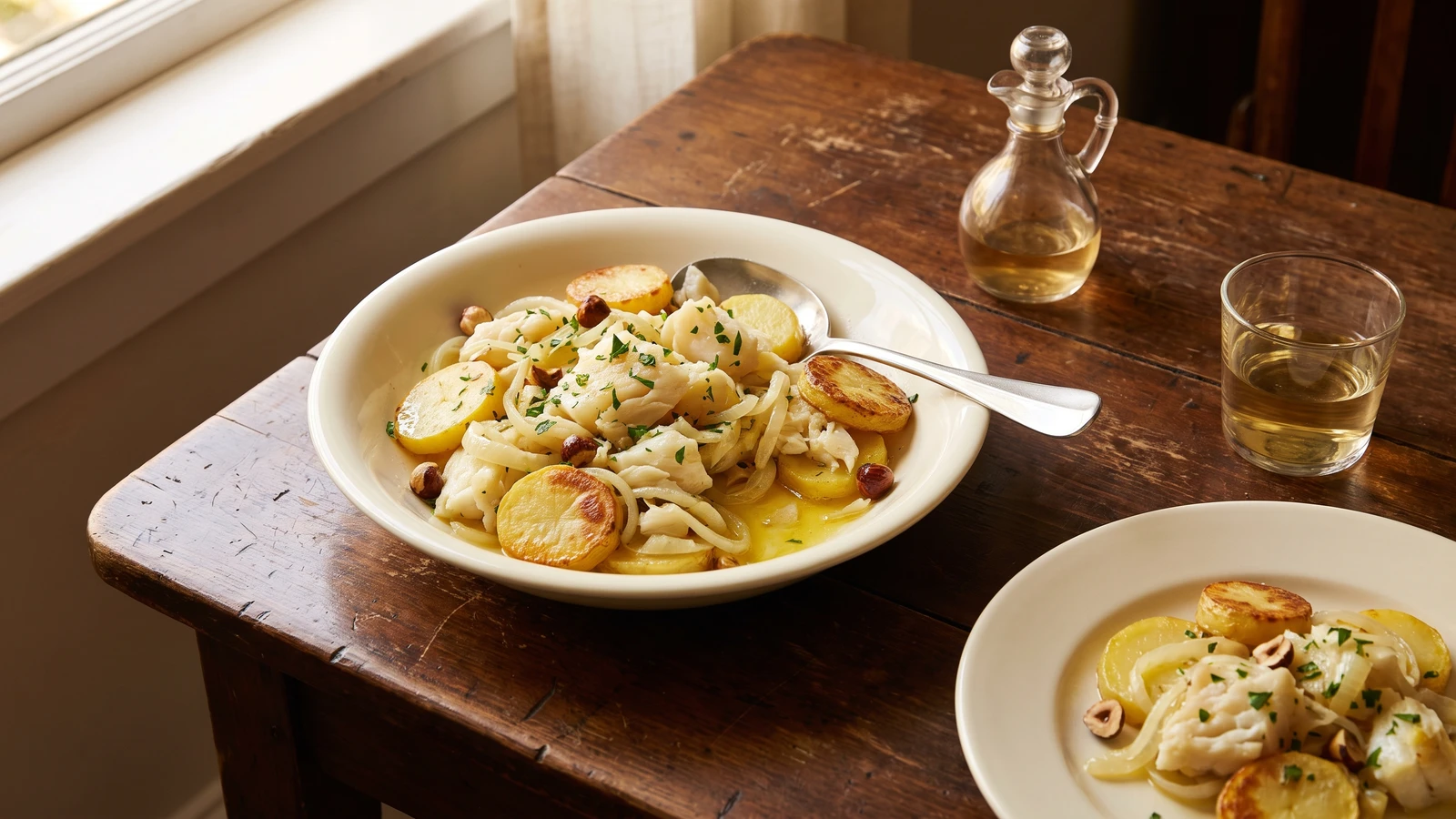
Morue à la Lyonnaise turns salt cod, onions, and potato roundels into a buttery skillet supper, finished with the few drops of vinegar that make the whole pan taste awake.
Morue à la Lyonnaise (Lyon-style salt cod with onions and potatoes) teaches one essential lesson before a pan ever meets the flame: salt cod must be desalted by judgment, not merely by the clock. Soak it, cook a small morsel, and taste. Once the salt is right, the rest is butter, patient onions, potatoes browned at their edges, and a final sharp flick of vinegar.
The original entry assumes the morue has already been soaked, poached, and flaked according to instructions elsewhere in the kitchen. It also assumes separate pans moving briskly and a hot timbale waiting at the pass. At home, one wide skillet does the work in sequence, and hot water warms the serving bowl while you cook. Its pound of cod and three potatoes already make an honest supper for four, so the proportions remain intact. One cook, one stove, one evening.
The separate station work and formal timbale are brigade scaffolding and can go. The gentle poach, butter-cooked onion, intact potato roundels, brisk final toss, and last drops of vinegar are the dish and must stay. Its foundation is onion softened in real butter, not a stock or cream sauce the entry never asked for. Before you touch the skillet, taste that test morsel of morue; every good decision follows from it.
Morue à la Lyonnaise belongs to Lyon's household and bouchon table, where salt cod arriving from Atlantic ports became a dependable fish for the inland winter larder. In classical kitchen language, à la lyonnaise points first to onions, not to a particular fish or sauce, and here their sweetness joins potatoes and butter to give the preserved cod its local form. The final vinegar is measured in drops because its work is balance: it lifts the butter and salt without making the dish taste sour.
Quantity
1 pound (454 g)
soaked for 24 to 36 hours and drained
Quantity
enough to cover the cod for soaking and poaching
Quantity
1 medium (about 1 cup / 170 g)
finely minced
Quantity
3 medium (about 3 cups / 510 g)
peeled and cut into ¼-inch (6 mm) roundels
Quantity
4 tablespoons (¼ cup / 56 g)
divided
Quantity
2 tablespoons (30 ml / 27 g)
Quantity
½ teaspoon (2.5 ml / 2.5 g)
divided to taste
Quantity
1 tablespoon (15 ml / 4 g)
finely chopped
| Ingredient | Quantity |
|---|---|
| dry-salted cod, preferably Icelandic or Newfoundlandsoaked for 24 to 36 hours and drained | 1 pound (454 g) |
| cold water | enough to cover the cod for soaking and poaching |
| medium onionfinely minced | 1 medium (about 1 cup / 170 g) |
| waxy yellow potatoespeeled and cut into ¼-inch (6 mm) roundels | 3 medium (about 3 cups / 510 g) |
| unsalted butterdivided | 4 tablespoons (¼ cup / 56 g) |
| neutral oil | 2 tablespoons (30 ml / 27 g) |
| white wine vinegardivided to taste | ½ teaspoon (2.5 ml / 2.5 g) |
| flat-leaf parsleyfinely chopped | 1 tablespoon (15 ml / 4 g) |
Rinse the dry-salted cod under cold water to remove its surface salt, then place it in a nonreactive bowl and cover generously with cold water. Refrigerate for 24 to 36 hours, changing the water 3 or 4 times. After 24 hours, cut off a thumbnail-sized morsel and simmer it in fresh water for one minute before tasting. It should remain pleasantly saline but not sting the tongue. If it is still fierce, return the remaining cod to fresh cold water for another 4 to 6 hours. Ça se rattrape, but the extra soak cannot be hurried.
Put the drained morue in a saucepan and cover it by 1 inch with fresh cold water. Bring the water slowly to just below a simmer, watching for a faint movement around the edge rather than a rolling boil. Lower the heat and poach for 8 to 10 minutes, until the flesh is opaque and separates readily along its natural flakes. If the water begins boiling, lift the pan from the heat and add a splash of cold water at once; the temperature will settle before the cod tightens.
Drain the morue and let it cool only until your fingers can handle it. Remove the skin and every bone, then separate the flesh into generous flakes rather than crumbs. Spread them on a clean towel and blot carefully. Dry fish takes on the butter's gloss in the final toss; wet fish releases water and leaves the potatoes limp.
Melt 1 tablespoon of the butter in a wide 12-inch skillet over medium-low heat. Add the minced onion and cook for 8 to 10 minutes, stirring often, until soft, sweet, and pale gold at the edges. Do not take it to a dark caramel. Scrape the onion and its butter into a bowl, leaving any light golden film in the skillet.
Melt another tablespoon of butter in the same skillet. Lay in the potato roundels, with only a little overlap, and cook over medium heat for 15 to 18 minutes, turning them carefully as their undersides turn gold. They are ready when a knife enters without resistance but the slices still hold their shape. If they brown before becoming tender, add 2 tablespoons (30 ml) of water and cover for 2 minutes, then uncover and let every drop evaporate before continuing. The potatoes are rescued, and their edges can still color.
Transfer the potatoes to the bowl with the onions. Increase the heat to medium-high and add the remaining 2 tablespoons of butter with all the neutral oil. When the butter foams and smells nutty but has not darkened, return the potatoes and onions, then add the flaked morue. Toss over brisk heat for 3 to 4 minutes, turning with a broad spatula so the potatoes take a little more color and the cod heats through. If the fish begins breaking into small pieces, stop shaking the skillet and turn the mixture in broad sections; the flavor is intact, and generous flakes will remain.
Take the skillet off the heat. Sprinkle over half the vinegar, toss once, and taste before adding the rest drop by drop. You should notice brightness, not sourness, and the cod will usually supply all the salt the dish needs. Fold in most of the parsley. Empty and dry a serving bowl warmed with hot water, spoon in the morue, and finish with the remaining parsley. Bring it straight to the table while the butter still gleams. À table!
1 serving (about 340g)
Culinary guides, cultural storytelling, and the editorial depth that makes cooking meaningful.
Discover Culinary ExplorerChef Juliette
John Dory has the delicacy of sole and the firmness of turbot. A light flouring, a quick butter sauté, and nut-brown beurre noisette show exactly why looks never mattered.

Chef Juliette
Fresh haddock proves its delicacy in the meunière pan: a fine flour crust, moist pearly flakes, and beurre noisette sharpened with lemon and parsley, ready from one skillet in half an hour.

Chef Juliette
Éperlans à l’Anglaise turns small fish into a lesson in disciplined coating: boned smelts under a close, crisp crumb, pan-fried in clarified butter and finished with bright, half-melted maître d’hôtel butter.

Chef Juliette
Tiny smelts, shallot, mushrooms, white wine, gratin sauce, and fine bread raspings meet a fierce oven, where the fish must turn tender in the same breath the buttered crust bronzes.