
Chef Juliette
John Dory (St. Pierre)
John Dory has the delicacy of sole and the firmness of turbot. A light flouring, a quick butter sauté, and nut-brown beurre noisette show exactly why looks never mattered.
A cooking platform built around craft, culture, and the stories behind what we eat.
Created by Chef Juliette
Based on No. 1031, Cabillaud Salé, or Morue à l’Indienne, from Le Guide Culinaire (1907) by Auguste Escoffier
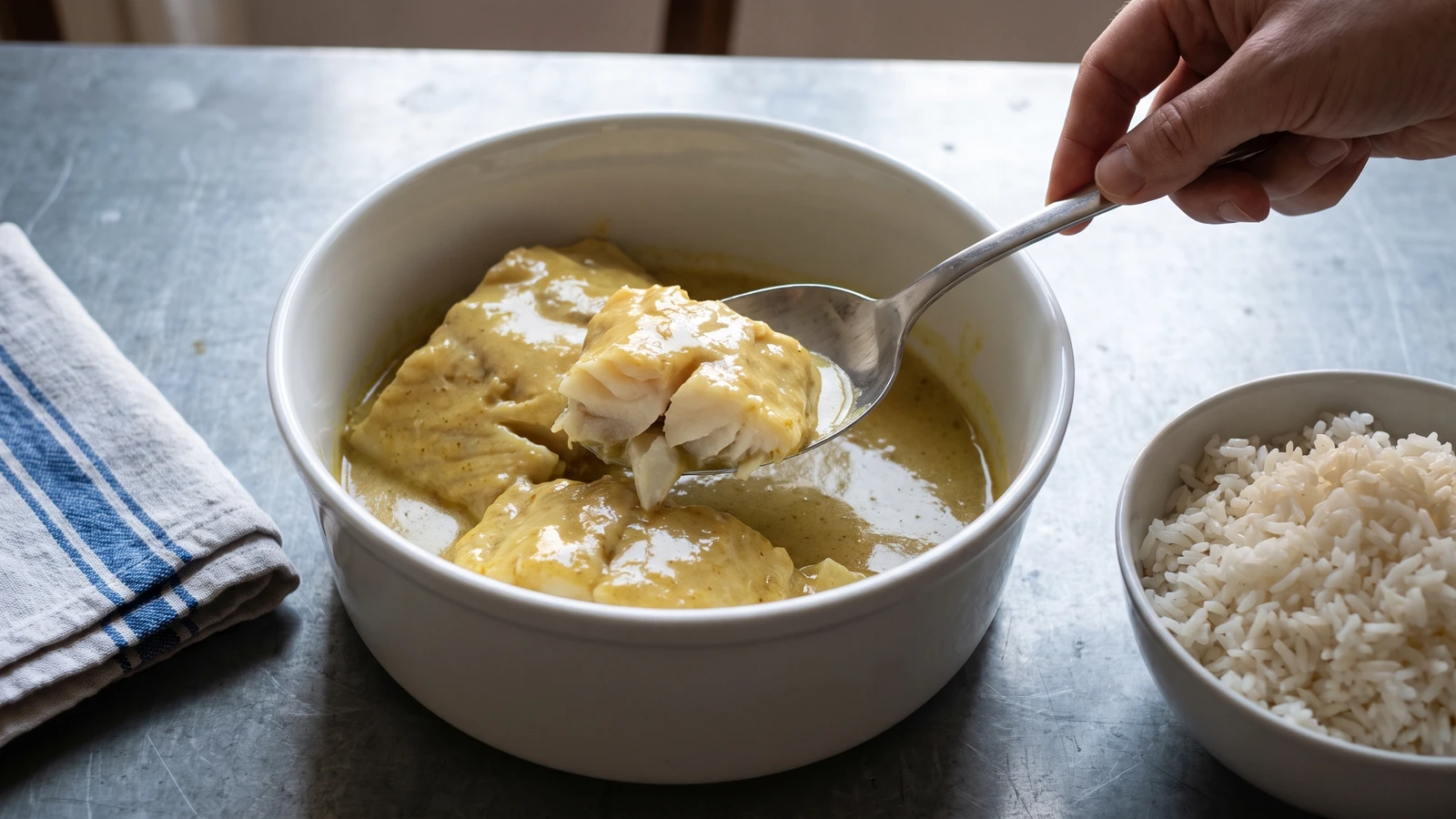
Salt cod, poached gently and folded into a mild sauce à l’Indienne, with dry, separate rice alongside: a lesson in keeping the fish’s flakes whole and the curry in its proper place.
Cabillaud Salé, or Morue à l’Indienne (salt cod in a mild French curry sauce), teaches control: the curry must sharpen the cured fish, never bury it, and the flakes must remain large enough to meet the fork as fish. Know that before touching a pan. Stir it like a hash and you lose the texture that gives the dish its character.
The original entry assumed a saucier with Sauce à l’Indienne waiting, a stockpot never cold, and rice kept dry for service. At home, a small butter roux and unsalted fish stock make exactly the book’s two-thirds imperial pint, 1⅔ cups (380 ml), while a low oven keeps the rice loose. The brigade’s standing sauce and large-batch mise en place are scaffolding and can go; the gentle poach, the separate rice, and the final fold are the dish and stay. One cook, one stove, one evening.
Begin with properly desalted morue, ready-soaked from the fishmonger if tonight is the night, or soaked ahead if you bought it dry. Prove the salt level with one cooked flake before seasoning anything else. Then guard the decisive step: fold the fish through the sauce with two or three broad turns, and stop.
Morue, salt cod brought from Newfoundland or Iceland, became part of Atlantic French larders through ports from Brittany to Bordeaux, where a durable fish could travel inland and wait in the pantry. The designation à l’Indienne belongs to the Parisian classical repertory: a mild curry-spiced sauce adapted to French sauce technique, not a claim to reproduce any one Indian regional curry. The pairing carried preserved Atlantic fish into grand kitchens, then back to the bourgeois table with rice served separately to absorb the sauce.
Quantity
1 lb (454 g)
soaked until pleasantly seasoned, not aggressively salty
Quantity
6 cups (1.4 L / 1.4 kg)
for poaching
Quantity
2 tablespoons (30 ml / 28 g)
Quantity
¼ cup (60 ml / 40 g)
very finely chopped
Quantity
1½ teaspoons (7.5 ml / 3 g)
Quantity
2 tablespoons (30 ml / 16 g)
Quantity
1⅓ cups (320 ml / 320 g)
divided
Quantity
½ cup (120 ml / 120 g)
divided
Quantity
⅛ teaspoon (0.6 ml / 0.3 g)
Quantity
1¼ cups (300 ml / 240 g)
Quantity
10 cups (2.4 L / 2.4 kg)
divided, for boiling and rinsing the rice
Quantity
1 teaspoon (5 ml / 6 g)
for the rice
| Ingredient | Quantity |
|---|---|
| desalted morue, Newfoundland or Iceland salt codsoaked until pleasantly seasoned, not aggressively salty | 1 lb (454 g) |
| cold waterfor poaching | 6 cups (1.4 L / 1.4 kg) |
| unsalted butter | 2 tablespoons (30 ml / 28 g) |
| yellow onionvery finely chopped | ¼ cup (60 ml / 40 g) |
| mild curry powder | 1½ teaspoons (7.5 ml / 3 g) |
| plain flour | 2 tablespoons (30 ml / 16 g) |
| unsalted fish stockdivided | 1⅓ cups (320 ml / 320 g) |
| heavy creamdivided | ½ cup (120 ml / 120 g) |
| ground white pepper | ⅛ teaspoon (0.6 ml / 0.3 g) |
| long-grain white rice | 1¼ cups (300 ml / 240 g) |
| waterdivided, for boiling and rinsing the rice | 10 cups (2.4 L / 2.4 kg) |
| fine saltfor the rice | 1 teaspoon (5 ml / 6 g) |
Cut a small flake from the thickest part of the morue and simmer it in a little plain water for one minute. Taste it. It should be distinctly seasoned but pleasant enough to eat alone. If it is too salty, cover the remaining fish with fresh cold water and soak it in the refrigerator for one to two more hours, changing the water once, then test again. If the salt is harsh rather than merely assertive, give it several more hours. Ça se rattrape now; no sauce can rescue fish that was never properly desalted.
Heat the oven to 250°F (120°C). Rinse the rice under cold water until the water runs nearly clear. Bring 8 cups (1.9 L / 1.9 kg) of the rice water to a strong boil with the fine salt, scatter in the rice, and boil uncovered until tender but still distinct, 12 to 14 minutes. Drain it at once, rinse with the remaining 2 cups (475 ml / 475 g) freshly boiled water, and shake the colander well. Spread the rice in a shallow ovenproof dish and dry it in the low oven for 8 to 10 minutes, gently lifting it once with a fork. Rice à l’Indienne means separate, dry grains ready to take sauce, not a sticky mound.
Lay the morue in a saucepan and cover it with the 6 cups (1.4 L / 1.4 kg) cold poaching water. Bring it slowly toward a bare tremble, then lower the heat and poach without boiling until the thickest part separates easily and is opaque throughout, usually 6 to 10 minutes. Drain well. While the fish is warm enough to handle, remove every scrap of skin and every bone, then lift the flesh into generous flakes about 1½ inches (4 cm) across. Do not mash or shred it.
Melt the butter in a small heavy saucepan over medium-low heat. Add the onion and cook for 4 to 5 minutes until soft and translucent, without browning. Stir in the curry powder for 30 seconds, just until fragrant, then add the flour and cook this roux, the butter-flour foundation, for 90 seconds. Reserve 1 tablespoon (15 ml / 15 g) each of the stock and cream for adjustment. Gradually whisk the remaining stock into the roux and simmer gently for 8 minutes. If lumps appear, stop adding liquid and whisk the base smooth before continuing. Pass the sauce through a fine sieve into a clean pan, add the remaining cream, and simmer until you have exactly 1⅔ cups (380 ml / about 390 g). It should be nappant, coating the back of a spoon in a thin, glossy veil. Add the white pepper, but no salt yet.
Return the sauce to the gentlest heat and add the drained flakes of morue. Slide a broad spoon beneath the fish and turn it through the sauce two or three times, just enough to coat every piece. Warm for 3 to 4 minutes without boiling. Taste before adding any salt. If the sauce is too tight, fold in the reserved stock a teaspoon at a time. If it becomes thin, lift out the fish with a slotted spoon, reduce the sauce alone, and return the flakes. If hard heat makes the cream look grainy, take the pan off the burner and whisk the reserved cold cream into the sauce before gently returning the fish.
Warm a deep porcelain timbale, or a generous serving bowl, with hot water and dry it well. Spoon in the morue à l’Indienne without packing it down, letting the pale ochre sauce settle naturally around the whole flakes. Bring the rice à l’Indienne in a separate warmed bowl so each person can take as much as the sauce requires. No scattered herbs, no decorative flourishes. The fish, curry, and rice have finished the matter. À table!
1 serving (about 405g)
Culinary guides, cultural storytelling, and the editorial depth that makes cooking meaningful.
Discover Culinary ExplorerChef Juliette
John Dory has the delicacy of sole and the firmness of turbot. A light flouring, a quick butter sauté, and nut-brown beurre noisette show exactly why looks never mattered.

Chef Juliette
Fresh haddock proves its delicacy in the meunière pan: a fine flour crust, moist pearly flakes, and beurre noisette sharpened with lemon and parsley, ready from one skillet in half an hour.

Chef Juliette
Éperlans à l’Anglaise turns small fish into a lesson in disciplined coating: boned smelts under a close, crisp crumb, pan-fried in clarified butter and finished with bright, half-melted maître d’hôtel butter.

Chef Juliette
Tiny smelts, shallot, mushrooms, white wine, gratin sauce, and fine bread raspings meet a fierce oven, where the fish must turn tender in the same breath the buttered crust bronzes.