Culinary Explorer

A cooking platform built around craft, culture, and the stories behind what we eat.
Discover Culinary Explorer
Salted Cod and Morue à l’Anglaise

Salted Cod and Morue à l’Anglaise

Created by Chef Juliette

Based on No. 1024a, Salted Cod and Morue à l’Anglaise, from Le Guide Culinaire (1907) by Auguste Escoffier

Salt cod rises slowly from cold water, then poaches away from the boil until pearly and tender, with buttered parsnips and sauce à l’Écossaise turning plain ingredients into a deeply comforting supper.

Main Dishes
French
Comfort Food
Weeknight
25 min
Active Time
50 min cook25 hr 15 min total
Yield4 servings

Morue à l’Anglaise (salt cod with parsnips and Scottish-style egg sauce) teaches one exact thing: poaching is controlled by the heat you stop, not the boil you maintain. Bring the fish up from cold water, catch the first true boil, then take the pot off the heat for fifteen minutes. Let it bubble on and the fibers clench; stop it on time and the fish opens into moist, pearly flakes.

The source entry assumed morue already desalinated in the larder, a saucier on staff to tend the roux-bound sauce, and a side of the fire where a pot could stand without boiling. Your refrigerator, one small saucepan, and a switched-off burner do the same work for four. The staffed sauce station is brigade scaffolding and can go; the cold-water start, the fifteen-minute off-boil poach, the separate timbale of parsnips, and the sauce à l’Écossaise are the dish and must stay. It needs neither the ever-ready stockpot nor the salamander.

At the table, the cod stays clean and saline, the parsnips bring earthy sweetness, and chopped egg softens into an ivory cream sauce flecked with parsley. One cook, one stove, one evening, once the fish has soaked. Watch for the first boil and move the pot immediately; that is the step that decides everything.

Morue à l’Anglaise belongs to the Parisian classical repertoire, where à l’anglaise named a French reading of British plain service: fish gently poached, a boiled root vegetable alongside, and sauce served separately. The pairing with sauce à l’Écossaise, a cream-bound egg sauce, reinforces that cross-Channel vocabulary, but the codification and presentation are French rather than a British household recipe copied whole. Salt cod traveled through port markets and inland larders across France for generations because curing carried sea fish far from the coast.

The technique, the tradition, and the story behind every dish.

Discover Culinary Explorer

Ingredients

skin-on salt cod

Quantity

2 pounds (900 g)

cut into 4 thick portions

cold water

Quantity

enough to cover the fish by at least 1 inch (2.5 cm)

for soaking and poaching

parsnips

Quantity

1½ pounds (680 g)

peeled and cut into even batons

unsalted butter

Quantity

4 tablespoons (60 ml / 56 g)

divided between the parsnips and sauce

all-purpose flour

Quantity

3 tablespoons (45 ml / 24 g)

whole milk

Quantity

1¼ cups (300 ml / 310 g)

heavy cream

Quantity

½ cup (120 ml / 120 g)

large eggs

Quantity

2

yellow onion

Quantity

1 small wedge

bay leaf

Quantity

1

flat-leaf parsley

Quantity

1 tablespoon (15 ml / 4 g)

finely chopped

fine sea salt

Quantity

¾ teaspoon (3.75 ml / 4.5 g), plus more only if needed

ground white pepper

Quantity

⅛ teaspoon (0.6 ml / 0.3 g)

freshly grated nutmeg

Quantity

⅛ teaspoon (0.6 ml / 0.3 g)

Equipment Needed

  • Large nonreactive dish for desalting
  • Wide 4-quart (3.8-liter) pot with lid
  • 2-quart (1.9-liter) saucepan
  • Fine-mesh sieve
  • Wide slotted spatula
  • Clean lint-free cotton or linen napkin
  • Small warmed timbale and sauceboat

Instructions

  1. 1

    Desalt the morue

    Rinse the surface salt from the morue under cold running water, then place it in a nonreactive dish and cover it by at least 1 inch (2.5 cm) with fresh cold water. Refrigerate for 24 to 36 hours, changing the water four times. After 24 hours, cut a thumbnail-size piece from the thickest portion and simmer it in fresh water for one minute before tasting. It should be distinctly saline but pleasant; if the salt bites sharply, give the fish another four to six hours in fresh water. Salt cod varies, and the tasting protects the entire supper.

    Keep the fish cold throughout desalting. Soaking on the counter encourages spoilage and does nothing useful for the texture.
  2. 2

    Cook the eggs

    Place the eggs in a small saucepan, cover them with cold water, and bring it just to the boil. Cover, remove from the heat, and leave for ten minutes, then cool the eggs in cold water. Peel and chop them into small, distinct pieces rather than crushing them to a paste. Set them aside while you prepare the parsnips and sauce.

  3. 3

    Prepare the parsnips

    Put the parsnip batons in a saucepan, cover with cold water, and add the measured salt. Bring to a gentle simmer and cook for twelve to eighteen minutes, until a knife enters without resistance but the pieces still hold their shape. Drain thoroughly, return them to the warm pan, and turn them with 2 tablespoons (30 ml / 28 g) of the butter. Cover and keep warm. The source asks for a timbale of parsnips, meaning they arrive in their own warmed serving bowl, not scattered beneath the fish.

  4. 4

    Build the egg sauce

    Warm the milk with the onion wedge and bay leaf until small bubbles gather at the edge, then cover and leave it for five minutes before removing the aromatics. In a clean saucepan, melt the remaining 2 tablespoons (30 ml / 28 g) butter over gentle heat. Stir in the flour and cook the roux for two minutes without letting it color. Whisk in the warm milk in four additions, smoothing each one before adding the next, then simmer gently for eight minutes. Add the cream, white pepper, and nutmeg, and simmer until nappant, thick enough to coat the back of a spoon while still flowing freely. If it turns lumpy, whisk firmly and pass it through a fine sieve; ça se rattrape. If it is too thick, loosen it with a spoonful of milk. Fold in the chopped eggs and parsley, taste before adding any salt, then cover and hold off direct heat. Do not boil the sauce after the eggs go in.

  5. 5

    Poach off the boil

    Drain the soaked cod and place it skin-side down in a wide pot where the pieces fit without overlapping. Cover with fresh cold water by 1 inch (2.5 cm) and bring it up slowly over medium heat. The instant the first true boil breaks the surface, switch off the burner, slide the pot onto a cold grate, and cover it. Leave the fish to poach in the retained heat for exactly fifteen minutes. This is the home equivalent of moving the pot to the side of the fire. If the water raced into a hard boil, lift the fish out immediately rather than letting it toughen. If the thickest piece still resists a knife after fifteen minutes, return it to the covered hot water, off the heat, for two or three minutes.

  6. 6

    Drain and serve

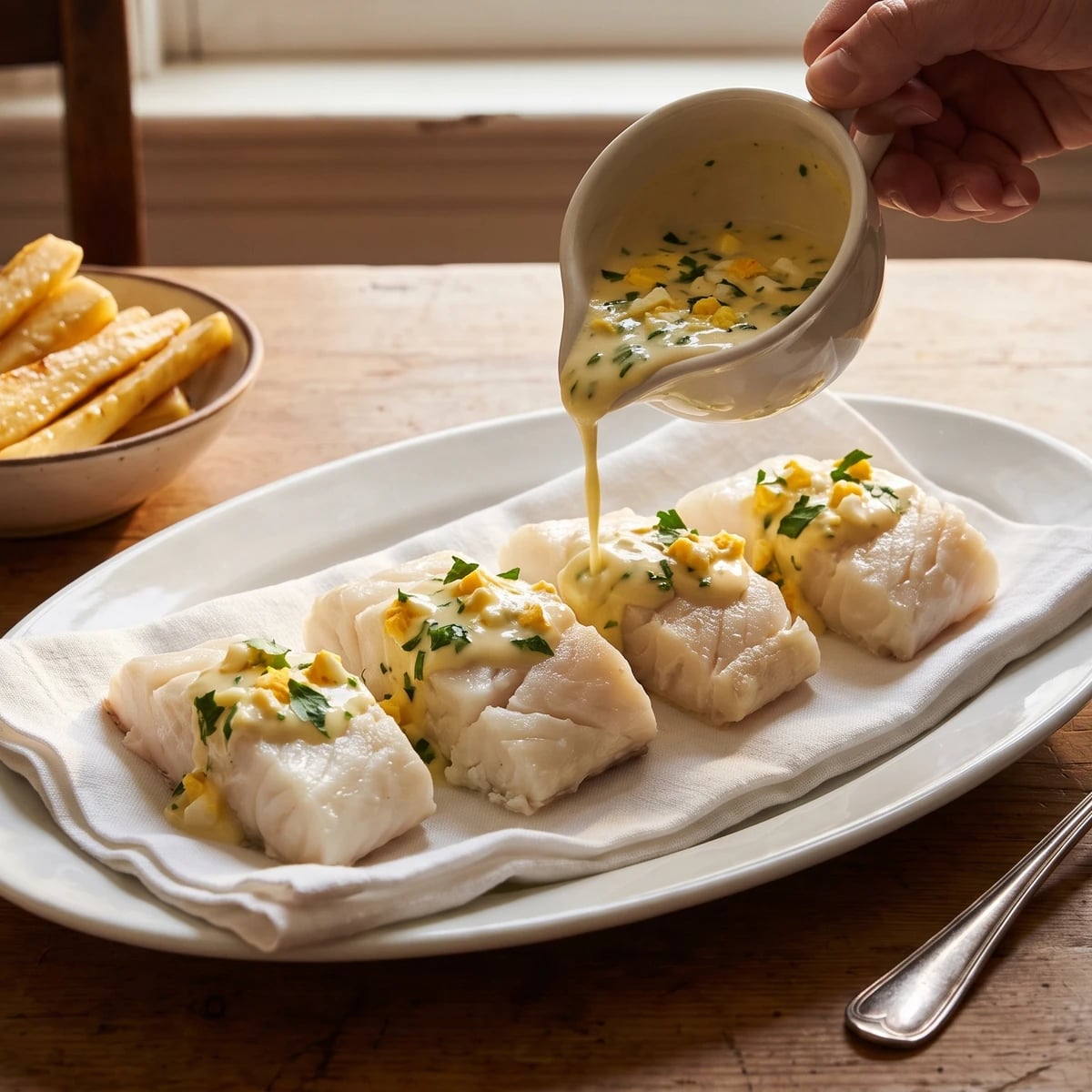
    Lift the cod carefully with a wide slotted spatula and let it drain for two minutes. Pull away the skin and any bones while the fish is warm, preserving the portions in large flakes. Arrange it on a warmed oval platter lined with a clean, unscented, lint-free folded napkin, which absorbs the last poaching water exactly as the source intends. Bring the buttered parsnips in their separate timbale and the warm sauce à l’Écossaise in a sauceboat, so each person can spoon the sauce over the fish at the table. À table!

Chef Tips

  • Choose thick center-cut salt cod with its skin attached. Thin tail pieces desalt quickly but dry before the fifteen-minute poach is finished; pieces of similar thickness cook as one dish instead of four separate negotiations.
  • The source notes that fresh cod may receive the same service, but morue is not merely fresh fish with extra salt. This version is timed for soaked salt cod; fresh cod needs no desalting and should be checked sooner after the pot leaves the boil.
  • The napkin is functional, not table theater. Use freshly washed lint-free cotton or linen with no scented softener. If you prefer, two layers of plain absorbent kitchen paper provide the same home-kitchen service.
  • Butter and cream are the structure of sauce à l’Écossaise. Margarine and imitation cream make the roux greasy and flatten the finish. We don't apologize for butter.
  • Serve a brisk, dry white such as Muscadet. Its acidity clears the cream and egg from the palate without bullying the delicate fish or the sweetness of the parsnips.

Advance Preparation

  • Begin desalting the morue 24 to 36 hours before supper and keep it refrigerated, changing the water four times. Once properly desalted, drain, cover, and refrigerate it for up to one day before poaching.
  • The eggs may be hard-cooked, peeled, and refrigerated one day ahead. Chop them shortly before they enter the sauce so the pieces remain neat.
  • The roux-bound sauce base may be prepared one day ahead without the eggs or parsley. Cool and refrigerate it promptly, then reheat over gentle heat with a spoonful of milk before folding in the eggs, parsley, and cream.
  • Leftover cooked cod and sauce should be cooled and refrigerated within two hours. Keep them separately for up to two days and reheat the sauce gently without boiling.

Frequently Asked Questions

Nutrition Information

1 serving (about 630g)

Calories
800 calories
Total Fat
31 g
Saturated Fat
17 g
Trans Fat
1 g
Unsaturated Fat
13 g
Cholesterol
355 mg
Sodium
2100 mg
Total Carbohydrates
40 g
Dietary Fiber
9 g
Sugars
13 g
Protein
88 g

Note: Chef personas and recipes are created with AI assistance. Cook with care: follow safe food-handling practices, check doneness with a thermometer when needed, and adapt for allergies and your kitchen.

Where cooking meets culture.

Culinary guides, cultural storytelling, and the editorial depth that makes cooking meaningful.

Discover Culinary Explorer

More from Fish - Cod (Cabillaud)

Browse the full collection