
Chef Juliette
John Dory (St. Pierre)
John Dory has the delicacy of sole and the firmness of turbot. A light flouring, a quick butter sauté, and nut-brown beurre noisette show exactly why looks never mattered.
A cooking platform built around craft, culture, and the stories behind what we eat.
Created by Chef Juliette
Based on No. 1015, Merlan à la Bercy, from Le Guide Culinaire (1907) by Auguste Escoffier
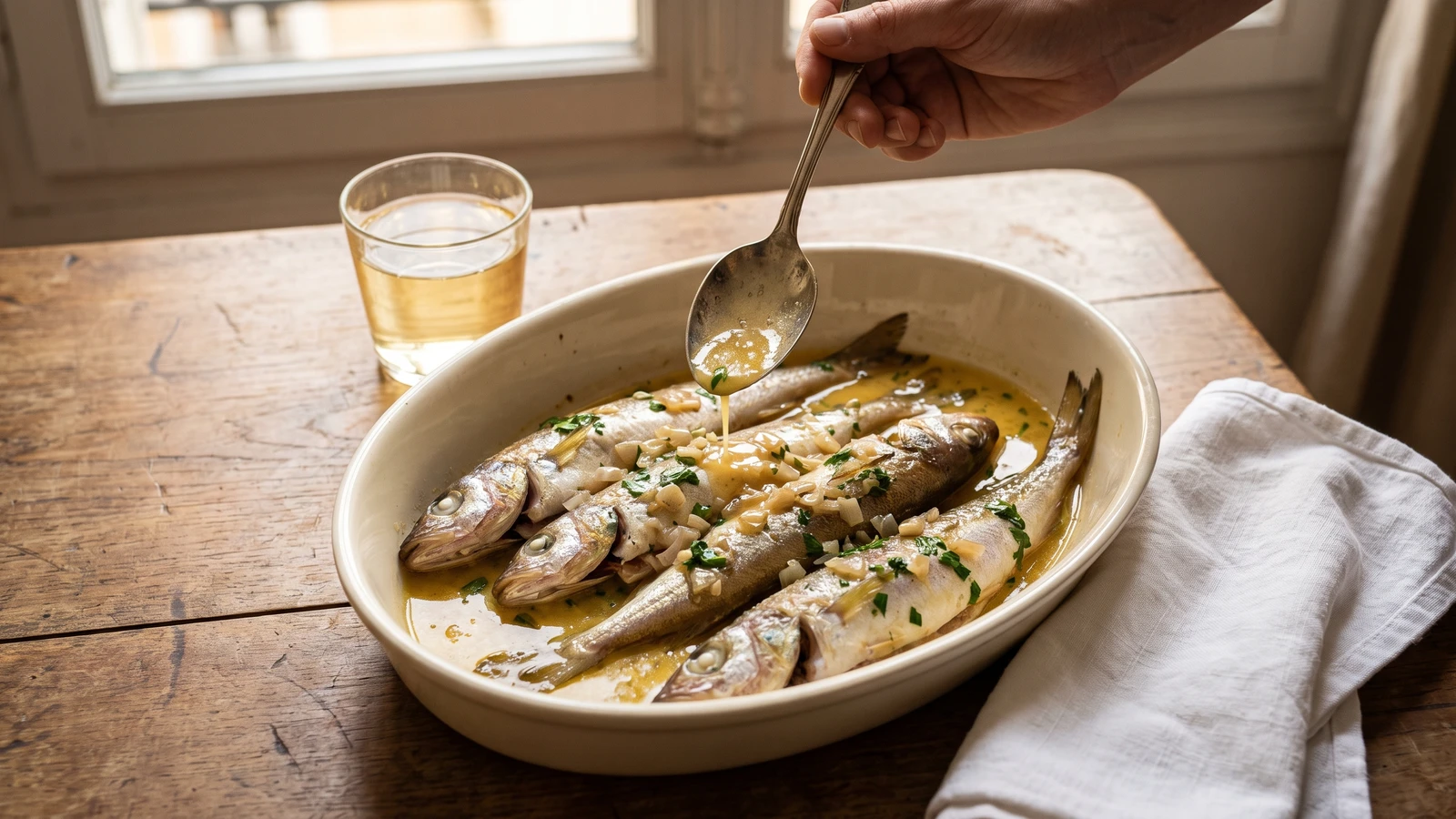
Merlan à la Bercy makes one promise: the whiting turns pearly and tender at the same moment its white wine, fumet, shallot, and butter liquor gathers into a shining glaze.
Merlan à la Bercy (whiting baked with shallots, white wine, and fish fumet) teaches timing by reduction. The fish and its cooking liquor must arrive together: flesh just pearly at the backbone, liquor nearly gone, butter and shallot gathered into a glaze. Know that before touching the pan, and the whole method becomes clear.
The terse classical entry sat inside a kitchen that assumed a saucier on staff, a stockpot never off the fire, and a salamander waiting to glaze the fish. At home, finished fish fumet, the concentrated fish essence named by the recipe, a wide shallow baking dish, and the broiler do the same honest work. Here, four small whole whiting replace the brigade quantity, and the liquid is measured to reduce while they bake. The staffed sauce station is scaffolding; opening the backs, basting often, and finishing the reduction with the fish are the dish and must stay. One cook, one stove, one evening.
Basted well, each fish leaves the oven glossy and faintly gilded, with the sharpness of shallot softened by wine, butter, and a few drops of lemon. The one step that matters most is watching the pan liquor while you baste: if it vanishes too soon or lingers after the fish is done, correct it at once. Ça se rattrape.
Merlan à la Bercy belongs to Paris, specifically Bercy, the Seine-side quarter shaped by wine warehouses and merchants rather than by a fishing fleet. Its name identifies a Parisian family of shallot-and-white-wine preparations that moved between café kitchens and the classical repertoire, where modest whiting cooked directly in its sauce instead of receiving one afterward. À la Bercy does not describe the fish's origin; it describes the wine-led method that made the dish at home in the capital.
Quantity
4 fish, 8 to 10 ounces (225 to 285 g) each
scaled, gutted, fins trimmed, and opened slightly down the back
Quantity
3 medium, 1/4 cup (60 ml / 45 g)
finely chopped
Quantity
6 tablespoons (90 ml / 90 g)
Quantity
6 tablespoons (90 ml / 90 g), plus up to 2 tablespoons (30 ml / 30 g) held back for rescue
Quantity
5 tablespoons (75 ml / 71 g)
softened
Quantity
Up to 1/2 teaspoon (2.5 ml / 3 g)
adjusted according to the seasoning of the fumet
Quantity
1 teaspoon (5 ml / 5 g)
Quantity
1 tablespoon (15 ml / 4 g)
finely chopped
| Ingredient | Quantity |
|---|---|
| whole whitingscaled, gutted, fins trimmed, and opened slightly down the back | 4 fish, 8 to 10 ounces (225 to 285 g) each |
| shallotsfinely chopped | 3 medium, 1/4 cup (60 ml / 45 g) |
| dry white wine | 6 tablespoons (90 ml / 90 g) |
| fish fumet | 6 tablespoons (90 ml / 90 g), plus up to 2 tablespoons (30 ml / 30 g) held back for rescue |
| unsalted buttersoftened | 5 tablespoons (75 ml / 71 g) |
| fine sea salt (optional)adjusted according to the seasoning of the fumet | Up to 1/2 teaspoon (2.5 ml / 3 g) |
| freshly squeezed lemon juice | 1 teaspoon (5 ml / 5 g) |
| flat-leaf parsleyfinely chopped | 1 tablespoon (15 ml / 4 g) |
Heat the oven to 450°F (230°C) with a rack in the upper third. Pat the whiting dry inside and out. If the fishmonger hasn't opened them down the back, make a shallow lengthwise cut through the thick flesh on each side of the backbone, stopping before the fish lies flat. This small opening lets heat reach the thickest part at the same pace as the thin belly. Season lightly, remembering that the fumet will reduce and become saltier.
Rub 1 tablespoon (15 ml / 14 g) of the softened butter over the bottom and sides of a shallow 13 by 9-inch (33 by 23 cm) ovenproof dish. Scatter the chopped shallots evenly across the base and lay the fish over them in one close layer. Pour the white wine and 6 tablespoons (90 ml / 90 g) of fish fumet around and over the whiting. Divide the remaining 4 tablespoons (60 ml / 57 g) butter among the fish, exactly 1 tablespoon, or about one-half ounce, on each.
Bake uncovered and begin basting after 3 minutes, tilting the dish carefully and spooning the wine, fumet, melted butter, and shallots over every fish. Baste again every 2 to 3 minutes and begin checking at 10 minutes. Watch the fish and liquid as one clock: the flesh should become opaque and release cleanly from the backbone just as the liquor reduces to a shallow, glossy layer. If the dish goes nearly dry before the fish is cooked, add 1 tablespoon (15 ml / 15 g) of the reserved fumet around the edge and continue basting. Ça se rattrape.
The whiting is done when the thickest flesh reaches 145°F (63°C), looks pearly rather than translucent, and separates cleanly from the backbone, usually after 12 to 16 minutes. Ideally, only 2 to 3 tablespoons of glossy liquor remain. If the fish is ready while the liquid is still watery, lift it carefully to a warm platter and pour the liquor and shallots into a small saucepan. Boil for 1 to 3 minutes until it coats a spoon without leaving a watery ring, then return everything to the baking dish. If the butter looks oily instead of joined to the reduction, take the pan off the heat and shake or whisk in 1 teaspoon of reserved fumet. Do not add flour; reduction is the sauce here.
Switch the oven to high broil. Spoon the reduced liquor and shallots over the whiting, then place the dish about 6 inches (15 cm) below the heat for 30 to 60 seconds, just until the buttered skin catches a faint gold and the glaze clings. Stay beside it. Whiting is delicate, and a dark crust bought with dry flesh is no bargain.
Remove the dish from the oven and sprinkle each fish with only a few drops of lemon juice, followed by the chopped parsley. Taste the shallot glaze and add the remaining salt only if it needs it. Serve one whole whiting per person, spooning the buttery reduction from the dish over each fish. À table!
1 serving (about 170g)
Culinary guides, cultural storytelling, and the editorial depth that makes cooking meaningful.
Discover Culinary ExplorerChef Juliette
John Dory has the delicacy of sole and the firmness of turbot. A light flouring, a quick butter sauté, and nut-brown beurre noisette show exactly why looks never mattered.

Chef Juliette
Fresh haddock proves its delicacy in the meunière pan: a fine flour crust, moist pearly flakes, and beurre noisette sharpened with lemon and parsley, ready from one skillet in half an hour.

Chef Juliette
Éperlans à l’Anglaise turns small fish into a lesson in disciplined coating: boned smelts under a close, crisp crumb, pan-fried in clarified butter and finished with bright, half-melted maître d’hôtel butter.

Chef Juliette
Tiny smelts, shallot, mushrooms, white wine, gratin sauce, and fine bread raspings meet a fierce oven, where the fish must turn tender in the same breath the buttered crust bronzes.