
Chef Graziella
Raviole Bolognesi
The sweet half-moon pastries of Bologna, filled with quince mostarda and baked until golden. A San Giuseppe tradition that proves dessert can carry memory and meaning in every bite.
A cooking platform built around craft, culture, and the stories behind what we eat.
Created by
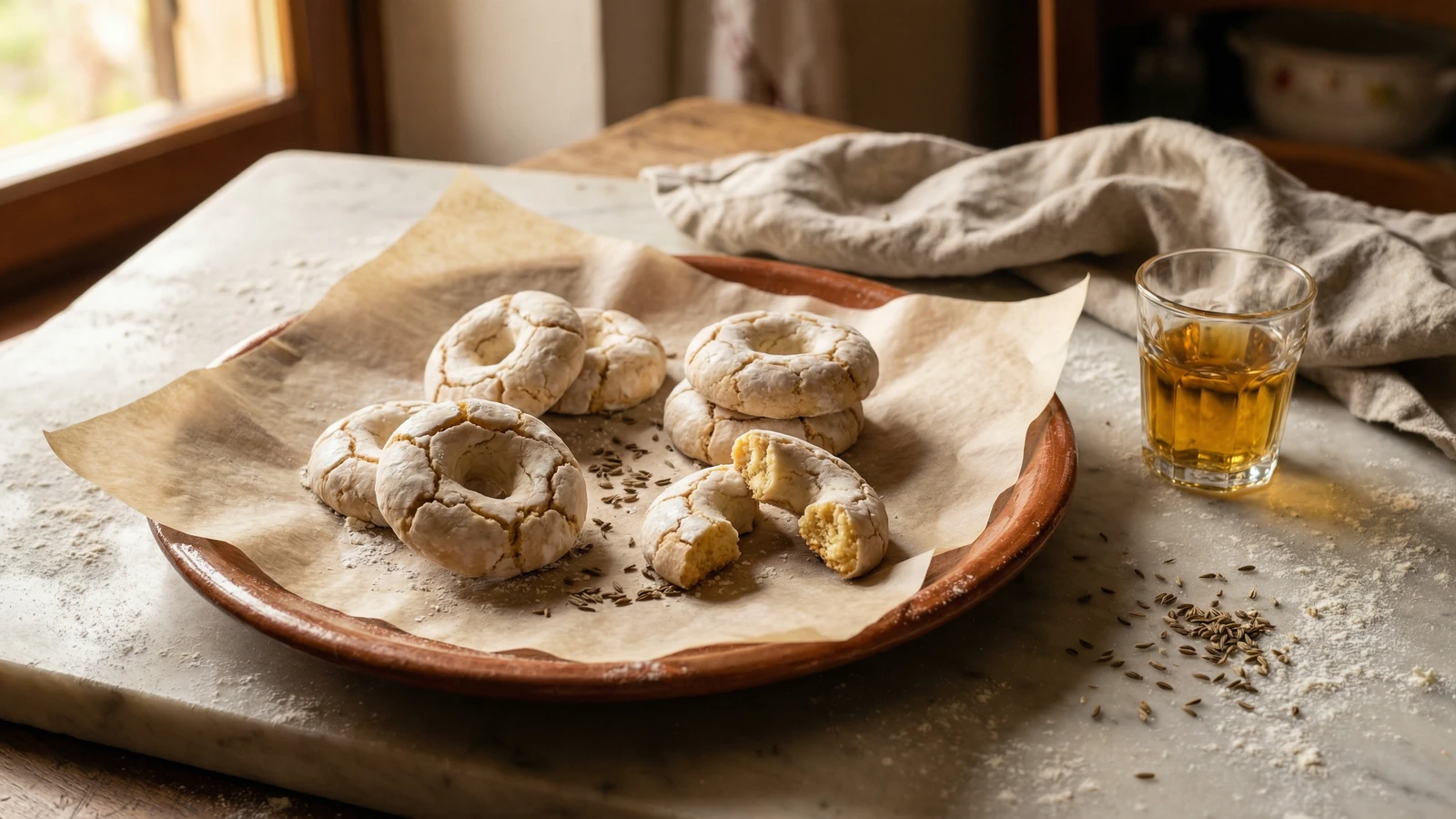
Mountain cookies from the high Apennines, where shepherds and woodcutters needed sustenance that would keep. The crackled white glaze conceals a tender, anise-scented crumb that tastes of another century.
These are the cookies of the montanari, the mountain people who lived in the high passes between Tuscany and Emilia-Romagna. They are not elegant. They are not refined. They are the cookies that sustained families through long winters when the snow closed the roads and the pantry held only what had been stored in autumn.
The anise here is not subtle. It announces itself, as mountain food must. The glaze, called ghiaccia in Italian, forms a shell that cracks when you bite through it. This is not a flaw. This is the point. The contrast between the hard, sweet exterior and the tender crumb beneath is what makes these cookies memorable.
Zuccherini means 'little sugared things,' and montanari tells you exactly who made them and where. Village women shaped these rings for feast days, for weddings, for the moments when ordinary bread would not do. They keep for weeks in a tin, which mattered when you lived hours from the nearest town.
Zuccherini montanari belong to the pastoral traditions of the Apennine ridge, where the borders between Tuscany and Emilia-Romagna blur into high meadows and chestnut forests. The cookies appear in village records from the 18th century, always associated with celebrations: weddings, baptisms, the feast of the local patron saint. The anise, grown in kitchen gardens or gathered wild, was believed to aid digestion and ward off illness.
Quantity
500g
Quantity
200g
Quantity
150g
softened
Quantity
3
Quantity
2 tablespoons
Quantity
1 tablespoon
Quantity
1
zested
Quantity
1 teaspoon
Quantity
1/4 teaspoon
Quantity
300g
sifted
Quantity
3 to 4 tablespoons
Quantity
1/2 teaspoon
| Ingredient | Quantity |
|---|---|
| all-purpose flour | 500g |
| granulated sugar | 200g |
| unsalted buttersoftened | 150g |
| large eggs | 3 |
| anise liqueur | 2 tablespoons |
| anise seeds | 1 tablespoon |
| lemonzested | 1 |
| baking powder | 1 teaspoon |
| fine sea salt | 1/4 teaspoon |
| confectioners' sugarsifted | 300g |
| warm water | 3 to 4 tablespoons |
| anise extract | 1/2 teaspoon |
Place the anise seeds in a small dry skillet over medium heat. Shake the pan frequently until the seeds become fragrant and darken slightly, about 2 minutes. Watch them. They burn quickly. Transfer immediately to a plate to cool, then crush lightly with the flat of a knife. You want pieces, not powder.
In a large bowl, beat the softened butter and granulated sugar until pale and fluffy, about 4 minutes with an electric mixer. The mixture should hold soft peaks when you lift the beater. This aeration gives the cookies their tender crumb.
Add the eggs one at a time, beating well after each addition. The mixture may look curdled. It will come together. Beat in the anise liqueur, crushed anise seeds, and lemon zest. The bowl should smell strongly of anise now.
Whisk together the flour, baking powder, and salt in a separate bowl. Add to the butter mixture in three additions, mixing on low speed until just combined after each. The dough will be soft and slightly sticky. Do not overmix. Overworked dough makes tough cookies.
Gather the dough into a ball, flatten into a disk, and wrap in plastic. Refrigerate for at least 30 minutes. The dough must be cool enough to handle but not so cold that it cracks when shaped. If it becomes too firm, let it rest at room temperature for 10 minutes.
Preheat your oven to 180°C (350°F). Line two baking sheets with parchment. Working with small portions of dough, roll pieces into ropes about 10cm long and the thickness of your finger. Bring the ends together to form rings, pressing gently to seal. Place on prepared sheets, spacing 3cm apart.
Bake for 12 to 15 minutes, rotating the pans halfway through. The cookies are done when the bottoms are lightly golden and the tops are set but still pale. They will firm as they cool. Do not overbake. A dry cookie cannot be rescued.
Let the cookies cool on the baking sheets for 5 minutes, then transfer to wire racks. They must be completely cool before glazing. Warm cookies will melt the glaze into a sticky mess rather than forming the characteristic shell.
Sift the confectioners' sugar into a bowl. Add the anise extract and 3 tablespoons warm water. Whisk until smooth. The glaze should be thick but pourable, like heavy cream. Add more water by the teaspoon if needed. It will set quickly, so work efficiently.
Set a wire rack over a sheet pan to catch drips. Dip the top of each cookie into the glaze, letting the excess drip off for a moment, then flip glazed-side up onto the rack. Alternatively, spoon glaze over each cookie, spreading with the back of the spoon. Let the glaze set completely, at least one hour, before storing.
1 serving (about 35g)
Culinary guides, cultural storytelling, and the editorial depth that makes cooking meaningful.
Discover Culinary ExplorerChef Graziella
The sweet half-moon pastries of Bologna, filled with quince mostarda and baked until golden. A San Giuseppe tradition that proves dessert can carry memory and meaning in every bite.

Chef Graziella
The twice-baked almond cookies of the Emilian hills, honest about their intention from the name alone. You will not eat these dry unless you have teeth of iron.

Chef Graziella
The ancient honey and nut tart of Emilia, encased in thin, shattering pastry and dense with spiced fruit. Christmas in Brescello has tasted like this for centuries.

Chef Graziella
Golden pillows of sweet egg pasta encasing vanilla cream perfumed with anise liqueur, fried until blistered and crisp, then buried under powdered sugar. Piacenza's gift to Carnival.