
Chef Graziella
Cantucci di Prato
The original twice-baked almond cookies of Tuscany, made without butter as tradition demands, hard enough to shatter between your teeth until you dip them in Vin Santo and they surrender.
A cooking platform built around craft, culture, and the stories behind what we eat.
Created by
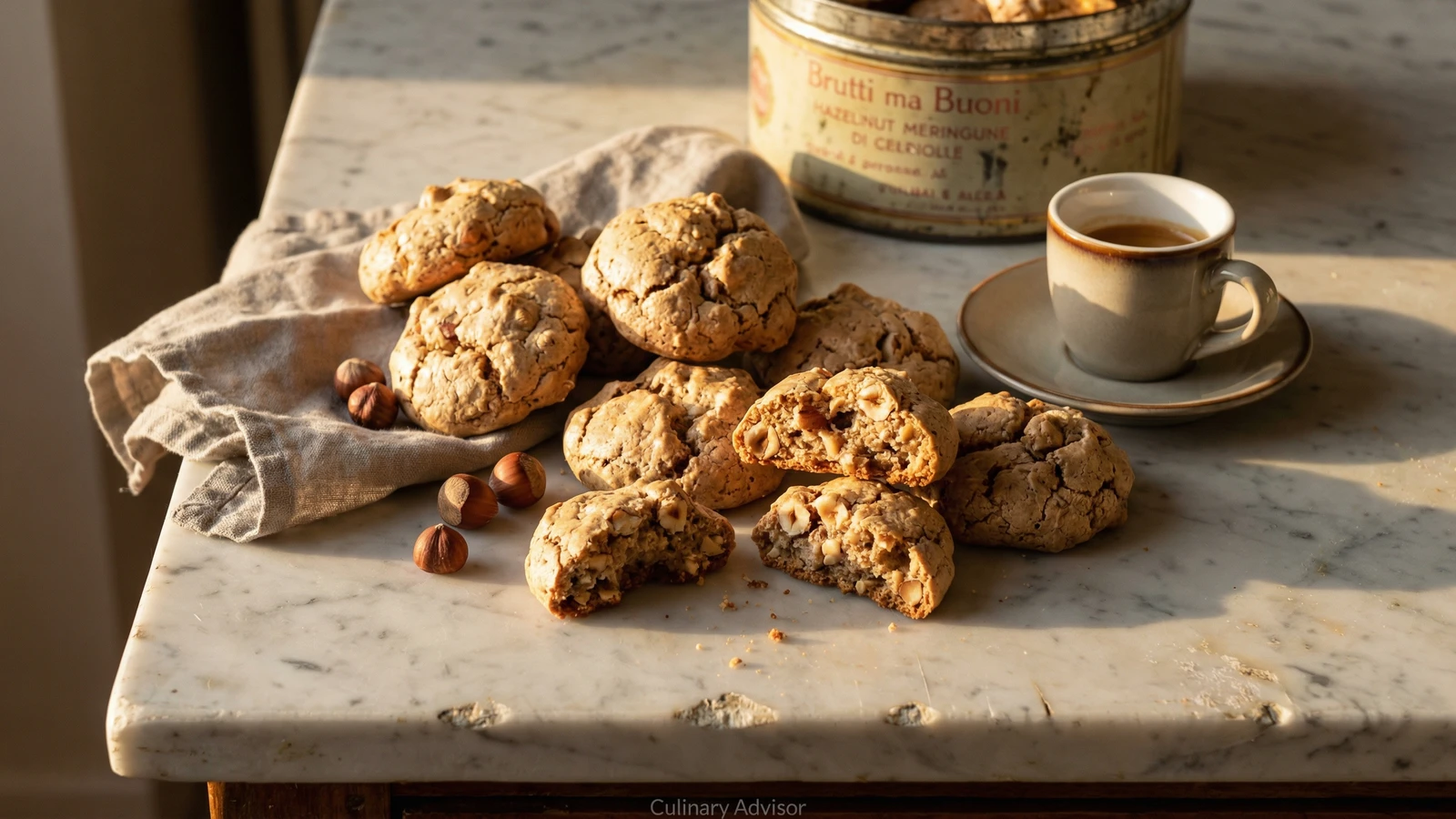
The cookies that prove beauty is the enemy of honest baking. Lumpy, cracked, and perfect, these hazelnut meringues are crisp shells hiding chewy, nutty centers.
The name says everything you need to know. Brutti ma buoni. Ugly but good. This is Italian honesty at its finest: we will not pretend these cookies are pretty, because they are not. They are lumpy and cracked and irregular, each one different from the last. And they are among the most satisfying cookies you will ever eat.
The technique is unusual. You cook the meringue mixture on the stovetop first, stirring constantly until it pulls away from the pan. This seems wrong. It feels like you are ruining it. You are not. This step dries the meringue and concentrates the flavor, creating that signature texture: a crisp exterior that shatters when you bite through to the chewy, nutty center.
The hazelnuts must be toasted and skinned, then chopped by hand. Not too fine, not too coarse. You want pieces that give resistance, that announce themselves. The egg whites provide structure, not sweetness. The sugar, added gradually, provides both. There is nothing else. No flour, no butter, no leavening. Just nuts, whites, and sugar, transformed by heat and patience into something greater than their parts.
Do not attempt to make these beautiful. Their beauty lies precisely in their ugliness. If your brutti ma buoni come out looking uniform and smooth, you have made a different cookie. You have missed the point entirely.
Brutti ma buoni trace their origins to Garibaldi's Italy, with the town of Borgomanero in Piedmont and Prato in Tuscany both claiming parentage. The cookie emerged from the practical wisdom of pasticcerie that refused to waste egg whites left over from custard making. Whether Piedmontese or Tuscan, the name itself, registered in the 19th century, reveals Italian pragmatism: acknowledge the flaw, celebrate the flavor.
Quantity
300g
Quantity
200g
Quantity
3 (about 100g)
Quantity
1 teaspoon
Quantity
pinch
| Ingredient | Quantity |
|---|---|
| whole hazelnuts | 300g |
| granulated sugar | 200g |
| large egg whites | 3 (about 100g) |
| pure vanilla extract | 1 teaspoon |
| fine sea salt | pinch |
Spread the hazelnuts in a single layer on a rimmed baking sheet. Toast in a 350°F oven for 12 to 15 minutes, shaking the pan halfway through, until the skins crack and blister and the nuts are golden beneath. You will smell them before you see the color change. Remove from the oven and let cool for five minutes.
While still warm, bundle the hazelnuts in a clean kitchen towel. Rub vigorously, letting the friction loosen the papery skins. Open the towel and pick out the nuts, leaving the skins behind. Some skin will cling. This is acceptable. Do not obsess. You want most of the skins removed, not every last flake.
Chop the skinned hazelnuts by hand with a heavy knife. You want a mixture of sizes: some pieces the size of a pea, others finer. Do not use a food processor, which will crush them into paste. The irregular texture is the point. Set aside.
In a large bowl, beat the egg whites with the salt using a whisk or electric mixer until they hold soft peaks. Add the sugar gradually, a few tablespoons at a time, beating well after each addition. Continue until the whites are glossy and hold stiff peaks when the whisk is lifted. Add the vanilla and beat briefly to incorporate.
Using a large spatula, fold the chopped hazelnuts into the meringue. Work gently but thoroughly. The nuts should be evenly distributed throughout. The mixture will be thick and heavy, no longer the ethereal cloud of pure meringue.
Transfer the mixture to a heavy-bottomed saucepan or large skillet. Set over the lowest possible heat. Stir constantly with a wooden spoon or heatproof spatula, scraping the bottom and sides. The mixture will seem to melt, become liquid, then gradually thicken again. Continue stirring for 15 to 20 minutes. The mixture is ready when it pulls away from the sides of the pan cleanly and holds its shape when you stop stirring.
Line two baking sheets with parchment paper. Working quickly while the mixture is still warm and pliable, use two spoons to drop rough mounds onto the prepared sheets, spacing them about two inches apart. Each cookie should be approximately one and a half tablespoons. Do not smooth them. Do not shape them into balls. Let them be ugly. That is their nature.
Bake in a 300°F oven for 20 to 25 minutes, rotating the sheets halfway through. The cookies are done when they are golden brown and feel dry to the touch on top, but still give slightly when pressed. They will crisp further as they cool. Remove from the oven and let cool completely on the baking sheets before removing. Do not touch them while warm. They are fragile until set.
Once completely cool, store the cookies in an airtight container at room temperature. They will keep for two weeks, though they rarely last that long. The contrast between crisp exterior and chewy interior remains if stored properly. Humidity is the enemy.
1 serving (about 17g)
Culinary guides, cultural storytelling, and the editorial depth that makes cooking meaningful.
Discover Culinary ExplorerChef Graziella
The original twice-baked almond cookies of Tuscany, made without butter as tradition demands, hard enough to shatter between your teeth until you dip them in Vin Santo and they surrender.

Chef Graziella
The ancient spiced honey cookies of Siena, dense with walnuts and candied fruit, perfumed with anise. Medieval travelers sustained themselves with these at stable inns, and the name stuck.

Chef Graziella
The ancient almond cookies of Siena, soft as a whisper, crackled on top, buried in powdered sugar. Eight centuries of Tuscan tradition in every bite.

Chef Juliette
A pale short-paste shell holds silken, lightly sweet carrot purée beneath neat glazed half-discs, their butter syrup catching the light: a classical tart poised between vegetable course and sweet.