
Chef Graziella
Baci di Dama
Piedmont's famous hazelnut cookies, each one small as a walnut and twice as fragile. Two tender domes joined by a whisper of dark chocolate, named for how they resemble lips meeting in a kiss.
A cooking platform built around craft, culture, and the stories behind what we eat.
Created by
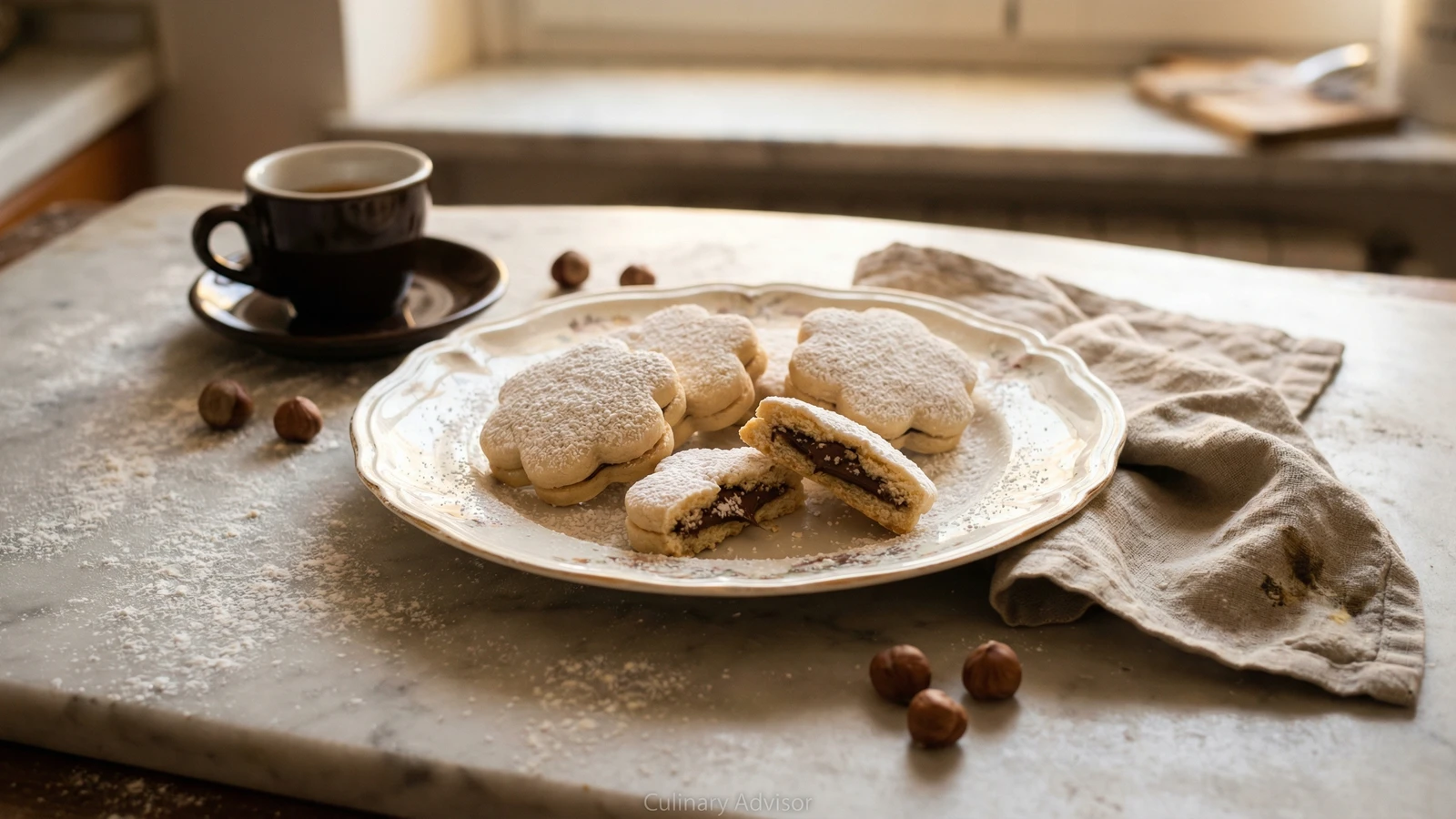
The flower-shaped butter cookies of Piedmont, impossibly tender from cooked egg yolks, sandwiched with gianduia cream. What the pasticcerie of Turin have known for generations.
These are not the canestrelli of Liguria, those simple rounds dusted with powdered sugar. The Piemontese version is something else entirely: two paper-thin wafers, delicate as communion hosts, embracing a filling of hazelnut and chocolate. The technique that makes them so tender will seem strange at first. You will hard-boil eggs, use only the yolks, and press them through a sieve. This is not optional. This is what separates a proper canestrello from an ordinary butter cookie.
Piedmont understands hazelnuts the way Emilia understands pork. The Tonda Gentile delle Langhe, grown in the hills south of Turin, is considered the finest hazelnut in the world. When Napoleon's blockades cut off cocoa supplies in the early 1800s, Piedmontese chocolatiers stretched their precious chocolate with local hazelnuts and created gianduia. That same combination fills these cookies.
The dough must stay cold. The butter must be cold. Your hands should work quickly. If the dough becomes soft and sticky, you have failed. Put it back in the refrigerator and try again. Simple does not mean easy.
Canestrelli take their name from 'canestro,' the Italian word for basket, likely referring to early versions baked in basket-shaped molds. The Piedmontese sandwich variation emerged in the 19th century alongside Turin's flourishing café culture, where pasticcerie competed to create ever more refined small pastries to accompany coffee and vermouth.
Quantity
250g
cold, cut into small cubes
Quantity
100g, plus more for dusting
Quantity
3
cooled and sieved
Quantity
1 teaspoon
Quantity
pinch
Quantity
300g
Quantity
150g
Quantity
100g (70% cacao)
finely chopped
Quantity
60g
softened
Quantity
30g
Quantity
1 tablespoon
| Ingredient | Quantity |
|---|---|
| unsalted buttercold, cut into small cubes | 250g |
| powdered sugar | 100g, plus more for dusting |
| hard-boiled egg yolkscooled and sieved | 3 |
| pure vanilla extract | 1 teaspoon |
| fine sea salt | pinch |
| all-purpose flour | 300g |
| Piedmontese hazelnuts | 150g |
| dark chocolatefinely chopped | 100g (70% cacao) |
| unsalted buttersoftened | 60g |
| powdered sugar | 30g |
| hazelnut liqueur (optional) | 1 tablespoon |
Place three eggs in a small saucepan and cover with cold water by one inch. Bring to a boil, then remove from heat, cover, and let stand for 12 minutes. Transfer eggs to ice water. When completely cool, peel and separate the yolks from the whites. Discard the whites or save them for another use. Press the yolks through a fine-mesh sieve into a small bowl. They should be dry and crumbly, like fine sand.
In a large bowl, combine the flour, powdered sugar, and salt. Add the cold butter cubes. Using your fingertips or a pastry cutter, work the butter into the flour until the mixture resembles coarse meal with some pea-sized pieces remaining. Add the sieved egg yolks and vanilla. Mix gently until the dough just comes together. Do not overwork it. The warmth of your hands is the enemy.
Divide the dough in half. Flatten each portion into a disc, wrap tightly in plastic, and refrigerate for at least one hour. The dough must be thoroughly cold before rolling. You may refrigerate it overnight.
While the dough chills, spread the hazelnuts in a single layer on a baking sheet. Toast in a 350°F oven for 10 to 12 minutes, until the skins crack and the nuts are fragrant and golden. Transfer immediately to a clean kitchen towel, fold the towel over, and rub vigorously to remove the skins. Some skin will remain. This is acceptable. Let the nuts cool completely.
Place the chopped chocolate in a heatproof bowl. Set over a pan of barely simmering water, ensuring the bowl does not touch the water. Stir until just melted, then remove from heat. In a food processor, grind the cooled hazelnuts until they become a paste, scraping down the sides several times. This takes 3 to 4 minutes. Add the softened butter, powdered sugar, melted chocolate, and liqueur if using. Process until smooth and creamy. Transfer to a bowl and refrigerate until spreadable but not hard, about 30 minutes.
Preheat the oven to 325°F. Line baking sheets with parchment paper. Working with one disc of dough at a time, roll on a lightly floured surface to 3mm thickness. This is thin. The cookies must be delicate. Using a 5cm flower-shaped cutter, cut as many shapes as possible. Transfer to prepared baking sheets, spacing them 2cm apart. Gather scraps, chill briefly, and reroll once. More than one reroll toughens the cookies.
Bake for 12 to 14 minutes, rotating the pan halfway through. The cookies are done when the edges are barely golden and the tops remain pale. They will seem underdone. They are not. They will crisp as they cool. Remove from oven and let cool on the baking sheet for five minutes before transferring to a wire rack to cool completely.
Match cookies into pairs of similar size. Spread approximately one teaspoon of gianduia cream on the flat side of one cookie. Press the flat side of its partner gently on top. The filling should reach nearly to the edges but not squeeze out. Repeat with remaining cookies and cream.
Place the assembled cookies on a wire rack set over parchment paper. Dust generously with powdered sugar through a fine-mesh sieve. The sugar should blanket the tops like fresh snow. Let the cookies rest for 30 minutes before serving. The filling will set slightly and the flavors will meld.
1 serving (about 42g)
Culinary guides, cultural storytelling, and the editorial depth that makes cooking meaningful.
Discover Culinary ExplorerChef Graziella
Piedmont's famous hazelnut cookies, each one small as a walnut and twice as fragile. Two tender domes joined by a whisper of dark chocolate, named for how they resemble lips meeting in a kiss.

Chef Graziella
The curved cornmeal cookies of Casale Monferrato, where butter, sugar, and fine maize flour come together in a crumbly, sandy sweetness that has survived unchanged since 1878.

Chef Graziella
The humble cornmeal cookies of Piedmont's wine country, where farmers' wives turned polenta flour and butter into something that has outlasted fashions and earned a place beside the region's finest wines.

Chef Juliette
A pale short-paste shell holds silken, lightly sweet carrot purée beneath neat glazed half-discs, their butter syrup catching the light: a classical tart poised between vegetable course and sweet.