
Chef Klaus
Himmel und Erde
Rhenish heaven and earth is cheap winter sense: floury potatoes folded with tart apple, then covered with crisp-edged blood sausage and fried onions. Sweet meets sharp. Fat makes it a meal.
A cooking platform built around craft, culture, and the stories behind what we eat.
Created by
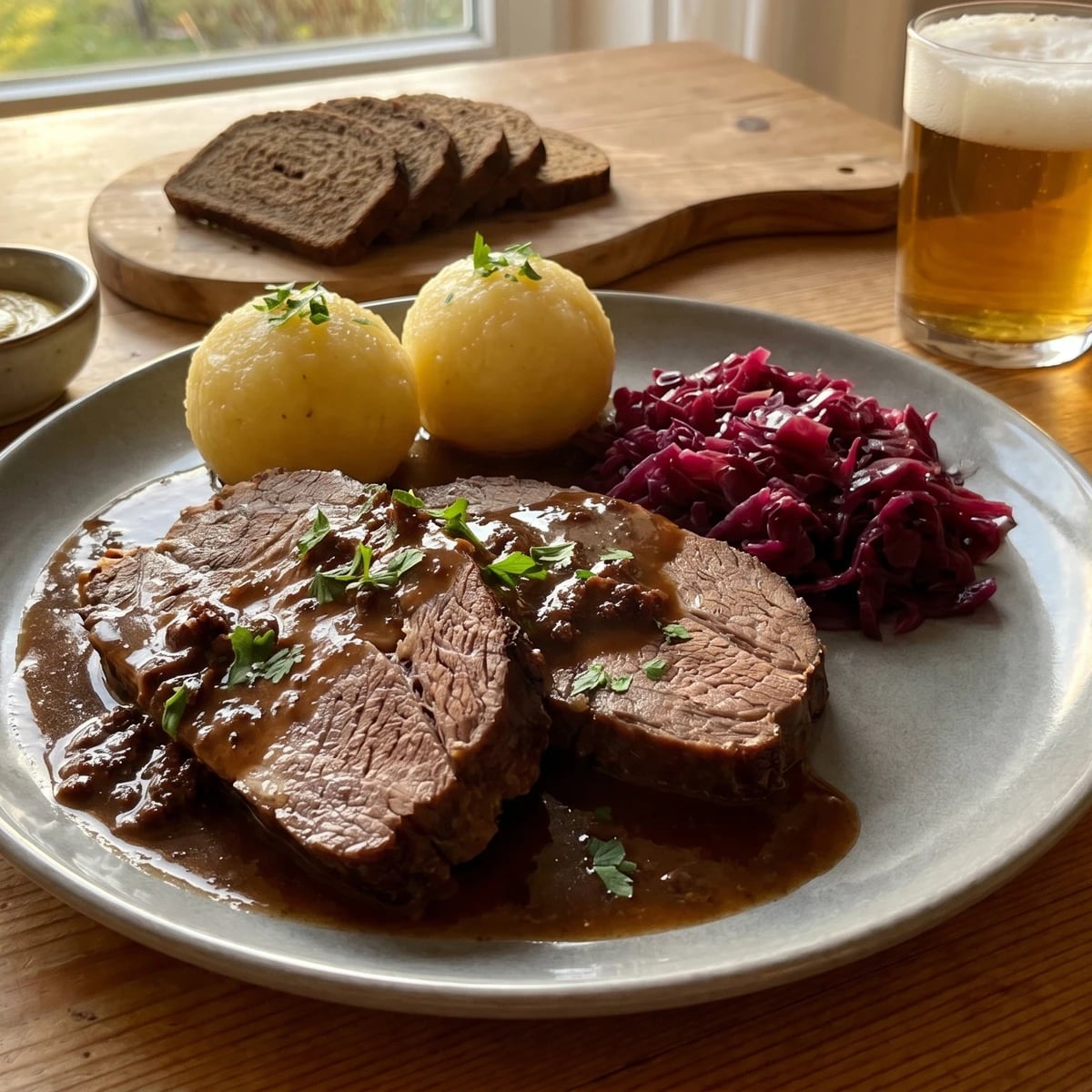
A fresh Westphalian beef shoulder roast, browned hard, braised low with roots, and finished with a dark pumpernickel gravy made from the pot, not a jar.
Westfälischer Schmorbraten is the Westphalian Sunday roast, built for the colder half of the year when the cellar has onions, carrots, celeriac, and rye bread waiting. I cook it from fresh beef shoulder, not a sour marinade, so the meat tastes of beef and the sauce tastes of the pot. This is the piece a confident home cook sets down for a birthday, a church Sunday, or a Monday after the Sunday work is done.
Every region pulls a roast its own way. The Rhineland turns toward Sauerbraten, with vinegar, raisins, and Lebkuchen; Swabia wants enough sauce for Spätzle, small egg noodles; Bavaria often argues from pork skin and beer. Westphalia keeps the roast plain and dark, roots underneath, stock from bones if you've got it, and a little Pumpernickel, the dense rye bread, to thicken what the meat has already given. Im Norden anders, im Süden anders.
The technique is the low braise, and low means the liquid only trembles. I brown the meat and roots first because a pale pot gives a pale gravy, then I set the covered pot into a cool oven and let it climb slowly; the shoulder tightens if it is bullied, but collagen melts when it is brought through heat gently and held there. Boil it hard and you've made grey strings. Runter mit der Temperatur.
When the fork turns in the meat, the sauce is already in the pot. Strain, press or blend the vegetables, crumble in the rye, and season at the end with mustard, vinegar, salt, and pepper. Nicht aus dem Glas. A packet would only hide the work you already did.
Westphalia's table was shaped by mixed farming on the North German Plain and the hill country to the south: cattle, pigs, rye, potatoes, cabbage, and stored roots made winter cooking practical long before refrigeration. The region became a Prussian province after the Congress of Vienna in 1815, but its food lines do not follow one neat border; Münsterland, Sauerland, and the Ruhr all keep different habits around meat, bread, and beer. Westfälischer Pumpernickel, the long-baked dark rye bread used here to deepen the gravy, has been protected in the European Union as a geographical indication since 2014.
Quantity
1.6kg
tied into an even roast
Quantity
2 teaspoons, plus more to finish
Quantity
1 teaspoon
Quantity
2 tablespoons
Quantity
3
thickly sliced
Quantity
2
chopped
Quantity
150g
chopped
Quantity
1
white and light green parts, rinsed and sliced
Quantity
2 tablespoons
Quantity
250ml
Quantity
750ml
Quantity
2
Quantity
6
lightly crushed
Quantity
4
Quantity
40g
crumbled
Quantity
1 tablespoon
Quantity
1 to 2 teaspoons
Quantity
1 small handful
chopped
| Ingredient | Quantity |
|---|---|
| beef shoulder or chucktied into an even roast | 1.6kg |
| fine salt | 2 teaspoons, plus more to finish |
| freshly ground black pepper | 1 teaspoon |
| lard or rapeseed oil | 2 tablespoons |
| onionsthickly sliced | 3 |
| carrotschopped | 2 |
| celeriacchopped | 150g |
| leekwhite and light green parts, rinsed and sliced | 1 |
| tomato paste | 2 tablespoons |
| malty dark beer | 250ml |
| unsalted beef stock from roasted bones | 750ml |
| bay leaves | 2 |
| juniper berrieslightly crushed | 6 |
| allspice berries | 4 |
| Westphalian Pumpernickel or dense dark ryecrumbled | 40g |
| sharp German mustard | 1 tablespoon |
| apple vinegar or pickle brine | 1 to 2 teaspoons |
| flat-leaf parsley (optional)chopped | 1 small handful |
Pat the beef dry and salt it all over 30 to 60 minutes before it goes in the pot, then tie it if it sprawls. Salt first pulls moisture to the surface, then moves back into the meat; that short rest seasons the roast without leaving a wet skin. Pat it dry again before searing, because water on the surface spends heat on drying instead of browning.
Heat the lard or oil in a heavy lidded pot over medium-high heat and brown the beef on every side, 12 to 15 minutes total. Don't rush it. The brown crust is not decoration; it is the colour and depth of the gravy before the liquid ever goes in. Lift the beef to a plate and keep the fat in the pot.
Add the onions, carrots, and celeriac to the pot with a pinch of salt and cook until the edges are deep golden, about 10 minutes. Add the leek for the last 3 minutes so it sweetens without burning, then stir in the tomato paste and cook until it turns brick-red. Pour in the beer and scrape the bottom clean; the stuck brown bits are the made sauce beginning. Let the beer reduce by half so the gravy tastes dark, not thin.
Add the stock, bay leaves, juniper, and allspice, then return the beef to the pot. The liquid should come about halfway up the roast; too much liquid boils the meat and weakens the sauce. Cover the pot, set it in a cool oven, then set the oven to 150C. Braise for 3 to 3 1/2 hours, turning the roast once, until a fork turns in the meat with little resistance. The slow climb through heat lets collagen melt before the muscle tightens hard. If the liquid bubbles hard, drop the oven to 135C. Runter mit der Temperatur.
Lift the roast to a board and rest it loosely covered for 20 minutes, because meat sliced straight from the pot spills its juices and cuts ragged. Remove the bay, juniper, and allspice from the braising liquid. Press the vegetables through a sieve or blend half of them into the liquid; Weggeworfen wird nichts, they are part of the sauce now. Simmer the sauce, crumble in the Pumpernickel, and whisk until it dissolves and thickens the gravy. Rye gives body and a quiet dark bitterness without flour.
Stir in the mustard and 1 teaspoon vinegar or pickle brine, then taste before adding more salt and pepper. Mustard, acid, and salt go in at the end because long boiling dulls them. Slice the beef across the grain into thick slices, lay it back in the gravy for a few minutes, and serve with boiled potatoes, Kartoffelklöße, potato dumplings, or Spätzle, small egg noodles, plus red cabbage or a sharp pickle. Schön ist, was schmeckt.
1 serving (about 300g)
Culinary guides, cultural storytelling, and the editorial depth that makes cooking meaningful.
Discover Culinary Explorer
Chef Klaus
Rhenish heaven and earth is cheap winter sense: floury potatoes folded with tart apple, then covered with crisp-edged blood sausage and fried onions. Sweet meets sharp. Fat makes it a meal.

Chef Klaus
Münsterland puts the potato into one thick pan cake, not a stack of little fritters: crisp edges, soft centre, bacon fat doing honest work.

Chef Klaus
Münsterland's sharp market ragout, once calf's head and now mostly veal and beef, works only when the meat is made tender before mustard, capers, and vinegar touch the pot.

Chef Klaus
Westphalia's pepper pot lives on onions, patient beef, and dark rye crumbs, not jarred sauce. The pepper is real, the simmer is low, and the spoon should stand in it.