
Chef Klaus
Allgäuer Krautkrapfen
The Allgäu pan dish that makes a meal from noodle dough, winter kraut, onion, and fat: brown the cut sides first, then cook gently so the rolls hold.
A cooking platform built around craft, culture, and the stories behind what we eat.
Created by
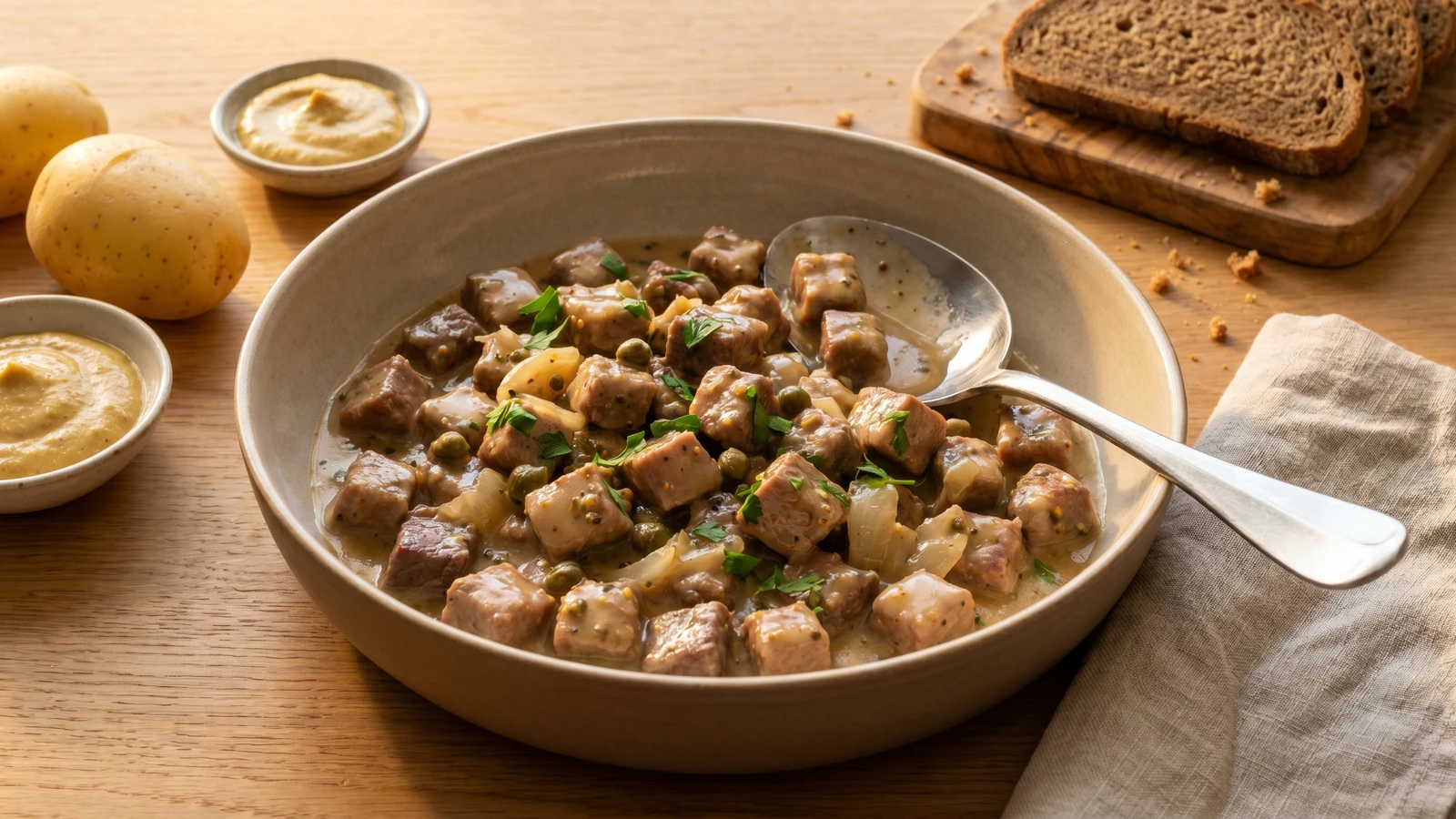
Münsterland's sharp market ragout, once calf's head and now mostly veal and beef, works only when the meat is made tender before mustard, capers, and vinegar touch the pot.
Töttchen belongs to Münsterland, the flat Westphalian country around Münster and Warendorf, and it smells of autumn markets, butcher's mornings, and the pot kept ready when people came in cold and hungry. It was once calf's head, tongue, and small bits from the slaughter table, cut into a sour mustard sauce. Weggeworfen wird nichts, nothing gets thrown away. Today I use veal shoulder and beef shin unless the butcher has head meat, because the point is not nostalgia; the point is gelatine, tenderness, and a sauce sharp enough to wake the meat up.
Every place that cooks sour meat has an opinion. The Rhineland goes sweet-and-sour with raisins and gingerbread in Sauerbraten; Swabia has its Saure Kutteln, sour tripe; Münsterland keeps Töttchen paler and sharper, with mustard, capers, vinegar, and onions. Im Norden anders, im Süden anders. This one is Westphalian, so don't turn it into brown roast gravy. Nicht aus dem Glas.
The rule is simple: tender first, sour after. Cook the veal and beef gently in unsoured stock, then add vinegar, mustard, and capers when the sauce already has body. Acid early tightens the meat and makes the broth dull; acid late cuts through tender meat and keeps the sauce clean.
Watch the pot, not the clock. A bare tremble gives you clear broth and meat that slices into neat pieces; a hard boil gives you grey shreds and a cloudy sauce. Das braucht seine Zeit, but not a whole Sunday. Serve it with boiled potatoes or rye bread and let the sharp sauce do its work.
Töttchen is a Münsterland specialty from Westphalia and began as a Schlachttag, a slaughter-day, and market dish made from calf's head, tongue, and small trimmings sold to cattle dealers and town workers. Warendorf's October Töttchenmarkt keeps the dish tied to the autumn market calendar, when fattened animals were traded and the head was not waste but supper. The modern dispute is the old butcher's table against the home kitchen: calf's head gives the old gelatine and texture, while veal and beef shoulder keep the dish cookable where head meat has vanished from ordinary counters.
Quantity
700g
in one large piece
Quantity
500g
in one large piece
Quantity
1kg
rinsed
Quantity
2
1 halved and 1 finely diced
Quantity
1
roughly chopped
Quantity
100g
roughly chopped
Quantity
1
split and rinsed
Quantity
2
Quantity
8
Quantity
4
lightly crushed
Quantity
2 litres
plus more if needed
Quantity
40g
Quantity
40g
Quantity
3 tablespoons
Quantity
3 tablespoons
plus more to taste
Quantity
2 tablespoons
drained
Quantity
1 tablespoon
Quantity
1 teaspoon
Quantity
to taste
Quantity
small handful
chopped
Quantity
to serve
| Ingredient | Quantity |
|---|---|
| veal shoulder or veal breastin one large piece | 700g |
| beef shin or chuckin one large piece | 500g |
| veal bones or beef marrow bonesrinsed | 1kg |
| onions1 halved and 1 finely diced | 2 |
| carrotroughly chopped | 1 |
| celeriacroughly chopped | 100g |
| small leeksplit and rinsed | 1 |
| bay leaves | 2 |
| black peppercorns | 8 |
| allspice berrieslightly crushed | 4 |
| cold waterplus more if needed | 2 litres |
| butter or lard | 40g |
| plain flour | 40g |
| sharp German mustard | 3 tablespoons |
| white wine vinegarplus more to taste | 3 tablespoons |
| capersdrained | 2 tablespoons |
| caper brine | 1 tablespoon |
| sugar | 1 teaspoon |
| salt and freshly ground black pepper | to taste |
| flat-leaf parsley (optional)chopped | small handful |
| boiled potatoes or thick rye bread (optional) | to serve |
Put the bones and beef into a heavy pot with the cold water and bring it up slowly, skimming the grey foam as it rises. Cold water pulls gelatine and flavour out of the bones before the meat tightens; a fast boil seals the outside, clouds the broth, and gives you a muddy sauce later.
Add the halved onion, carrot, celeriac, leek, bay, peppercorns, and allspice, then keep the pot at a bare tremble for 1 hour. Add the veal after that first hour, because beef shin needs the head start and veal turns dry if it is bullied for the full time. Cook another 1 to 1 1/4 hours, until a skewer slides into both meats without resistance.
Lift out the meat and strain the broth through a fine sieve, pressing nothing through because cloudy vegetable mash makes a dull sauce. Measure 1 litre of broth and keep it hot. When the meat is cool enough to handle, cut it into small bite-size cubes and moisten it with one ladle of broth, because dry boiled meat never becomes tender again by wishing.
Melt the butter or lard in a wide saucepan and sweat the finely diced onion until soft but not brown. Stir in the flour and cook it for 2 minutes, moving it constantly, so the flour loses its raw taste before the broth goes in. Keep it pale; Töttchen is a sharp Münsterland ragout, not a dark roast sauce.
Whisk in the hot broth a ladle at a time until the sauce is smooth, then simmer it gently for 15 minutes so the flour swells fully and the sauce takes on a light gloss. Add the diced meat and warm it through at low heat. Runter mit der Temperatur, down with the temperature; boiling now breaks the meat apart and turns neat ragout into scraps.
Stir in the mustard, vinegar, capers, caper brine, sugar, salt, and pepper, then let the sauce barely move for 5 minutes. Mustard and vinegar go in at the end because long boiling dulls the mustard and drives the vinegar harsh, while late acid stays bright against the meat. Taste it properly: sour first, then meat, then salt. Würzen, Fett, Salz zum Schluss.
Spoon the Töttchen into shallow bowls, scatter with parsley if you use it, and serve with boiled potatoes or thick rye bread. The potatoes catch the sauce, the bread wipes the bowl, and both are better than pretending this needs decoration. Schön ist, was schmeckt.
1 serving (about 330g)
Culinary guides, cultural storytelling, and the editorial depth that makes cooking meaningful.
Discover Culinary ExplorerChef Klaus
The Allgäu pan dish that makes a meal from noodle dough, winter kraut, onion, and fat: brown the cut sides first, then cook gently so the rolls hold.

Chef Klaus
Swabian egg pasta turned toward the apple cellar: fresh Spätzle tossed with browned butter, tart apples, cinnamon, and enough restraint to stay supper, not cake.

Chef Klaus
Hesse's pork goulash belongs to Apfelwein country: shoulder, onions, and tart cider cooked low until the cheap cut turns soft and the sauce lands sweet-sour, not sour-sweet.

Chef Klaus
The old sweet supper that saves yesterday's loaf: stale bread drinks eggy milk, the pan stays moderate, and butter browns the outside only after the centre has set.