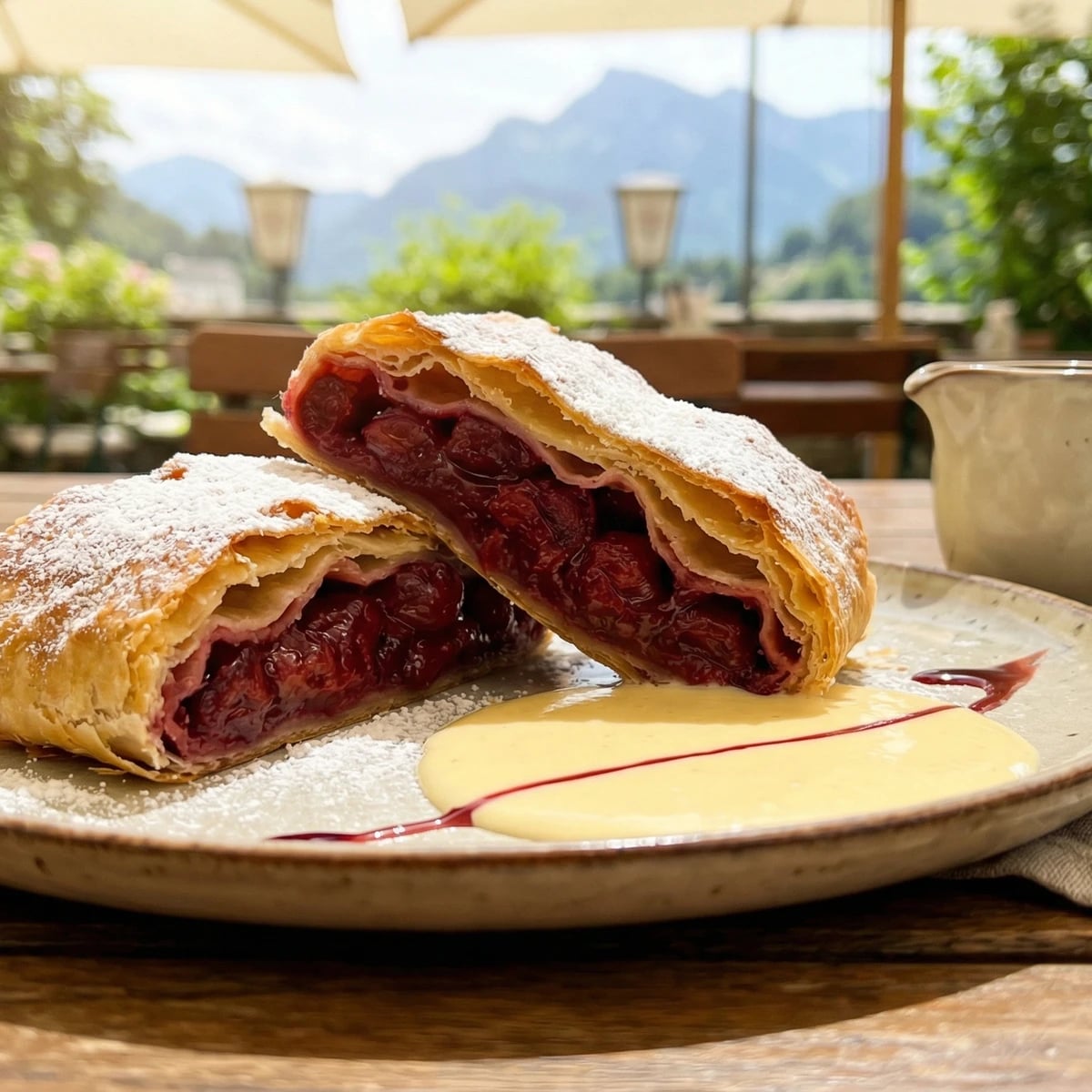
Hand-stretched strudel filled with tart Weichseln sour cherries, butter-toasted breadcrumbs, and a whisper of cinnamon, baked until the pastry shatters and the fruit spills dark and warm onto your plate.
Pastries & Cookies
Austrian
Dinner Party
Special Occasion
1 hr
Active Time
35 min cook•1 hr 35 min total
Yield6 servings
There were maybe three weeks every summer when Gretel and my grandmother Eva would get excited about the same thing at the same time. The sour cherries were in. Weichseln, the Austrians call them, and if you've only ever eaten sweet cherries from a supermarket bag, you don't yet know what a cherry can be. Weichseln are smaller, darker, sharper. They taste like summer with something to say.
I remember Gretel pitting them at Eva's kitchen table in Kent, her fingers stained red to the knuckle, a bowl of fruit in front of her and a saucer of pits growing beside it. She'd pop one in her mouth every few minutes and wince a little at the sourness, then smile. The strudel that came out of those afternoons was the best thing I'd ever tasted. Thin, crackling pastry giving way to hot, jammy fruit that had just enough sugar to let the tartness sing instead of shout.
Weichselstrudel is a seasonal dish and I won't pretend otherwise. You make it in July when the sour cherries arrive, and you make it as many times as you can before they disappear. The window is narrow. That's part of what makes it special. Austrian cooking is honest about seasons, and this strudel belongs to high summer the way Zwetschkenstrudel belongs to autumn. If you can't find fresh Weichseln, jarred Schattenmorellen (preserved sour cherries) from a good German or Austrian grocer are a decent stand-in, but drain them well. The dough is the same hand-stretched strudel dough you'd use for Apfelstrudel: flour, water, oil, a splash of vinegar, rested and pulled on a floured cloth until you can read the newspaper through it. The filling comes together in minutes. What matters is the fruit.
Strudel dough came to Austria through Ottoman and Byzantine pastry traditions, likely arriving via Hungary during the Habsburg empire's expansion eastward. The earliest known strudel recipe dates to 1696, found in a handwritten cookbook now held in the Vienna City Library. Sour cherry varieties like the Weichsel have been cultivated in the Wachau valley and Lower Austria for centuries, and Weichselstrudel became a fixture of summer Mehlspeisen in Viennese and Lower Austrian home kitchens. Unlike Apfelstrudel, which crossed borders and became internationally famous, Weichselstrudel remained a more regional treasure, made only when the short cherry season allowed it.
The technique, the tradition, and the story behind every dish.
•Large clean cloth for stretching (a cotton tablecloth or clean bedsheet works)
•Rolling pin
•Cherry pitter
•Baking sheet lined with parchment
•Pastry brush
•Wide pan for toasting breadcrumbs (28cm)
•Fine-mesh sieve for powdered sugar
•Serrated knife for slicing
Instructions
1
Make the strudel dough
Mound the griffiges Mehl on a clean work surface and make a well in the center. Pour in the warm water, oil, vinegar, and salt. Work the dough together with your hands, pulling from the outside in. Knead it firmly for about ten minutes until it becomes smooth, elastic, and no longer sticky. It should feel alive under your hands, like it's pushing back a little. The vinegar helps relax the gluten, which is why the dough will stretch later without tearing. Shape it into a ball, brush the surface with a thin film of oil, and cover with a warm, inverted bowl. Let it rest for at least thirty minutes.
Gretel always said the dough should feel like your earlobe when it's ready. Soft, smooth, and warm. If it fights you, it needs more kneading. If it tears when you pull it, it needs more rest. Don't skip the resting time. The gluten must relax or you'll be patching holes instead of stretching pastry.
2
Prepare the cherry filling
While the dough rests, pit the sour cherries if you haven't already. Toss them gently in a bowl with the sugar, cinnamon, Vanillezucker, and the Kirsch if using. Let them sit for fifteen minutes. The sugar will draw juice from the cherries and begin to dissolve. Don't panic at the liquid collecting in the bowl. You want some of it. Not all of it. Drain the cherries through a sieve set over a small saucepan and reserve the juice. You'll reduce it later.
Pitting sour cherries is messy work and there's no way around it. A cherry pitter makes it bearable. If you don't have one, the old Austrian method works: press the blunt end of a chopstick through the bottom of each cherry to push the pit out the top. Either way, your hands will look like a crime scene. That's how you know summer is happening.
3
Toast the breadcrumbs
Melt the 100g of butter in a wide pan over medium heat. When the foam subsides, add the breadcrumbs and stir constantly. They'll sizzle and start turning golden after about three minutes. Keep stirring. You want them evenly golden brown, nutty-smelling, and dry to the touch. Pull the pan off the heat the moment they reach a warm almond color. They'll continue darkening from residual heat. These butter-toasted crumbs form a barrier between the wet cherry filling and the stretched dough. Without them, the bottom of your strudel turns to paste.
4
Stretch the dough
Preheat your oven to 190°C (375°F). Cover a large table with a clean cloth and dust it generously with flour. Place the rested dough in the center and roll it out with a rolling pin into a rough rectangle. Now comes the part that separates strudel from every other pastry. Flour your hands, slide them under the dough, palms down, and begin stretching it outward from the center. Use the backs of your hands and your knuckles, working gently and evenly. Walk around the table. Rotate. Pull. Let gravity help where the dough hangs over your fists. You want it thin enough to read a newspaper through it. This takes patience and a light touch. If a small hole appears, don't panic, just leave it. A few tears won't ruin anything. Trim off the thick edges with scissors once the dough is fully stretched.
The dough stretches best at room temperature. If your kitchen is cold, it will resist you. Run your hands under warm water, dry them, and try again. Confidence matters here: tentative little tugs accomplish nothing. Steady, even pressure from underneath is the whole technique.
5
Fill and roll the strudel
Brush the entire surface of the stretched dough with melted butter. Scatter the toasted breadcrumbs evenly over two-thirds of the dough, leaving the far third bare. Spread the drained cherries over the breadcrumbs in a line along the edge nearest you, about a hand's width from the border. Fold that near border over the cherries, then use the cloth underneath to roll the strudel away from you. Lift the cloth edge and let gravity do the work. The strudel rolls itself. Tuck the ends under to seal in the juice. Carefully transfer the roll to a parchment-lined baking sheet, seam side down. Bend it into a gentle curve if your sheet isn't long enough.
The cloth is not optional. Trying to roll strudel by hand without the cloth is how you end up with torn dough and cherry filling on the counter. The cloth gives you control. Lift it, the strudel rolls. That simple.
6
Bake the strudel
Brush the top of the strudel generously with more melted butter. Place it in the center of the oven and bake for 30 to 35 minutes. After fifteen minutes, brush it again with butter. The strudel is done when the pastry is deep golden brown and you can hear the layers crackling if you lean close to the oven. The cherry filling will be bubbling at the ends, dark and jammy. While it bakes, bring the reserved cherry juice to a simmer in that small saucepan and reduce it by half. It will thicken into a glossy syrup. Set it aside.
7
Dust and serve
Let the strudel cool for ten minutes on the baking sheet. It needs this rest or the filling will run everywhere when you slice it. Transfer to a cutting board and dust generously with powdered sugar through a small sieve. Slice into thick portions with a serrated knife, letting each piece fall gently to show the layers of stretched dough curling around the dark cherry filling inside. Serve warm on individual plates with a spoonful of warm Vanillesauce pooled beside each slice and a drizzle of the reduced cherry syrup. The vanilla tempers the tartness. The syrup intensifies it. Between them, the cherry gets to be everything it is. Mahlzeit!
Chef Tips
•Weichseln have a short season, usually three weeks in July. When you see them, buy more than you think you need and pit a batch for the freezer. Spread them on a tray in a single layer, freeze solid, then bag them. Frozen Weichseln make perfectly good strudel in January when you're dreaming of summer.
•If you can't find fresh Weichseln, look for jarred Schattenmorellen (preserved sour cherries) at a Central European grocer. Drain them thoroughly and reduce the sugar by a third, because the jarred ones are already sweetened. Tinned sweet cherries from the supermarket are not a substitute. They're too soft, too sweet, and they'll turn your strudel into a soggy red mess.
•The Vanillesauce is not a suggestion, it's a structural part of the dish. Tart sour cherries need something rich and sweet beside them to find their balance. Make a proper custard sauce: milk, egg yolks, sugar, a scraped vanilla pod. It takes ten minutes and changes everything.
•Strudel dough gets easier every time you make it. Your first attempt might look rough. Your third will look professional. The dough teaches your hands what it needs. Keep making it.
Advance Preparation
•The strudel dough can rest for up to two hours at room temperature under its warm bowl. It only improves. Don't refrigerate it or the gluten will tighten up again.
•Breadcrumbs can be toasted in butter up to a day ahead. Store in an airtight container at room temperature.
•The cherry filling should be prepared and drained no more than thirty minutes before assembly. If the cherries sit too long in sugar, they release too much liquid and the bottom of your strudel will be soggy.
•Vanillesauce can be made a day ahead and reheated gently. Press cling film directly onto the surface while it cools to prevent a skin forming.
Frequently Asked Questions
Nutrition Information
1 serving (about 220g)
Calories
585 calories
Total Fat
25 g
Saturated Fat
13 g
Trans Fat
1 g
Unsaturated Fat
11 g
Cholesterol
50 mg
Sodium
140 mg
Total Carbohydrates
82 g
Dietary Fiber
4 g
Sugars
35 g
Protein
8 g
Where cooking meets culture.
Culinary guides, cultural storytelling, and the editorial depth that makes cooking meaningful.