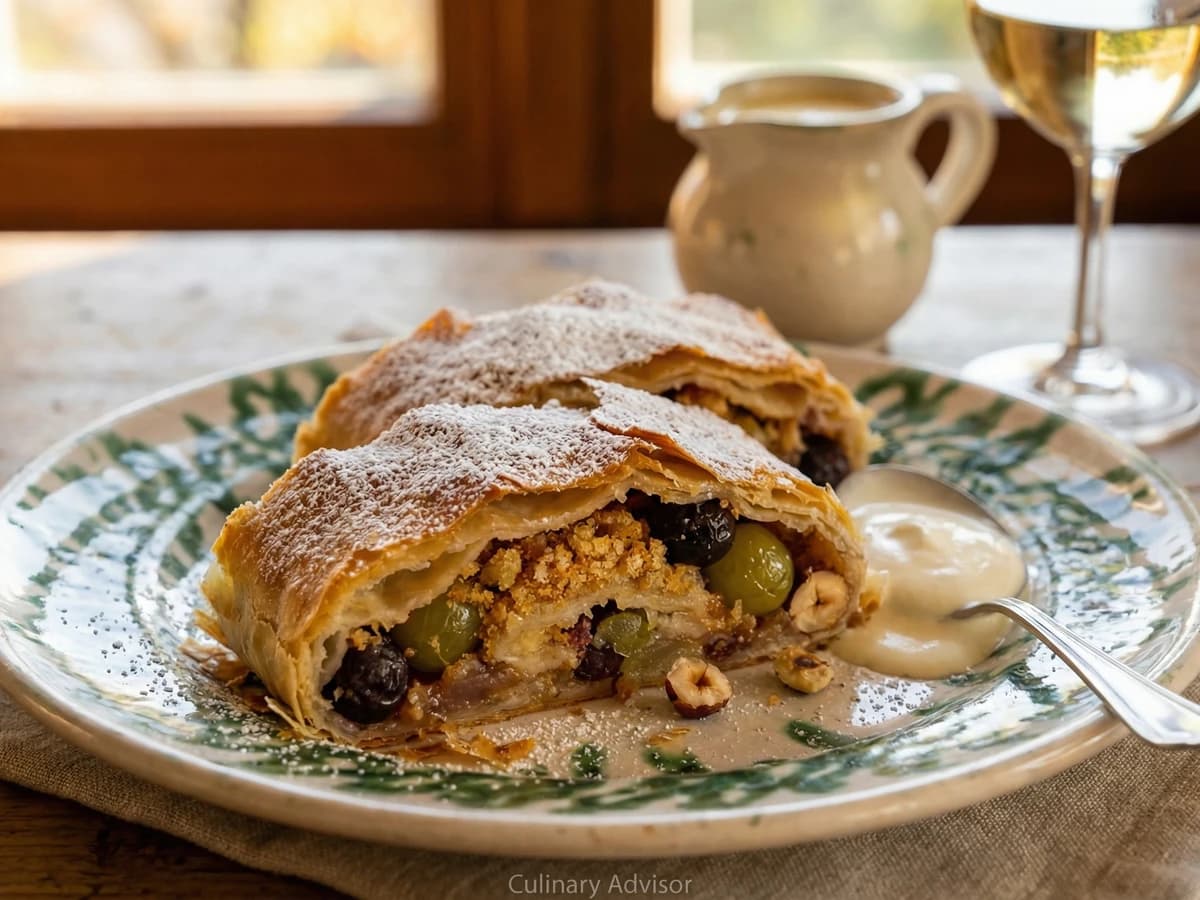
Hand-stretched Apfelstrudel with tart apples, rum-soaked raisins, and buttery toasted breadcrumbs, rolled on a floured cloth and baked until the layers shatter under powdered sugar.
Pastries & Cookies
Austrian
Comfort Food
Weeknight
1 hr
Active Time
40 min cook•1 hr 40 min total
Yield6 servings
In my grandmother Eva's kitchen in Deal, I watched Gretel Beer stretch strudel dough across a tablecloth until you could read the pattern of the fabric through it. I was maybe seven. She used the backs of her hands, working from the center outward, her knuckles dusted with flour, talking the whole time. She told me the dough would tell me when it was ready if I paid attention. She was right. When the dough stops resisting and starts to move with you, when it drapes over your fists like warm silk instead of snapping back, that's the moment.
Apfelstrudel is where Austrian home baking lives. Not in the elaborate Torten of the Konditorei, beautiful as those are, but in this: a simple dough pulled thin by hand, wrapped around whatever fruit the season gives you, and baked until the kitchen smells like butter and cinnamon and caramelized apple. Every family in Austria has a version. Every grandmother claims hers is best. The arguments are endless and nobody ever wins, which is exactly as it should be.
The filling is plain. Tart apples, raisins soaked in rum, a handful of toasted breadcrumbs to catch the juices, cinnamon, sugar, lemon zest. Nothing exotic. The magic is in the dough and what happens to it in the oven. Those paper-thin layers crisp and separate, each one shattering differently under your fork, while the apple inside goes soft and jammy. You serve it warm with a drift of powdered sugar and a spoonful of vanilla sauce or a cloud of Schlagobers (whipped cream) on the side. Gretel always said the strudel dough is the heart of Austrian Mehlspeisen. Get that right and everything else follows.
Strudel arrived in Vienna through the Ottoman Empire, its ancestry traceable to Turkish baklava-style layered pastry traditions. The oldest known Viennese strudel recipe dates to 1696, a handwritten manuscript now held in the Vienna City Library. By the 18th century, Apfelstrudel had become the defining pastry of the Habsburg lands, spreading through every province of the empire and adapting to local fruits and fillings, from Topfen in Bohemia to cherries in Hungary, while the hand-stretched dough technique remained constant across all of them.
The technique, the tradition, and the story behind every dish.
•Large clean tablecloth or cotton bedsheet for stretching
•Rolling pin
•Wide pan (24cm) for toasting breadcrumbs
•Pastry brush
•Baking sheet with parchment paper
•Serrated knife for slicing
•Fine-mesh sieve for powdered sugar
Instructions
1
Make the strudel dough
Mound the flour on a clean work surface and make a well in the center. Add the egg, oil, vinegar, salt, and lukewarm water. Work the wet ingredients into the flour with a fork, then switch to your hands once it starts coming together. Knead the dough firmly for ten minutes. You're building gluten on purpose here, and that takes effort. Slam it against the counter a few times. The dough should become smooth, elastic, and slightly tacky but not sticky. When you press it with your finger, it should spring back slowly.
The vinegar isn't for flavor. It relaxes the gluten just enough that the dough will stretch later without tearing. A teaspoon is all you need. Don't skip it.
2
Rest the dough
Shape the dough into a smooth ball, brush the surface lightly with oil, and place it under an inverted warm bowl. Let it rest for at least thirty minutes. Forty-five is better. The gluten you just built up needs to relax completely, or the dough will fight you when you try to stretch it. You can use this time to prepare the filling. Walk away from the dough. It knows what it's doing.
Warm the bowl with hot water before inverting it over the dough. The gentle warmth helps the gluten relax faster. Gretel used to set a kettle on the stove while she kneaded, then pour the hot water into the bowl and tip it out before covering the dough.
3
Soak the raisins
Put the raisins in a small bowl and pour the rum over them. Give them a stir and leave them alone for at least thirty minutes. They should be plump and soft by the time you need them. If you skip this step, the raisins just sit in the strudel like dry little pebbles and the whole filling suffers for it.
4
Toast the breadcrumbs
Melt the 100g of butter in a wide pan over medium heat. When it foams, add the breadcrumbs and stir constantly. You're looking for an even golden color and a nutty, toasted smell. This takes about five minutes. The moment they turn golden, get them out of the pan and into a bowl. Breadcrumbs go from toasted to burned in seconds and they won't warn you. The toasted breadcrumbs are doing critical work in this strudel: they form a barrier between the wet apple filling and the thin dough, absorbing the juices so the bottom layers stay crisp instead of turning to paste.
5
Prepare the apple filling
Peel and core the apples, then slice them thinly, about three millimeters. Toss the slices in a large bowl with the sugar, cinnamon, lemon zest, lemon juice, and vanilla sugar. The lemon juice keeps the apples from browning, but it's there for flavor too. That sharpness cuts through the sweetness and butter in the finished strudel. Use tart apples. If your apples aren't tart, add more lemon juice. A sweet, mealy apple makes a forgettable strudel.
Austrian bakers use Boskoop apples when they can get them, firm and tart with a flavor that deepens in the oven. Bramley works beautifully if you're in Britain. Granny Smith is the safest bet elsewhere. The apple should make you wince slightly when you eat a raw slice. That's the tartness you want.
6
Stretch the dough
Preheat your oven to 190°C (375°F). Cover your largest table with a clean cloth or bedsheet and dust it generously with flour. Place the rested dough in the center and roll it out with a rolling pin into a rough rectangle, as thin as you can manage. Now put the rolling pin away. From here, you use your hands. Slide your hands under the dough, palms down, knuckles up. Working from the center outward, gently pull and stretch the dough over the backs of your hands. Move around the table. Let gravity help. The dough should stretch willingly if it rested long enough. Keep going until it's translucent, thin enough that you can see the cloth pattern through it. If you hold your hand underneath, you should see the shadow of your fingers clearly. Trim any thick edges with scissors.
Remove your rings and watch before stretching. The dough is so thin that any snag will tear it. And don't panic if you get a small hole or two. It happens to everyone, including people who've been doing this for fifty years. The rolling will hide small tears. Only a large rip in the center is a real problem.
7
Fill the strudel
Brush the entire surface of the stretched dough with melted butter. Sprinkle the toasted breadcrumbs evenly over the lower third of the dough, leaving a border of about five centimeters on each side. Spread the apple slices over the breadcrumbs in an even layer. Drain the raisins (drink the rum if you like, I won't tell) and scatter them over the apples.
8
Roll the strudel
Fold the side edges of the dough inward over the filling to seal the ends. Then, using the cloth underneath to help you, lift the edge of the dough closest to the filling and roll it away from you, tucking the filling inside as you go. Let the cloth do the work. You're not rolling with your hands, you're lifting the cloth and the dough rolls itself. Keep going until the whole strudel is wrapped in a tight log, seam side down. The roll should be firm but not compressed. You want air between those layers.
9
Bake the strudel
Carefully transfer the strudel to a parchment-lined baking sheet, curving it gently into a crescent if it's too long for the sheet. Brush the top generously with the remaining melted butter. Bake at 190°C for 35 to 40 minutes, brushing with a little more butter halfway through. The strudel is done when the pastry is deep golden brown and the layers look dry and flaky, not pale and soft. You'll hear a faint crackling when you lean in close. That's the layers separating.
Don't underbake this. A pale strudel is a soggy strudel. You want a deep, confident golden brown all over. The filling is insulated by all those layers, so the apples won't overcook even if the outside looks bold.
10
Rest, slice, and serve
Let the strudel cool for ten minutes on the baking sheet. Not longer. You want it warm, not hot, not cold. Dust it generously with powdered sugar through a small sieve. Slice with a serrated knife using a gentle sawing motion so the layers shatter cleanly instead of crushing. Serve each slice with a spoonful of warm vanilla sauce or a generous cloud of Schlagobers on the side, never on top. The cream melts against the warm pastry and into the apple filling when the person eating it decides the moment is right. That's their choice to make, not yours. Mahlzeit!
Chef Tips
•Use griffiges Mehl if you can source it. Austrian coarse flour develops strong, elastic gluten that stretches beautifully without tearing. If you can't find it, bread flour is your closest substitute. Regular all-purpose flour has slightly less protein and the dough may tear more easily, so add an extra five minutes of kneading.
•The dough can rest for up to two hours under the warm bowl without any harm. Longer is fine. Shorter than thirty minutes is not. If you rush the rest, the gluten won't relax and you'll be fighting the dough instead of stretching it. Patience here saves you frustration later.
•Gretel always said you should be able to read a newspaper through the dough. I've tested this. She was right. If you can't see through it, keep stretching. You'll be surprised how thin it can go before it tears.
•Make your own vanilla sauce if you have twenty minutes: warm 500ml of milk with a split vanilla pod and a tablespoon of sugar, then whisk in two egg yolks tempered with a little of the hot milk. Stir over gentle heat until it coats a spoon. It's better than anything from a carton and it takes less time than you think.
Advance Preparation
•The strudel dough can be made up to two hours ahead and left to rest under its warm bowl at room temperature. It only gets more pliable with time.
•Raisins can be soaked in rum up to a day ahead. Cover and refrigerate. They'll only improve.
•Breadcrumbs can be toasted a day ahead and stored in an airtight container at room temperature.
•Once baked, Apfelstrudel is best within three hours. It can be gently rewarmed in a 160°C oven for ten minutes the next day, but the layers will never be quite as crisp as the first time. This is a strudel you bake when you know people are coming, not one you make and hope someone shows up.
Frequently Asked Questions
Nutrition Information
1 serving (about 210g)
Calories
610 calories
Total Fat
25 g
Saturated Fat
12 g
Trans Fat
0 g
Unsaturated Fat
11 g
Cholesterol
78 mg
Sodium
145 mg
Total Carbohydrates
89 g
Dietary Fiber
6 g
Sugars
42 g
Protein
9 g
Where cooking meets culture.
Culinary guides, cultural storytelling, and the editorial depth that makes cooking meaningful.