
Chef Elsa
Anisbogen
Paper-thin anise wafers piped, dried overnight, baked pale gold, and bent over a rolling pin while still hot. Old-fashioned Austrian Weihnachtsbäckerei at its most elegant and rewarding.
A cooking platform built around craft, culture, and the stories behind what we eat.
Created by
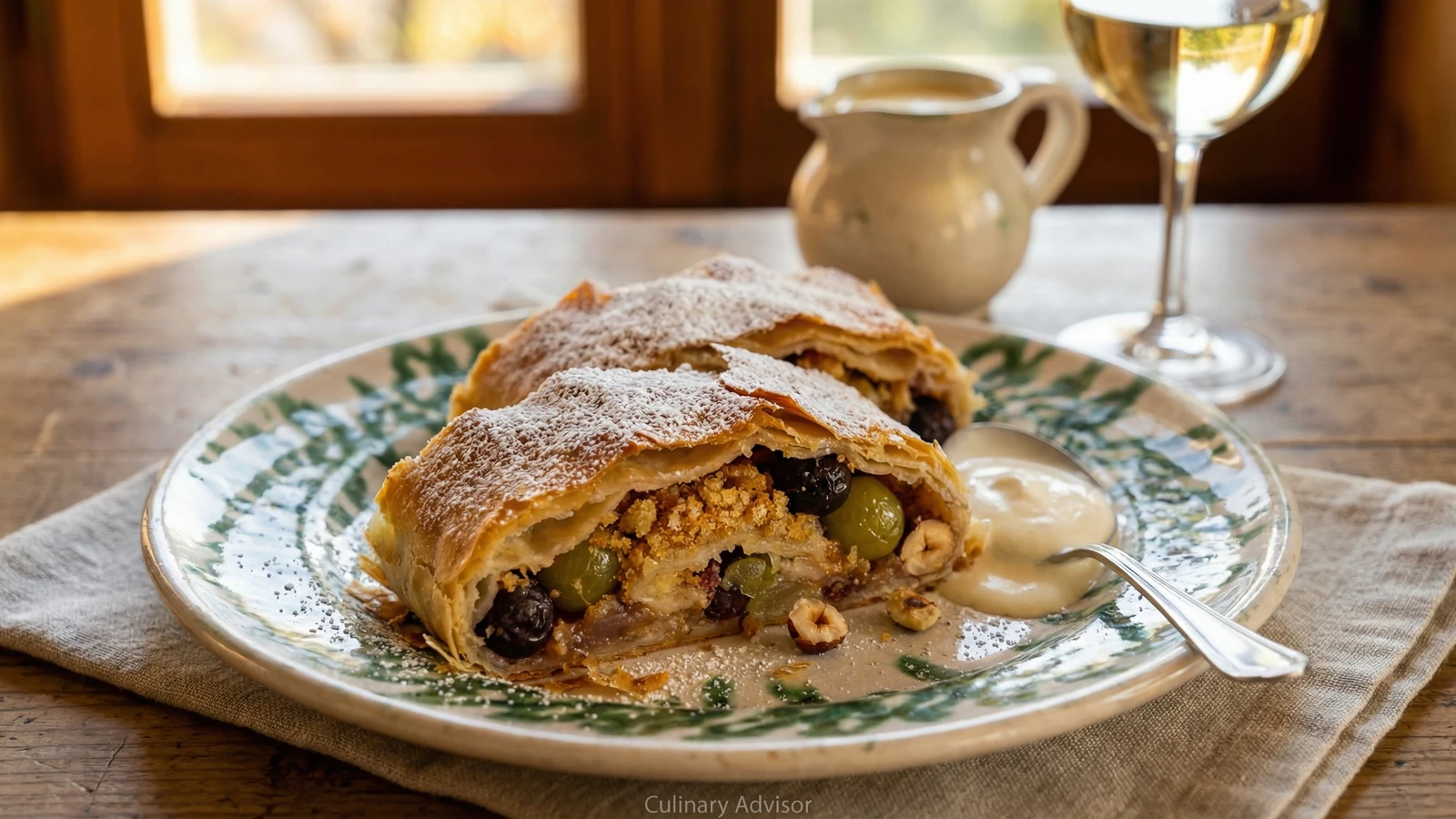
Hand-stretched strudel filled with ripe wine grapes, toasted hazelnuts, cinnamon, and lemon zest, baked golden and dusted with powdered sugar. The taste of an Austrian autumn, wrapped in pastry.
There's a window in autumn, maybe three or four weeks, when the grapes in the Wachau valley are so ripe they split if you look at them too hard. That's when you make Weintraubenstrudel. Not before. Not after. Gretel always said the calendar doesn't tell you when to bake this. The fruit does.
I first tasted it on one of our autumn trips through Lower Austria, when I was maybe ten. We'd stopped at a Heuriger, one of those wine tavern gardens where the vintner's family cooks whatever the season gives them. The woman brought out a strudel I didn't recognize. No apples, no Topfen. Grapes. Whole grapes baked inside stretched dough with hazelnuts and cinnamon, the juice soaking into the pastry from the inside while the outside went golden and shattering. Gretel took one bite and closed her eyes, and when Gretel closed her eyes over food, you paid attention.
Weintraubenstrudel is one of the secrets of Viennese cuisine that most people outside Austria never hear about. It belongs to the Alt-Wiener Mehlspeisen tradition, the old Viennese flour-based sweets that are the true heart of Austrian pastry. The grapes burst in the oven, releasing their juice into the breadcrumb layer that's there specifically to catch it. The hazelnuts toast deeper in the heat. The lemon zest sharpens everything. It's simple food done well, the kind of cooking that depends on good ingredients and proper technique rather than a long list of complicated steps.
This is a seasonal dish and I won't pretend otherwise. Make it in late September or October when grapes are at their peak. If you can find wine grapes with seeds, even better. They have more flavor than the bland table varieties bred for supermarket shelves. Use the best grapes you can get your hands on, a mix of dark and green if the market has them, and let the fruit do the talking.
Weintraubenstrudel belongs to the Alt-Wiener Mehlspeisen repertoire, a collection of flour-based pastries that developed in Vienna during the 18th and 19th centuries alongside the city's Kaffeehaus culture. The stretched dough technique itself arrived in Vienna through Ottoman influence, related to the Turkish yufka tradition, and Austrian bakers adapted it to wrap whatever the season provided: apples in autumn, cherries in summer, Topfen year-round. Grape strudel was tied specifically to the Weinlese, the grape harvest in Lower Austria's wine regions, when imperfect or surplus grapes that wouldn't make it into wine were turned over to the kitchen. It's one of the lesser-known strudel varieties outside Austria, though in the Wachau and around Vienna it remains a seasonal tradition that marks the turning of the year.
Quantity
250g
Quantity
1 large
Quantity
125ml
Quantity
2 tablespoons
Quantity
1 teaspoon
Quantity
pinch
Quantity
500g
stems removed
Quantity
100g
toasted and roughly chopped
Quantity
80g
Quantity
80g
Quantity
80g
Quantity
1 packet (8g)
Quantity
1 teaspoon
Quantity
1
zested
Quantity
2 tablespoons
Quantity
for dusting
Quantity
for serving
| Ingredient | Quantity |
|---|---|
| griffiges Mehl (coarse flour) or plain flour | 250g |
| egg | 1 large |
| warm water | 125ml |
| neutral oil (sunflower or grapeseed) | 2 tablespoons |
| white wine vinegar | 1 teaspoon |
| salt | pinch |
| ripe grapes, mixed dark and greenstems removed | 500g |
| hazelnutstoasted and roughly chopped | 100g |
| fine dry breadcrumbs | 80g |
| unsalted butter | 80g |
| granulated sugar | 80g |
| Vanillezucker (vanilla sugar) | 1 packet (8g) |
| ground cinnamon | 1 teaspoon |
| lemonzested | 1 |
| rum (optional) | 2 tablespoons |
| powdered sugar | for dusting |
| Schlagobers (whipped cream) or vanilla sauce | for serving |
Mound the flour on a clean work surface and make a well in the center. Add the egg, warm water, oil, vinegar, and salt. Work the liquid into the flour with your fingertips, then knead the dough for a full ten minutes. It will start sticky and resistant. Keep going. By the end it should be smooth, soft, and slightly tacky to the touch. Gretel always said the dough should feel like your earlobe when it's ready. Form it into a ball, brush the surface lightly with oil, and cover it with a warm bowl turned upside down. Let it rest for thirty minutes.
While the dough rests, wash the grapes and dry them thoroughly. If your grapes are large, halve them. Small wine grapes can go in whole. Toss them in a bowl with the sugar, Vanillezucker, cinnamon, lemon zest, and rum if you're using it. Let this sit while you prepare the rest. The sugar will begin drawing juice from the grapes, which is exactly what you want. That juice becomes the sauce inside the strudel.
Melt 40g of the butter in a small pan over medium heat. When it foams, add the breadcrumbs and stir constantly until they turn an even golden brown, about four minutes. They should smell nutty and warm. Take them off the heat immediately. Breadcrumbs go from golden to burnt in seconds and there's no saving them once they turn. The toasted breadcrumbs serve a purpose beyond flavor: they absorb the grape juice during baking so your strudel stays crisp instead of turning soggy from the inside.
Preheat your oven to 190°C (375°F). Lay a clean tablecloth or large tea towel on your table and dust it generously with flour. Place the rested dough in the center and roll it out with a pin as far as it will go easily. Now put the rolling pin away. Slide your hands under the dough, palms down, knuckles up, and begin stretching it gently outward from the center. Walk around the table. Let gravity help. The dough should stretch to about 60 by 40 centimeters, thin enough that you can see the pattern of the cloth through it. If it tears in a spot or two, don't panic. Patch it by pressing the edges together. A small tear won't ruin anything.
Melt the remaining 40g of butter and brush it generously over the entire surface of the stretched dough. Scatter the toasted breadcrumbs evenly across the lower third, leaving a border of about three centimeters on each side. Spread the chopped hazelnuts over the breadcrumbs. Now spoon the sugared grapes over the nuts, distributing them evenly. Pour any juice that has collected in the bowl over the filling. Fold the side edges of the dough inward over the filling to seal the ends.
Using the cloth underneath to help you, lift the edge of the dough closest to the filling and roll the strudel away from you in one steady motion. The cloth does the work. You're guiding, not forcing. Let the strudel roll onto itself until the seam is on the bottom. Carefully transfer it to a parchment-lined baking sheet, curving it into a slight crescent if it's too long for the tray. Brush the top with the last of the melted butter. Bake for 30 to 35 minutes until the pastry is deep golden brown and the ends are visibly crisp. You'll hear it crackling faintly when you take it out. That's the sound of success.
Let the strudel cool for ten minutes on the tray. Not longer. You want it warm, not hot, so the filling has time to settle but the pastry hasn't lost its crispness. Dust generously with powdered sugar through a fine sieve. Slice with a serrated knife into thick pieces. Each cut should reveal the layers: shattering pastry, then the golden breadcrumb barrier, then the soft, jammy grapes nestled among toasted hazelnuts. Serve with a generous spoonful of Schlagobers on the side, or warm vanilla sauce if the evening calls for it. Mahlzeit!
1 serving (about 200g)
Culinary guides, cultural storytelling, and the editorial depth that makes cooking meaningful.
Discover Culinary ExplorerChef Elsa
Paper-thin anise wafers piped, dried overnight, baked pale gold, and bent over a rolling pin while still hot. Old-fashioned Austrian Weihnachtsbäckerei at its most elegant and rewarding.

Chef Elsa
Thick apple rings in a light, eggy batter, fried golden in butter and oil, then buried under cinnamon sugar while they're still hot enough to melt it on contact.

Chef Elsa
Hand-stretched Apfelstrudel with tart apples, rum-soaked raisins, and buttery toasted breadcrumbs, rolled on a floured cloth and baked until the layers shatter under powdered sugar.

Chef Elsa
Austria's flat country doughnut with a blistered, paper-thin center and a fat golden rim, pooled with warm apricot jam and buried under powdered sugar. The thing people queue for at every Bauernmarkt from Salzburg to Vienna.