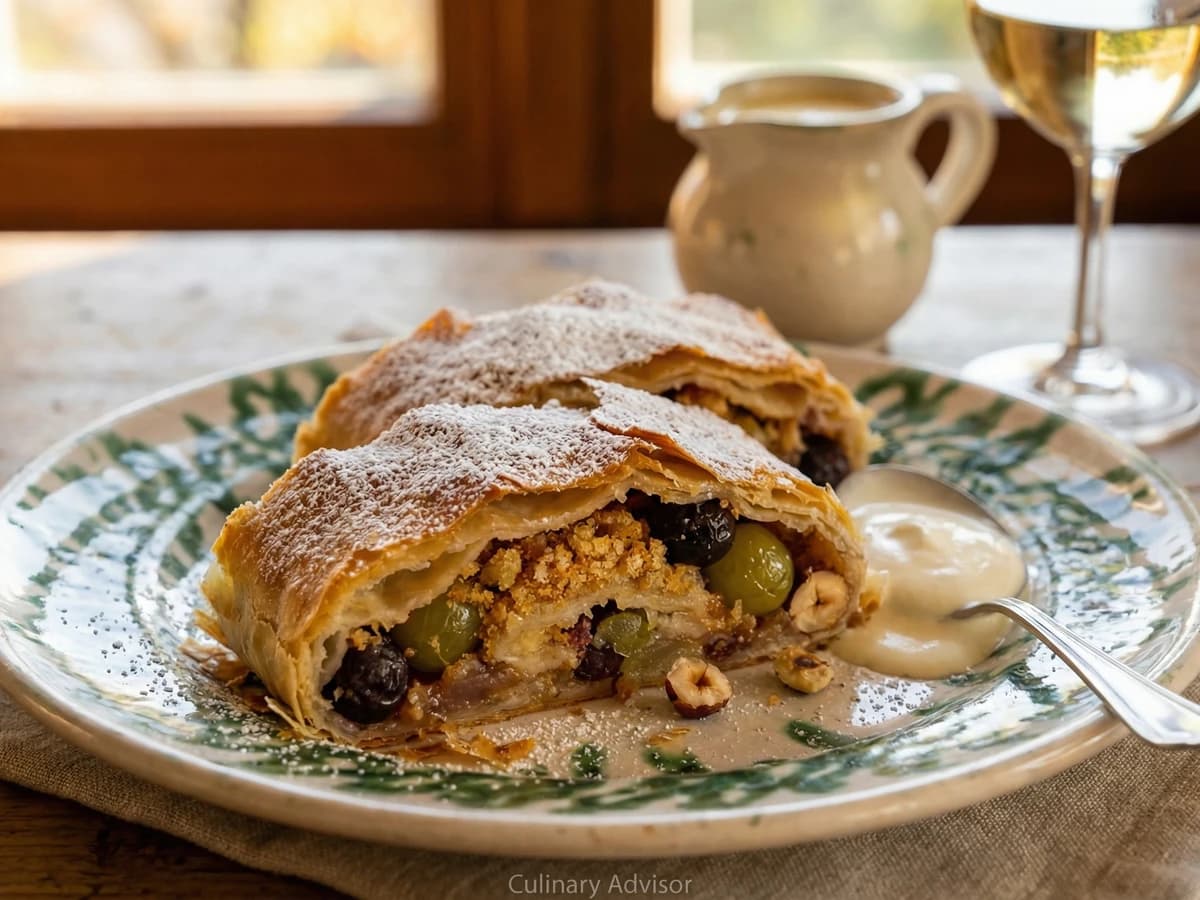
Hand-stretched strudel filled with rum-laced chestnut puree, toasted breadcrumbs, and a whisper of lemon zest. Autumn in Austria, rolled up and baked golden.
Pastries & Cookies
Austrian
Comfort Food
Make Ahead
1 hr 15 min
Active Time
35 min cook•1 hr 50 min total
Yield6 servings
Every October, the Grünmarkt in Salzburg smells like roasting chestnuts. The Maroni stands appear as if on cue, paper cones piled high, and for a few golden weeks the whole city tastes like autumn. Kastanienstrudel is what happens when that season meets the Mehlspeisen tradition, and it's one of the things I look forward to all year.
Gretel always said chestnuts were the most generous nut. They give you sweetness, body, and a kind of velvet richness that almonds and walnuts can't match. She used to roast them in Eva's kitchen in Kent, split across the top so they wouldn't explode in the oven (a lesson she claimed to have learned the hard way in 1952). Then she'd peel them while they were still hot, swearing quietly in Viennese German, and push them through a ricer into a bowl with rum and sugar and a scrape of vanilla. That puree is the heart of this Strudel. It's dense and fragrant and the color of burnished wood.
The dough is the same hand-stretched dough you'd use for Apfelstrudel. Flour, water, oil, a splash of vinegar, rested until it relaxes, then pulled across a floured cloth until you can read a newspaper through it. The filling goes on in a thick line along one edge, and you roll the whole thing using the cloth to guide it. When it comes out of the oven, the pastry is shatteringly thin and crisp, and the chestnut filling inside is soft and warm and faintly boozy. You dust it with powdered sugar and serve it with Schlagobers. That's all it needs.
This is not a summer Strudel. Don't try to make it in July. Wait for the chestnuts. Austrian cooking is seasonal and that's part of what makes it honest. When October comes and the first Maroni appear, you'll know it's time.
Chestnut trees have grown across Lower Austria, Styria, and southern Burgenland for centuries, and Maroni (roasted sweet chestnuts) became a beloved Viennese street food by the 18th century. Kastanienstrudel belongs to the broader family of filled Strudels that developed in Habsburg kitchens, where the paper-thin dough technique arrived through Ottoman and Hungarian influences. While Apfelstrudel claimed the spotlight, regional cooks filled the same stretched dough with whatever the season offered: poppy seeds, quark, cherries in summer, and chestnuts when autumn turned the hills gold.
The technique, the tradition, and the story behind every dish.
•Large clean cotton cloth or tablecloth for stretching
•Rolling pin
•Potato ricer or food mill
•Pastry brush
•Baking tray lined with parchment
Instructions
1
Make the strudel dough
Mound the flour on a clean work surface and make a well in the center. Pour in the warm water, oil, vinegar, and salt. Work it together with your hands, pulling the flour in from the edges until a shaggy dough forms, then knead for a full ten minutes. This is not a gentle process. You're developing gluten, and the dough needs to be worked until it's completely smooth, elastic, and no longer sticky. Slap it against the counter a few times if it helps. When it's ready, it should feel like your earlobe: soft, pliable, with a slight spring.
The vinegar isn't for flavor. It relaxes the gluten and makes the dough easier to stretch later without tearing. Don't skip it.
2
Rest the dough
Brush the surface of the dough lightly with oil, place it on a plate, and cover it with a warm, inverted bowl. Let it rest for at least thirty minutes, and up to an hour is better. The gluten needs this time to relax completely. If you try to stretch it too soon, it will fight you, snapping back like a rubber band, and you'll tear it. Patience now saves frustration later.
3
Roast and peel the chestnuts
While the dough rests, score each chestnut with a sharp knife, cutting a deep cross through the flat side of the shell. Spread them on a baking tray and roast at 200°C for twenty minutes. The shells will curl back at the cuts. Peel them while they're still hot, removing both the hard outer shell and the papery inner skin. This is the tedious part. The inner skin clings and you'll lose your temper at least once. Work in small batches, keeping the unpeeled ones warm in the oven, because cold chestnuts are nearly impossible to peel cleanly.
If you can find good vacuum-packed cooked chestnuts, use them. Life is short and chestnut peeling is long. You'll need about 300g of peeled chestnuts, which is what 500g of fresh ones gives you after the shells and skins come off.
4
Make the chestnut filling
Push the warm peeled chestnuts through a potato ricer or food mill into a large bowl. You want a fine, fluffy texture, not a paste. If you don't have a ricer, pulse them in a food processor until smooth, but take care not to overwork them or the filling turns gluey. Beat the softened butter with the sugar until light and creamy, then beat in the egg yolks one at a time. Add the Vanillezucker, rum, and lemon zest. Fold in the chestnut puree and the cream until everything is combined. The filling should be thick and spreadable, the color of caramel, and it should smell like autumn distilled into a bowl.
5
Toast the breadcrumbs
Melt the 40g of butter in a small pan over medium heat. Add the breadcrumbs and stir constantly until they turn golden and fragrant, about three to four minutes. Watch them carefully. Breadcrumbs go from golden to burnt in seconds and burnt breadcrumbs will ruin the whole Strudel. Tip them onto a plate to cool. These toasted crumbs serve two purposes: they absorb moisture from the filling so the dough stays crisp, and they add a nutty, buttery crunch between the layers.
6
Stretch the dough
Lay a clean cotton cloth (a tablecloth works well) over your largest table and dust it generously with flour. Place the rested dough in the center and roll it out with a rolling pin as far as it will go easily. Then put down the pin. From here, you use your hands. Slide them under the dough, palms down, backs of your hands supporting the weight, and gently pull outward from the center. Work your way around, stretching a little at a time. The dough should become thin enough that you can see the pattern of the cloth through it. A few small tears are fine. Don't panic over them. Trim off the thick edges with kitchen scissors.
Remove your rings and watch before stretching. Jewelry catches on the dough and tears it. Gretel always said your hands should be bare and your confidence high.
7
Fill and roll the strudel
Preheat your oven to 190°C. Brush the entire surface of the stretched dough with melted butter. Scatter the toasted breadcrumbs evenly over the bottom third of the dough, closest to you. Spoon the chestnut filling in a thick line along that same edge, leaving about five centimeters clear on each side. Use the cloth to lift the edge of the dough up and over the filling, then keep rolling, letting the cloth do the work. The dough wraps around the filling in thin, overlapping layers. Tuck the ends under to seal everything in. Gently transfer the strudel, seam side down, onto a parchment-lined baking tray. Curve it slightly if it's too long for the tray. Brush the top generously with the remaining melted butter.
8
Bake the strudel
Bake at 190°C for thirty to thirty-five minutes. After twenty minutes, brush the top with butter again. The strudel is done when the pastry is deep golden brown all over and the layers look dry and flaky. You'll hear it crackle faintly when you lean close. Let it rest on the tray for ten minutes before slicing. The filling needs that time to set or it will ooze out when you cut.
9
Dust and serve
Dust the strudel generously with powdered sugar. Cut thick slices on the diagonal with a serrated knife, letting each cut show the spiral of thin pastry wrapped around the dark chestnut filling. Serve warm with a generous spoonful of Schlagobers on the side. Not on top. On the side. The cream is a companion, not a blanket. Mahlzeit!
Chef Tips
•Buy your chestnuts from a source that sells them fresh in season, not the ones that have been sitting in a bin since last year. Fresh chestnuts are heavy for their size, glossy, and firm when you press them. If they rattle inside the shell, they've dried out and your filling will taste flat.
•The rum in the filling is not decoration. It lifts the chestnuts out of stodginess and gives the whole thing a warm, rounded depth. Use a decent dark rum, not cooking rum. If you'd drink it, you can bake with it.
•Strudel dough stretches best at room temperature in a warm kitchen. If your kitchen is cold, the dough stiffens and resists. Run the heating for an hour before you start, or let the dough rest in a slightly warm spot.
•Kastanienstrudel is best eaten within a few hours of baking, when the pastry is still crisp. By the next day the filling softens the layers. It's still good reheated in a hot oven for ten minutes, but it won't be the same and I won't pretend otherwise.
Advance Preparation
•The strudel dough can rest for up to two hours under its warm bowl. Longer than that and it dries out.
•The chestnut filling can be made one day ahead and refrigerated. Bring it to room temperature before filling the strudel, or it will be too stiff to spread without tearing the dough.
•Chestnuts can be roasted and peeled the day before and stored in an airtight container in the fridge. Warm them gently before ricing.
Frequently Asked Questions
Nutrition Information
1 serving (about 210g)
Calories
820 calories
Total Fat
48 g
Saturated Fat
27 g
Trans Fat
0 g
Unsaturated Fat
21 g
Cholesterol
190 mg
Sodium
100 mg
Total Carbohydrates
84 g
Dietary Fiber
4 g
Sugars
24 g
Protein
9 g
Where cooking meets culture.
Culinary guides, cultural storytelling, and the editorial depth that makes cooking meaningful.