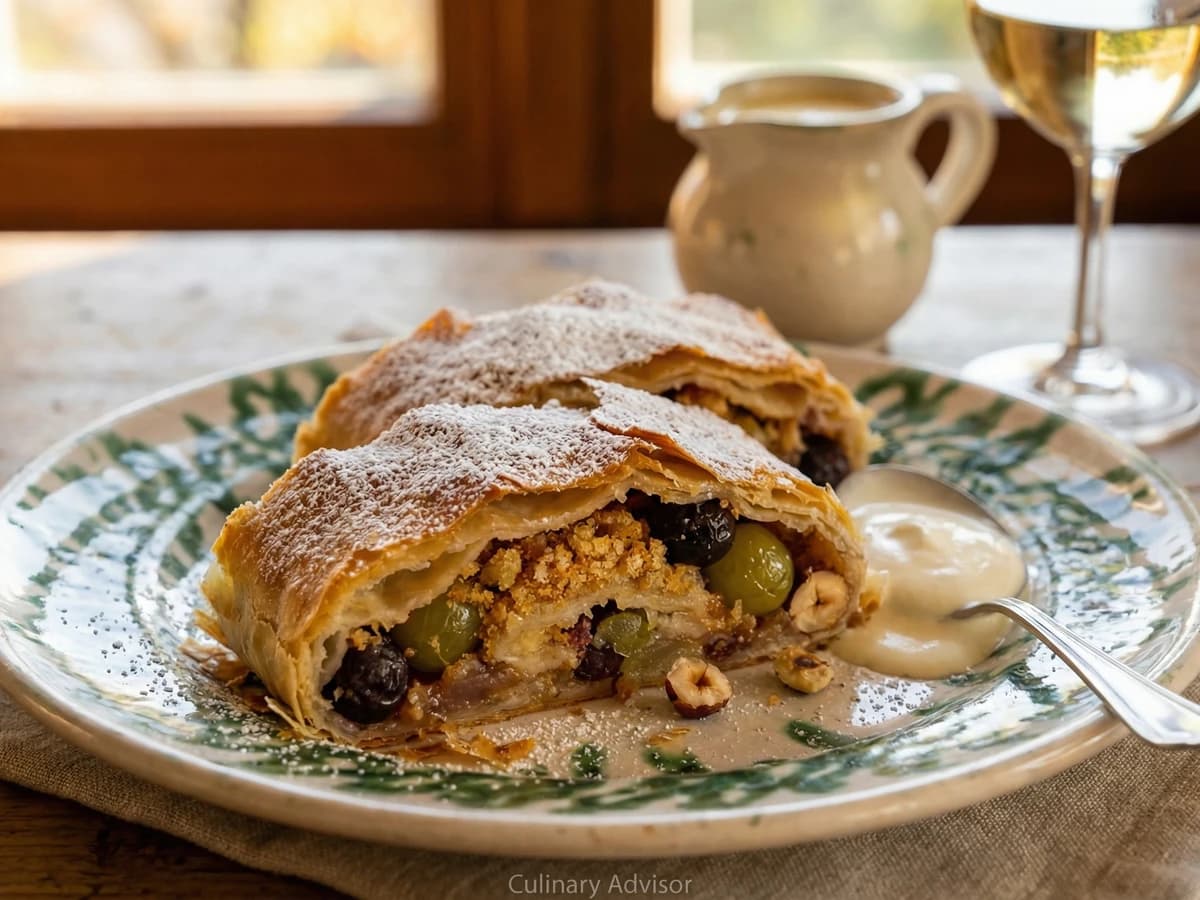
Hand-stretched strudel filled with ripe autumn pears, toasted walnuts, and cinnamon, baked until the pastry shatters and the kitchen smells like an October afternoon in the Salzkammergut.
Pastries & Cookies
Austrian
Comfort Food
Make Ahead
1 hr
Active Time
40 min cook•1 hr 40 min total
Yield6 servings
When the first good pears appeared in the markets every autumn, Gretel always said the same thing: forget the Apfelstrudel for a week. Make Birnenstrudel. She was right. Ripe pears have a softness that apples never quite reach, a honeyed sweetness that melts into the cinnamon and butter-toasted breadcrumbs without any sharpness or resistance. The filling becomes almost perfumed as it bakes. You open the oven and the whole kitchen goes quiet for a second.
I make this every October at the restaurant when the Williams pears from the Steiermark come in. They arrive firm enough to slice cleanly but ripe enough to smell like autumn from across the room. The walnuts are important here. Pears on their own would make a filling that's all softness, all one texture. The walnuts give you something to bite against, a little resistance, a little earthiness that balances the fruit.
The strudel dough is the same one you'd use for Apfelstrudel: flour, water, oil, a splash of vinegar, kneaded until smooth, rested until relaxed, stretched on a floured cloth until you can see through it. That technique is the heart of every strudel recipe I know, and once you've learned it, you can fill it with whatever the season gives you. In my grandmother Eva's kitchen, I watched Gretel stretch dough across the table with the patience of someone who had done it a thousand times. She never rushed it. The dough will tell you when it's ready, she said. You just have to listen with your hands.
Birnenstrudel appears in Austrian cookbooks from the early 19th century alongside its more famous cousin, Apfelstrudel. Pear strudel was particularly popular in the orcharding regions of Styria (Steiermark) and Lower Austria, where Williams and Bosc pears grew abundantly. The strudel dough technique itself traces back to Ottoman and Byzantine layered pastry traditions that entered Austrian cooking through centuries of cultural exchange across the Habsburg empire. By the time Birnenstrudel was being recorded in recipe collections, the hand-stretched dough had already become a distinctly Austrian craft.
The technique, the tradition, and the story behind every dish.
•Large clean tablecloth or cotton sheet for stretching
•Rolling pin
•Large baking sheet with parchment
•Pastry brush
•Serrated knife for slicing
Instructions
1
Make the strudel dough
Mound the griffiges Mehl on a clean work surface and make a well in the center. Add the oil, vinegar, salt, and lukewarm water. Work it together with your hands, pulling flour in from the edges until you have a shaggy mass, then knead for a good ten minutes. The dough will go from rough and reluctant to smooth and almost silky. When you press your thumb into it, it should spring back gently. Gretel always said the dough should feel like your earlobe when it's ready.
The vinegar isn't for flavor. The acid weakens the gluten just enough to make the dough cooperative when you stretch it later. A splash of vinegar is the difference between a dough that stretches like a bedsheet and one that fights you all the way across the table.
2
Rest the dough
Form the dough into a smooth ball, brush the surface lightly with oil, and place it under an overturned warm bowl. Let it rest for at least thirty minutes. The gluten needs to relax completely. If you skip this or cut it short, the dough will snap back when you try to stretch it and you'll tear holes through it. Patience here saves you grief later.
Warm the bowl with hot water before inverting it over the dough. The gentle warmth keeps the dough supple and makes stretching easier.
3
Prepare the filling
Peel and core the pears, then slice them thinly, about three millimeters. Toss them immediately with lemon juice so they don't brown. In a separate pan, melt the 80g of butter over medium heat and toast the breadcrumbs, stirring constantly, until they turn golden and smell nutty, about four minutes. Don't walk away from this. Breadcrumbs go from golden to burnt in seconds. Let them cool slightly, then toss together the sliced pears, toasted breadcrumbs, chopped walnuts, sugar, cinnamon, Vanillezucker, lemon zest, and the rum-soaked raisins if you're using them.
4
Stretch the dough
Lay a clean cloth on your table and dust it generously with flour. Roll the dough out as far as it will go with a rolling pin, then set the pin aside. Slide your hands under the dough, backs of the hands facing up, knuckles supporting the weight, and start stretching gently from the center outward. Walk around the table, pulling and coaxing, letting gravity help. The dough should stretch until you can see the cloth pattern through it, thin enough to read a newspaper if you had one underneath. Trim any thick edges with scissors. A few small tears are fine. You'll roll over them.
Remove rings and watches before you start. Strudel dough is paper-thin and any sharp edge will tear it. Use the backs of your hands, never your fingertips, and let the weight of the dough do most of the work.
5
Fill and roll
Preheat your oven to 190°C (375°F). Brush the entire surface of the stretched dough with melted butter. Spread the pear filling in a line along one long edge, leaving a few centimeters clear at both ends. Fold those ends inward over the filling so nothing escapes during baking. Now lift the cloth from the filled edge and let the strudel roll itself forward, the cloth doing the work for you. Don't squeeze or press. Let gravity and the cloth guide it into a loose roll. Ease it onto a parchment-lined baking sheet, seam side down, and gently curve it if it's too long for your tray.
6
Bake the strudel
Brush the top generously with melted butter. Place it in the oven and bake for thirty-five to forty minutes, brushing with more butter twice during baking. The strudel is done when the pastry is deep golden and the layers look dry, flaky, and crisp. You'll hear it crackle faintly when you lean close. Let it rest on the tray for ten minutes before slicing. The filling needs a moment to settle or it will spill out the moment you cut.
7
Dust and serve
Dust the warm strudel generously with powdered sugar and slice it with a serrated knife into thick pieces, each about three fingers wide. Serve with a spoonful of warm vanilla sauce or a cloud of lightly whipped Schlagobers. The pears will be soft and fragrant, the walnuts still holding their crunch, the pastry shattering at the first touch of a fork. Mahlzeit!
Chef Tips
•Choose pears that are ripe but still firm. If they're soft enough to dent when you hold them, they'll collapse into mush inside the strudel. You want fruit that holds its shape through forty minutes of baking. Williams or Bosc pears are ideal. Conference pears work too if that's what you can find.
•Toast the breadcrumbs properly. This step is doing two things: the butter-toasted crumbs absorb juice from the pears so the dough stays crisp underneath, and they add a warm, nutty flavor that ties the whole filling together. Raw breadcrumbs taste like cardboard and do half the job.
•Brush with butter three times during baking: once before it goes in, twice more while it bakes. Each layer of butter crisps the pastry further and gives the finished strudel that shattering, flaky quality. Don't be cautious with the butter. This is not the moment for restraint.
•If you can't find griffiges Mehl, use a mix of seventy percent all-purpose flour and thirty percent bread flour. It won't be identical, but it gives you a dough with enough structure to stretch thin without tearing.
Advance Preparation
•The strudel dough can rest under its warm bowl for up to two hours. Beyond that it starts to dry out even under the bowl.
•Breadcrumbs can be toasted in butter a day ahead and stored in an airtight container at room temperature.
•The assembled, unbaked strudel does not hold. Once it's rolled, it goes into the oven. The pear juices will soak through the dough if you wait.
•Baked Birnenstrudel is best the day it's made, but leftovers reheat well in a 160°C oven for ten minutes. The pastry won't shatter quite the same way, but the flavor is still beautiful.
Frequently Asked Questions
Nutrition Information
1 serving (about 240g)
Calories
655 calories
Total Fat
30 g
Saturated Fat
12 g
Trans Fat
0 g
Unsaturated Fat
17 g
Cholesterol
47 mg
Sodium
190 mg
Total Carbohydrates
90 g
Dietary Fiber
8 g
Sugars
36 g
Protein
9 g
Where cooking meets culture.
Culinary guides, cultural storytelling, and the editorial depth that makes cooking meaningful.