
Chef Jeong-sun
Agwi-jjim (Braised Monkfish with Bean Sprouts)
Firm monkfish buried under crisp soybean sprouts, minari, and a red gochugaru sauce thickened at the end; Masan's market dish asks for heat, timing, and a steady hand.
A cooking platform built around craft, culture, and the stories behind what we eat.

Created by
The big market-cart mandu with a soft leavened wrapper and a generous pork, tofu, noodle, and vegetable filling, built large enough that one dumpling can feed a hungry person.
Wang-mandu belongs to the market hour when people are too hungry for a snack and too busy for a proper table. A woman at a stall lifts the lid, tucks one dumpling into paper, and that is lunch. Do not make it small. The name means king dumpling, and a shy one is just a regular mandu wearing the wrong name.
This dish lives or dies by two balances: a wrapper soft enough to puff around the filling, and a filling dry enough not to make that wrapper soggy. People think the size is the hard part. It isn't. The hard part is squeezing the tofu, salting and wringing the cabbage, cutting the noodles short, and seasoning the pork enough that a thick bread-like wrapper doesn't make the center taste dull.
My teacher, Master Seong-nyeo, made us weigh filling for large mandu because hands lie when they get tired. Notebook 41 says 85 grams of filling for a 65 gram dough ball. That gives a palm-sized dumpling that closes cleanly and cooks through. 손맛 is real, the hand-taste your grandmother trusted. I still measure it, so it can be handed on.
I won't tell you this is quick. It asks for kneading, resting, chopping, folding, and waiting at the steamer. But the work is friendly work. Make a tray, eat a few tonight, freeze the rest, and your future table will thank the hands you used today.
Mandu entered Korea through long contact across northern routes, with records of dumpling-like foods appearing by the Goryeo period and becoming part of both winter and holiday cooking. The large, breadier wang-mandu sold in markets is a more modern everyday form, shaped by urban stalls and flour-rich post-war food culture, closer in spirit to jjinppang-mandu than to the small boiled mandu served in tteok-manduguk. Its size is practical history: one hot dumpling from a market cart could stand in for a whole meal.
Quantity
420g, plus more for dusting
Quantity
2 teaspoons
Quantity
2 tablespoons
Quantity
1 teaspoon
Quantity
240ml, about 38 C
Quantity
1 tablespoon
for the dough
Quantity
300g
preferably 20 percent fat
Quantity
200g
pressed and squeezed dry
Quantity
180g
finely chopped
Quantity
1 teaspoon
for salting the cabbage
Quantity
80g
Quantity
120g
finely diced
Quantity
80g
finely diced
Quantity
4
finely chopped
Quantity
4 cloves
minced
Quantity
1 tablespoon
finely grated
Quantity
2 tablespoons
for the filling
Quantity
1 tablespoon
Quantity
1 tablespoon
Quantity
1 teaspoon
for the filling
Quantity
1/2 teaspoon
freshly ground
Quantity
1 tablespoon
for the filling
Quantity
1
Quantity
2 tablespoons
Quantity
as needed
for the steamer paper
Quantity
3 tablespoons
for dipping sauce
Quantity
1 tablespoon
for dipping sauce
Quantity
1 tablespoon
for dipping sauce
Quantity
1 teaspoon
for dipping sauce
Quantity
1 teaspoon
for dipping sauce
| Ingredient | Quantity |
|---|---|
| all-purpose flour | 420g, plus more for dusting |
| instant yeast | 2 teaspoons |
| sugar | 2 tablespoons |
| fine sea salt | 1 teaspoon |
| warm water | 240ml, about 38 C |
| neutral oilfor the dough | 1 tablespoon |
| ground porkpreferably 20 percent fat | 300g |
| firm tofupressed and squeezed dry | 200g |
| napa cabbagefinely chopped | 180g |
| fine sea saltfor salting the cabbage | 1 teaspoon |
| dried dangmyeon (sweet potato glass noodles) | 80g |
| onionfinely diced | 120g |
| carrotfinely diced | 80g |
| scallionsfinely chopped | 4 |
| garlicminced | 4 cloves |
| gingerfinely grated | 1 tablespoon |
| soy saucefor the filling | 2 tablespoons |
| toasted sesame oil | 1 tablespoon |
| oyster sauce (optional) | 1 tablespoon |
| sugarfor the filling | 1 teaspoon |
| black pepperfreshly ground | 1/2 teaspoon |
| toasted sesame seedsfor the filling | 1 tablespoon |
| egg white | 1 |
| potato starch or cornstarch | 2 tablespoons |
| neutral oilfor the steamer paper | as needed |
| soy saucefor dipping sauce | 3 tablespoons |
| rice vinegarfor dipping sauce | 1 tablespoon |
| waterfor dipping sauce | 1 tablespoon |
| gochugaru (Korean chili flakes) (optional)for dipping sauce | 1 teaspoon |
| toasted sesame seedsfor dipping sauce | 1 teaspoon |
Stir the flour, instant yeast, sugar, and salt in a large bowl. Add the warm water and oil, then mix until a rough dough forms. Knead 8 to 10 minutes by hand, or 6 minutes in a mixer on low, until smooth and elastic. The dough should feel soft but not sticky; if it smears on your palm, knead in flour 1 tablespoon at a time.
Shape the dough into a ball, put it in a lightly oiled bowl, cover, and let it rise in a warm place for 60 to 75 minutes, until nearly doubled. This rest is not decoration. It gives wang-mandu the soft, pillowy wrapper that separates it from thin-skinned mandu.
Toss the chopped napa cabbage with 1 teaspoon salt and let it sit 15 minutes. Squeeze it hard in a clean towel until no liquid drips. Press the tofu the same way and crumble it finely. A wet filling punishes you twice: it weakens the wrapper and makes the center taste flat.
Boil the dangmyeon for 6 to 7 minutes, until fully tender, then rinse briefly and drain very well. Chop into 1 cm pieces. Long noodles pull the filling apart when you bite, so cut them short. They should carry seasoning, not behave like a second wrapper inside the dumpling.
In a large bowl, combine the pork, squeezed tofu, squeezed cabbage, chopped noodles, onion, carrot, scallions, garlic, ginger, soy sauce, sesame oil, oyster sauce if using, sugar, pepper, sesame seeds, egg white, and starch. Mix in one direction with your hand for 2 full minutes, until the pork turns sticky and binds the vegetables. That stickiness is structure, not fussiness.
Pinch off 1 tablespoon of filling and cook it in a small pan or microwave until done. Taste it. It should be savory enough to stand up to the thick wrapper, with garlic and sesame present but not shouting. Add up to 1 teaspoon more soy sauce only if it tastes weak, then mix again. Do not taste raw pork.
Punch the risen dough down and divide it into 10 pieces, about 65g each. Roll each piece into a ball, cover with a towel, and rest 10 minutes. Rested dough rolls without fighting you; unrested dough shrinks back and makes thick, stubborn edges.
On a lightly floured surface, roll each dough ball into a 13 to 14 cm round, keeping the center slightly thicker than the edge. The center must carry the weight of the filling. Thin the edge so the pleats don't become a heavy knot at the top.
Place about 85g filling in the center of each wrapper. Gather the edge upward, pleating as you go, and pinch firmly at the top to seal. Set each dumpling on a small square of oiled parchment or cabbage leaf. If the wrapper tears, you overfilled it or rolled the center too thin. Fix the next one. That is how hands learn.
Cover the shaped mandu and let them rest 15 to 20 minutes, until the wrapper looks a little puffed and relaxed. Do not let them double again. Too much proofing makes the surface wrinkled and the dough collapses when cooked.
Bring water to a strong boil in a steamer pot. Arrange the mandu with at least 4 cm between them, because they expand. Cover and steam over medium-high heat for 18 to 20 minutes, until the wrapper is springy and the pork filling reaches 71 C in the center. Keep the lid closed. Lifting it early drops the temperature and toughens the wrapper.
Turn off the heat and let the mandu sit covered for 3 minutes before opening the lid. This short rest helps the wrapper settle instead of shrinking. Stir together the dipping sauce ingredients and serve the mandu whole, with danmuji (yellow pickled radish) or a sharp kimchi beside them.
1 serving (about 200g)
Culinary guides, cultural storytelling, and the editorial depth that makes cooking meaningful.
Discover Culinary ExplorerChef Jeong-sun
Firm monkfish buried under crisp soybean sprouts, minari, and a red gochugaru sauce thickened at the end; Masan's market dish asks for heat, timing, and a steady hand.

Chef Jeong-sun
A quick Korean rice bowl built on contrast: warm rice, cold popping flying-fish roe, chopped vegetables, gim, sesame oil, and the crisp rice bottom a hot stone bowl gives you.
Chef Jeong-sun
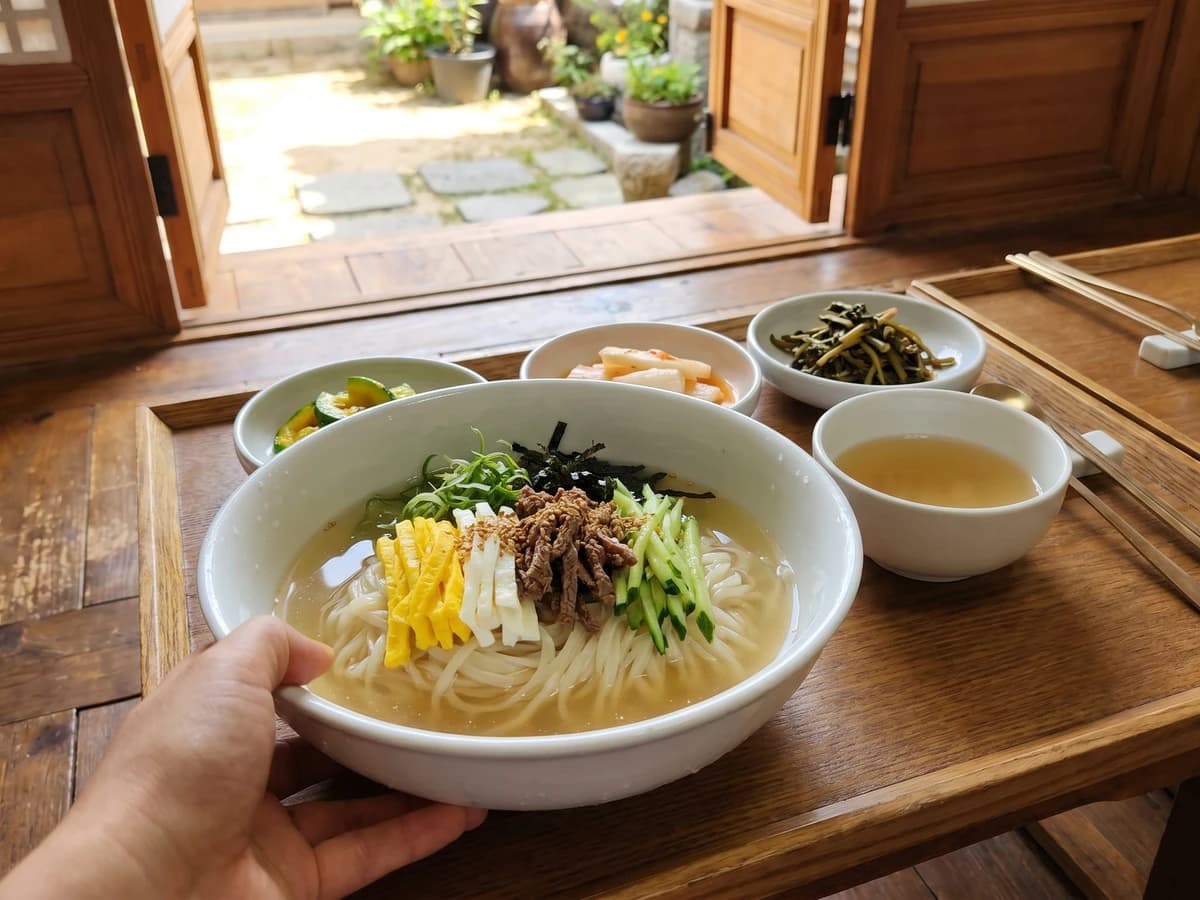
Andong's guest noodles, wheat and roasted soybean flour rolled thin, boiled and rinsed cold, then set in a clear chilled anchovy broth with careful strips of beef, egg, and cucumber.

Chef Jeong-sun
Andong's ritual-table rice served on an ordinary day: separate soy-sesame namul, warm rice, and clear radish soup, mixed without gochujang so every vegetable keeps its own voice.