
Chef Jeong-sun
Agwi-jjim (Braised Monkfish with Bean Sprouts)
Firm monkfish buried under crisp soybean sprouts, minari, and a red gochugaru sauce thickened at the end; Masan's market dish asks for heat, timing, and a steady hand.
A cooking platform built around craft, culture, and the stories behind what we eat.
Created by
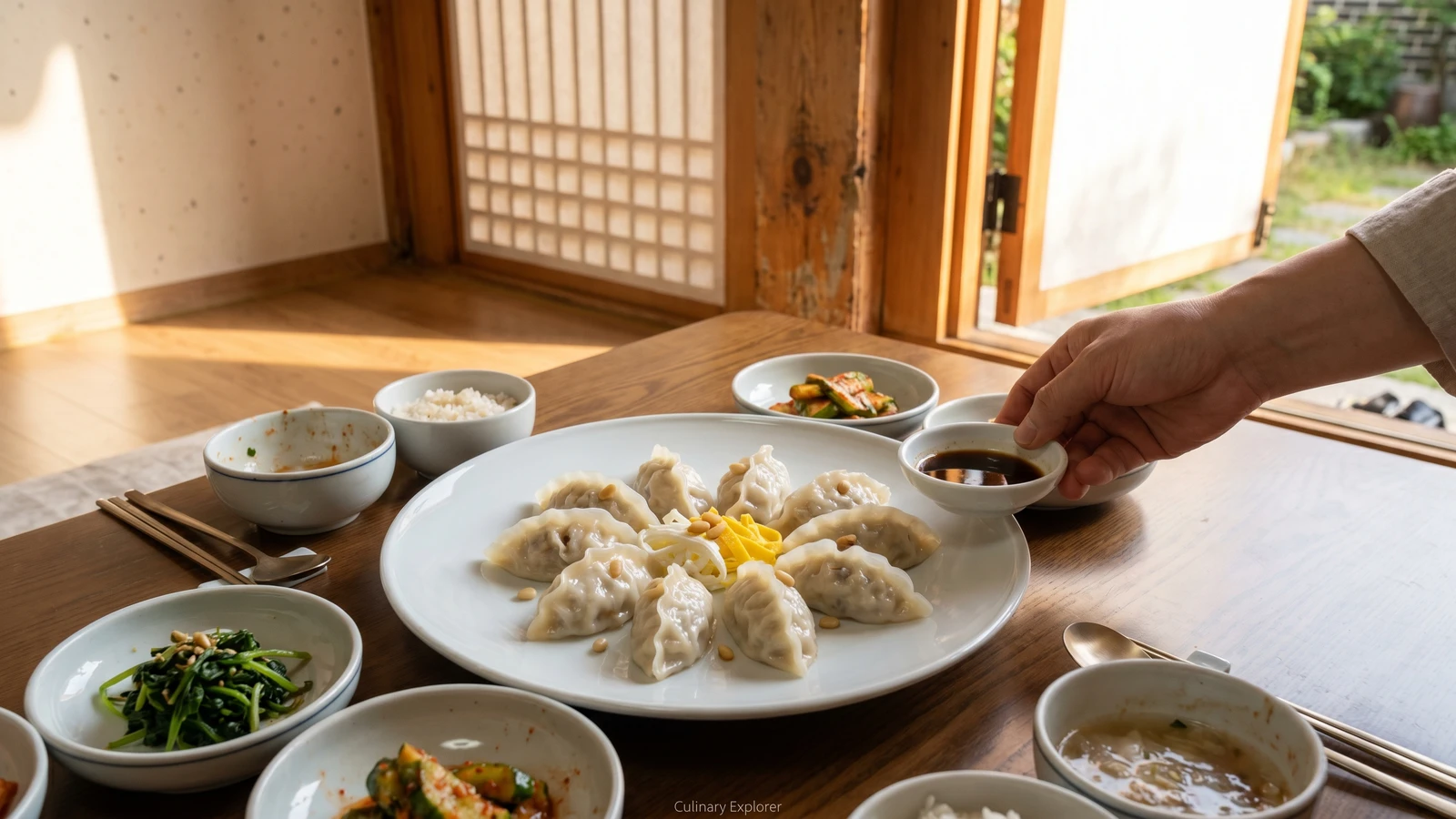
Thin slices of white fish stand in for dumpling wrappers, folded around a restrained beef and mushroom filling, then steamed until pale, tender, and worthy of a summer dinner table.
Eomandu lives or dies by the knife before it ever reaches the steamer. A dumpling without dough sounds like a clever trick, but there is no trick here: the fish must be sliced thin enough to fold, the filling must be small enough to respect the wrapper, and the starch must be a veil, not a coat. I won't tell you this is easy. It is careful work, and careful work is the point.
Eomandu belongs to the refined branch of Joseon-period Korean cooking in which thin white fish replaced wheat dough as the dumpling wrapper, making it especially suited to warm-weather meals when heavy dumplings felt out of season. The dish appears in records of court and aristocratic tables, where mung-bean starch was used to help delicate fish hold a filling of seasoned meat and mushrooms. Its name is plain: eo means fish and mandu means dumpling, a direct description of the technique rather than a poetic name.
Quantity
450g
flounder, sole, cod, or sea bream
Quantity
1/2 teaspoon
divided
Quantity
1 tablespoon
Quantity
1/4 teaspoon
Quantity
120g
Quantity
4
soaked until soft, stems removed, caps finely minced
Quantity
1/2 small
seeded and julienned
Quantity
1/2 teaspoon
Quantity
1 teaspoon
Quantity
1 teaspoon
Quantity
1 teaspoon
finely minced
Quantity
1 teaspoon
finely minced
Quantity
1/2 teaspoon
Quantity
1 teaspoon
lightly crushed
Quantity
1 large
Quantity
6 tablespoons
plus more if needed
Quantity
1 teaspoon
for greasing the steamer plate
Quantity
1 egg
separated, cooked thin, cut into strips
Quantity
1 tablespoon
Quantity
2 tablespoons
Quantity
1 tablespoon
Quantity
1 tablespoon
Quantity
1/2 teaspoon
Quantity
1 teaspoon
finely chopped
| Ingredient | Quantity |
|---|---|
| skinless white fish filletflounder, sole, cod, or sea bream | 450g |
| fine sea saltdivided | 1/2 teaspoon |
| clear rice wine or cheongju | 1 tablespoon |
| finely ground white pepper | 1/4 teaspoon |
| lean ground beef | 120g |
| dried shiitake mushroomssoaked until soft, stems removed, caps finely minced | 4 |
| cucumberseeded and julienned | 1/2 small |
| salt for cucumber | 1/2 teaspoon |
| soy sauce | 1 teaspoon |
| toasted sesame oil | 1 teaspoon |
| garlicfinely minced | 1 teaspoon |
| scallionfinely minced | 1 teaspoon |
| sugar | 1/2 teaspoon |
| toasted sesame seedslightly crushed | 1 teaspoon |
| egg white | 1 large |
| mung-bean starchplus more if needed | 6 tablespoons |
| neutral oilfor greasing the steamer plate | 1 teaspoon |
| egg jidan garnish (optional)separated, cooked thin, cut into strips | 1 egg |
| pine nuts (optional) | 1 tablespoon |
| soy sauce for dipping sauce | 2 tablespoons |
| rice vinegar for dipping sauce | 1 tablespoon |
| water for dipping sauce | 1 tablespoon |
| sugar for dipping sauce | 1/2 teaspoon |
| scallion for dipping saucefinely chopped | 1 teaspoon |
Pat the fish very dry and slice it on a shallow diagonal into 16 thin pieces, each about 8cm long and 5cm wide if the fillet allows it. Lay the slices between two sheets of parchment and tap them gently with the flat side of a knife or a small pan until they are thin enough to fold without cracking. This is the dish's first test. If the fish is thick, it breaks. If it is ragged, it will not wrap cleanly.
Sprinkle the fish with 1/4 teaspoon of the fine sea salt, the rice wine, and the white pepper. Let it rest 10 minutes, then blot again. The salt firms the fish just enough to handle, and the rice wine keeps its flavor clean. Do not soak it longer, or the flesh turns wet and difficult.
Toss the cucumber with 1/2 teaspoon salt and set it aside for 10 minutes. Squeeze it dry in a clean cloth. This is not fussiness. Cucumber carries more water than it admits, and that water will loosen the filling and tear the fish wrapper if you leave it there.
In a bowl, combine the beef, minced shiitake, squeezed cucumber, soy sauce, sesame oil, garlic, scallion, sugar, crushed sesame seeds, and the remaining 1/4 teaspoon sea salt. Mix in one direction with chopsticks or your hand for 1 full minute, until the filling turns sticky. That stickiness is what holds the dumpling together without a flour wrapper.
Spread the mung-bean starch in a shallow dish. Brush one fish slice lightly with egg white, then dust only the inner side with starch and shake off the extra. Too much starch makes a gummy skin. Too little gives the filling nothing to grip. A thin, even veil is the measure.
Place 1 level teaspoon of filling in the center of the starched side of each fish slice. Fold the fish around it into a half-moon or small bundle, pressing the edges gently so the starch and egg white seal. Do not overfill. Eomandu should show the fish, not become a meatball wearing a fish coat.
Bring water to a steady simmer in a steamer. Lightly oil a heatproof plate or line the steamer with parchment pierced with small holes. Arrange the dumplings with space between them and steam 6 to 8 minutes, until the fish is opaque and the beef filling is cooked through. Keep the heat moderate; hard boiling makes the wrappers curl and split.
Stir together the soy sauce, rice vinegar, water, sugar, and chopped scallion until the sugar dissolves. Taste it. It should be light and sharp, not heavy, because the dumplings are delicate and need a sauce that bows a little.
Lift the dumplings carefully with a small spatula and arrange them on a warm or room-temperature plate. Garnish with thin strips of yellow and white jidan and a few pine nuts if you are using them. Serve with the dipping sauce on the side. Eat them soon after steaming, while the fish is tender and the filling still tastes clear.
1 serving (about 205g)
Culinary guides, cultural storytelling, and the editorial depth that makes cooking meaningful.
Discover Culinary ExplorerChef Jeong-sun
Firm monkfish buried under crisp soybean sprouts, minari, and a red gochugaru sauce thickened at the end; Masan's market dish asks for heat, timing, and a steady hand.

Chef Jeong-sun
A quick Korean rice bowl built on contrast: warm rice, cold popping flying-fish roe, chopped vegetables, gim, sesame oil, and the crisp rice bottom a hot stone bowl gives you.
Chef Jeong-sun
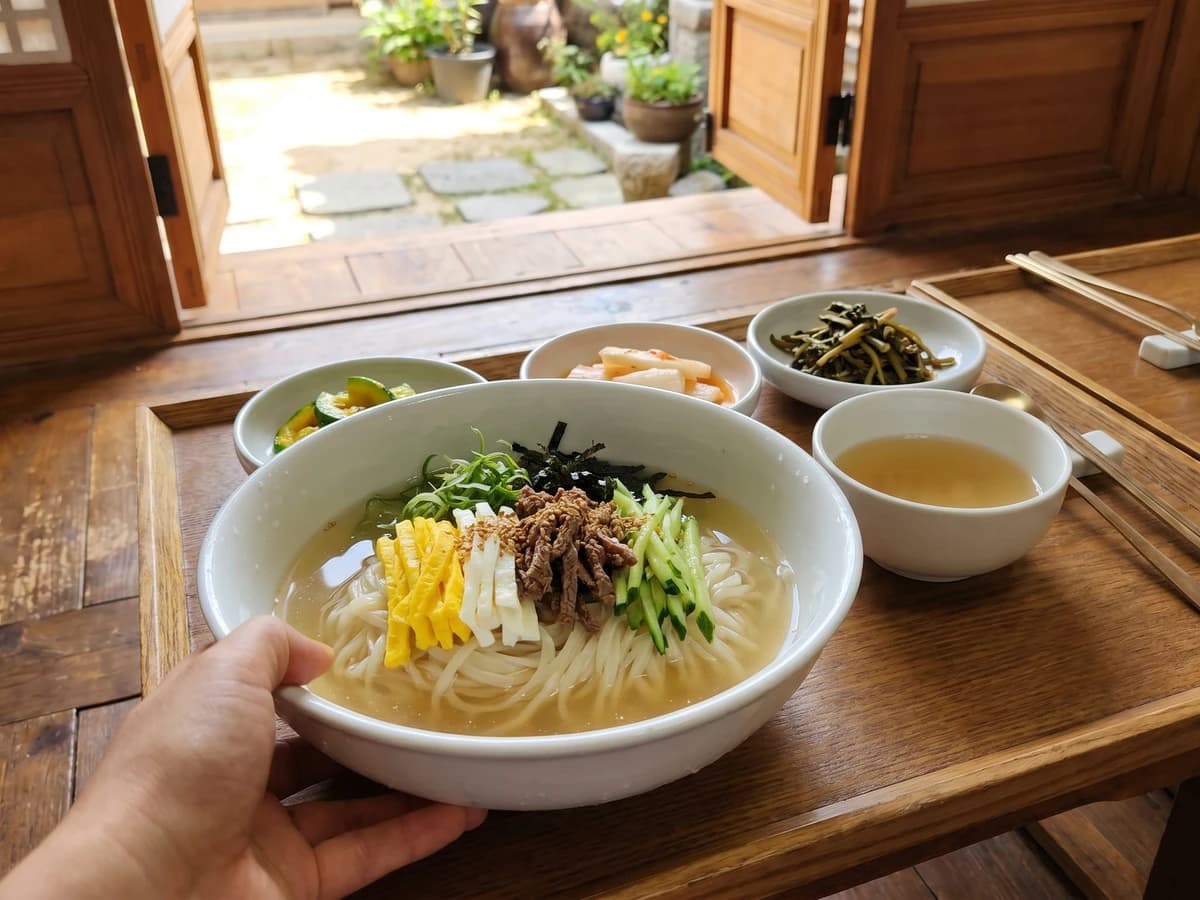
Andong's guest noodles, wheat and roasted soybean flour rolled thin, boiled and rinsed cold, then set in a clear chilled anchovy broth with careful strips of beef, egg, and cucumber.

Chef Jeong-sun
Andong's ritual-table rice served on an ordinary day: separate soy-sesame namul, warm rice, and clear radish soup, mixed without gochujang so every vegetable keeps its own voice.