
Chef Elsa
Almjause (Alpine Hut Snack Board)
A wooden board loaded with mountain cheese, juniper-smoked Speck, air-dried Hauswürstel, handmade Liptauer, fresh Kren, and thick-cut Bauernbrot, the way Austrian Almhütten have fed hikers for generations.
A cooking platform built around craft, culture, and the stories behind what we eat.
Created by
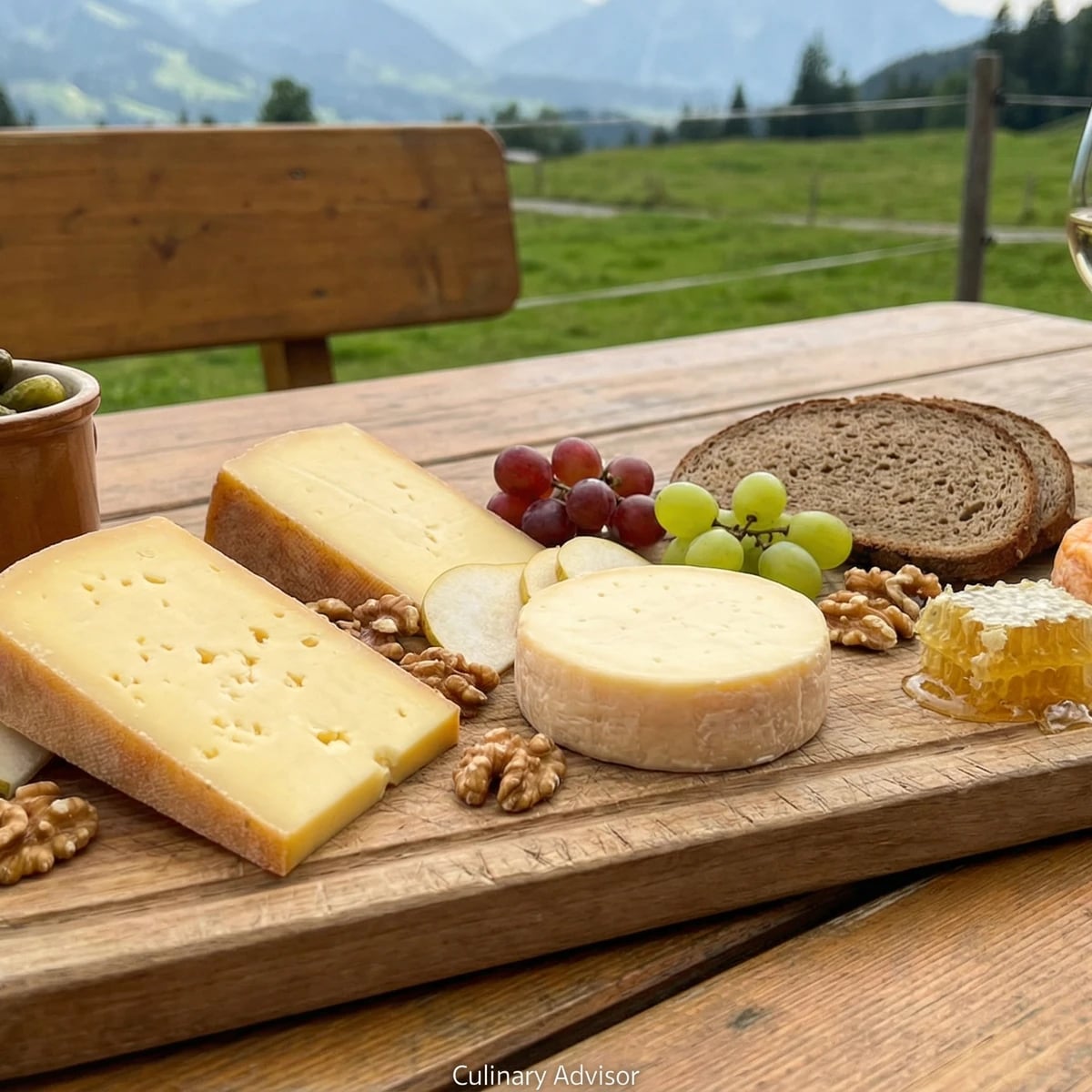
Three alpine cheeses from the Bregenzerwald arranged on a carved wooden Brettl with dark rye bread, raw honeycomb, walnuts, and seasonal fruit, the way Vorarlberg's mountain dairies have been feeding people for centuries.
The first time I tasted Vorarlberger Bergkäse properly was on a childhood trip with Gretel and my grandmother Eva. We'd driven west from Salzburg, past Innsbruck, and into Vorarlberg, which feels like a different country entirely. The dialect changes. The architecture changes. The cheese changes most of all. Gretel knew a Sennerei in Andelsbuch where you could buy wheels straight from the aging cellar, and I remember standing in that cool, damp room surrounded by enormous rounds of cheese stacked on spruce shelves, the smell sharp and buttery and alive. Gretel bought a wedge of aged Bergkäse and a piece of Rässkäse so pungent the woman wrapped it in three layers of paper. We ate both on dark bread in the car, and I thought it was the best thing I'd ever tasted.
Vorarlberg is Austria's smallest province but its biggest cheese story. The Bregenzerwald valley runs through the heart of it, and the dairy traditions there are older than most European borders. The farmers still practice Dreistufenwirtschaft, moving their herds up the mountain in stages through the summer: valley floor in spring, middle pastures in early summer, high Alpen at the peak. Each altitude gives the milk a different character, and the cheese made at the top, the true Alpkäse, has a sweetness and depth that valley milk can't produce. You're tasting the wildflowers and grasses of a specific meadow at a specific altitude. That's not poetry. That's biology.
A proper Vorarlberger Käseplatte isn't complicated to assemble, but it asks you to respect three things: the quality of the cheese, the temperature at which you serve it, and the restraint to keep the accompaniments simple. The cheeses are the performance. Everything else on the board is the audience.
Vorarlberger Bergkäse received its Protected Designation of Origin (PDO) from the European Union in 1997, recognizing a cheesemaking tradition documented in the Bregenzerwald since the 14th century. The region's Dreistufenwirtschaft, the three-stage alpine farming system where herds move to progressively higher pastures through summer, was inscribed on Austria's UNESCO Intangible Cultural Heritage list. The Bregenzerwald Käsestraße, established in 1998, connects over twenty Sennereien and alpine dairies along a route through the valley, making it one of Europe's oldest organized cheese trails.
Quantity
250g
aged minimum 6 months
Quantity
200g
3-4 months aged
Quantity
150g
Quantity
150g
Quantity
1 small loaf
sliced
Quantity
100g
Quantity
100g
Quantity
2
Williams or Conference, sliced
Quantity
small bunch
seasonal
Quantity
8-10
Quantity
generous piece
room temperature
| Ingredient | Quantity |
|---|---|
| Vorarlberger Bergkäse (PDO)aged minimum 6 months | 250g |
| Alpkäse or Vorarlberger Alpkäse3-4 months aged | 200g |
| Rässkäse (washed-rind alpine cheese) | 150g |
| Sura Kees (Bregenzerwald acid-set cheese) (optional) | 150g |
| dark rye bread (Schwarzbrot)sliced | 1 small loaf |
| raw honeycomb or alpine honey | 100g |
| walnut halves | 100g |
| ripe pearsWilliams or Conference, sliced | 2 |
| grapesseasonal | small bunch |
| cornichons | 8-10 |
| unsalted alpine butterroom temperature | generous piece |
Take all the cheeses out of the refrigerator a full hour before you plan to serve. Set them on the counter, still wrapped, and leave them alone. Cold cheese tastes like nothing. At fridge temperature, the fat in the cheese is solid and the flavor compounds are locked down. As the cheese warms toward room temperature, the fat softens, the texture changes, and suddenly you can taste what you paid for. This is the single most important step and the one most people skip.
How you cut cheese matters because the flavor develops from rind to center. The Bergkäse is the firmest: cut it into thin, even slices from a wedge so each piece carries a strip of the natural rind. The Alpkäse is slightly softer, so cut it into broader, thinner triangles. The Rässkäse has a sticky, washed rind: cut it into small rectangles so your guests can pick it up cleanly and aren't wrestling with it on the board. If you have Sura Kees, it's crumbly and dry. Break it into rough pieces rather than trying to slice it. Each cheese has a different texture and cutting it correctly is part of treating it with respect.
Slice the pears lengthwise into thin wedges just before serving. Pears oxidize quickly, so this is not a job you do ahead. If you're using grapes, pull them into small clusters of three or four rather than piling the whole bunch on the board. Arrange the cornichons in a small dish or earthenware crock. Set the honey or honeycomb in a separate small bowl with a drizzle stick. Pile the walnuts loosely. Everything should look generous and natural, not architected.
Use a large wooden Brettl, the kind of carved board you'd see at any Vorarlberg Buschenschank. Place the three (or four) cheeses in separate areas of the board with space between them. They should not touch each other. The Bergkäse anchors the board because it's the star and the largest portion. Set the Alpkäse opposite, the Rässkäse to one side. Tuck the fruit, walnuts, and cornichons into the gaps. Place the sliced Schwarzbrot either on the board if it fits or on a separate plate alongside. Set the butter on the board in a small mound or in a crock.
Bring the board to the table and tell your guests what they're eating. Not a lecture, just a sentence or two. This is Bergkäse from Vorarlberg, aged six months, nutty and firm. This is Rässkäse, it's pungent, start with a small piece. The Alpkäse was made from summer milk. People eat more adventurously when they know what's in front of them. Serve with a dry Austrian white, a Grüner Veltliner or a Vorarlberger cider if you can find one. Mahlzeit!
1 serving (about 330g)
Culinary guides, cultural storytelling, and the editorial depth that makes cooking meaningful.
Discover Culinary Explorer
Chef Elsa
A wooden board loaded with mountain cheese, juniper-smoked Speck, air-dried Hauswürstel, handmade Liptauer, fresh Kren, and thick-cut Bauernbrot, the way Austrian Almhütten have fed hikers for generations.

Chef Elsa
Dark, spiced, and wickedly good: Blunzn mashed with onion, mustard, and marjoram into the kind of spread that disappears first from every Heuriger Brettl, scooped up on torn hunks of dark bread.

Chef Elsa
A silky potato and sour cream spread with raw onion and paprika, piled onto dark rye bread the way they serve it at every Heuriger in Lower Austria. No cheese, despite the name. Just good potatoes and honest cooking.

Chef Elsa
A proper Carinthian Brettljause built around PDO Gailtaler Almkäse, nutty raw-milk alpine cheese served with Speck, dark Bauernbrot, pickles, fresh horseradish, and everything you need for an afternoon on an Almhütte terrace.