
Chef Elsa
Blunzenaufstrich (Blood Sausage Spread)
Dark, spiced, and wickedly good: Blunzn mashed with onion, mustard, and marjoram into the kind of spread that disappears first from every Heuriger Brettl, scooped up on torn hunks of dark bread.
A cooking platform built around craft, culture, and the stories behind what we eat.
Created by
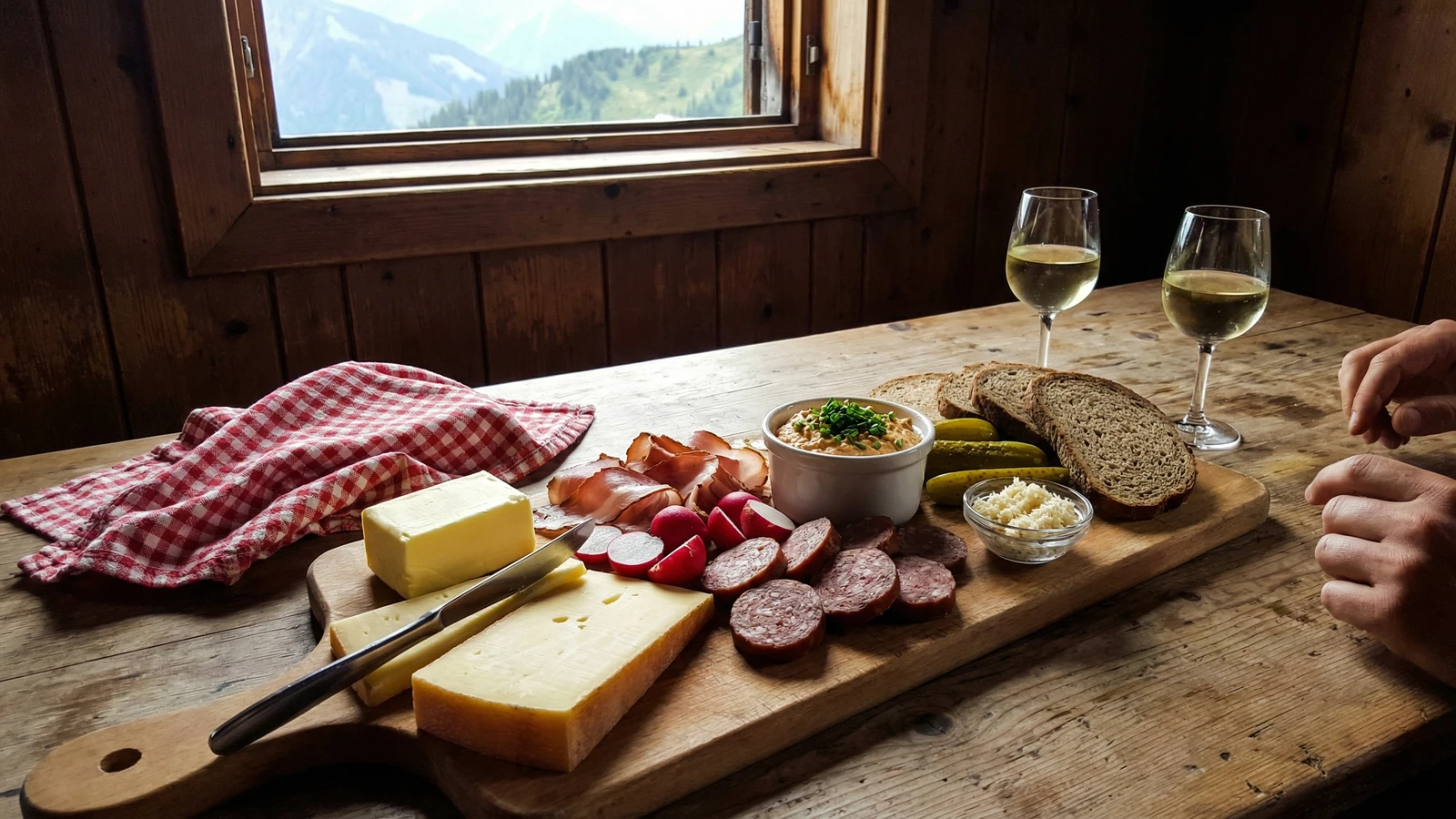
A wooden board loaded with mountain cheese, juniper-smoked Speck, air-dried Hauswürstel, handmade Liptauer, fresh Kren, and thick-cut Bauernbrot, the way Austrian Almhütten have fed hikers for generations.
On childhood trips to Austria with Gretel and my grandmother Eva, we'd hike to an Almhütte above the Salzkammergut and sit down at a wooden table that had seen fifty years of elbows. The Sennerin, the dairymaid who ran the hut, would bring out a board. Nothing fancy. Cheese she'd made that morning from the cows grazing twenty meters away. Speck from the farm below. Butter so fresh it was still pale. Dark bread. Radishes. That was it. I remember Gretel pointing at the board and telling me: this is the truest cooking in Austria. No technique, no recipe. Just people who know their ingredients.
Almjause means 'alpine snack,' and it's what you eat at a mountain hut after a hike. The word Jause itself is old Viennese for a between-meals bite, something to keep you going. At altitude, after three hours of walking, it becomes the best meal of your life. The cheese is Almkäse or Bergkäse, a firm alpine cheese made from the milk of cows that eat wildflowers and mountain grass. The Speck is Tyrolean, smoked with juniper and beech, then air-dried in cold mountain air until the fat turns translucent and the lean goes deep ruby. The butter tastes like butter used to taste before we forgot what butter was.
You don't need to hike to earn this. Make it at home on a Saturday afternoon. Lay everything on a wooden board, pour some wine, and sit with people you like. The principle is the same whether you're at 1,800 meters or in your kitchen: choose good things, put them together simply, and let them be what they are. Gretel always said the hardest thing in cooking is knowing when to stop. This board is a lesson in exactly that.
The Almjause tradition is rooted in Austria's alpine dairy farming culture, where Sennerinnen (dairymaids) spent summers at high-altitude huts tending cattle and making cheese from fresh milk. When hikers and farmers arrived at the hut, they were fed from whatever the Alm produced: fresh cheese, butter, cured meats stored from the valley, and bread brought up the mountain. The practice of opening Almhütten to hikers as informal restaurants became widespread in the Tyrol, Salzburg, and Styria by the late 19th century, and today a proper Almjause remains a protected regional food tradition, with many huts still making their own Almkäse on site.
Quantity
200g
cut in thick wedges
Quantity
150g
sliced thin
Quantity
150g
sliced on the diagonal
Quantity
100g
cold from the fridge
Quantity
1 loaf
thickly sliced
Quantity
250g
Quantity
80g
Quantity
1 tablespoon
Quantity
1 teaspoon
lightly crushed
Quantity
1 tablespoon
finely chopped
Quantity
2 tablespoons
finely diced
Quantity
1 teaspoon
Quantity
to taste
Quantity
6 small
Quantity
1 bunch
halved
Quantity
1 small piece
for grating
Quantity
1 tablespoon
chopped
| Ingredient | Quantity |
|---|---|
| Bergkäse or Almkäsecut in thick wedges | 200g |
| Tiroler Specksliced thin | 150g |
| Hauswürstel or Landjägersliced on the diagonal | 150g |
| unsalted alpine buttercold from the fridge | 100g |
| dark Bauernbrot (farmer's rye bread)thickly sliced | 1 loaf |
| Topfen (quark or farmer's cheese) | 250g |
| softened butter (for Liptauer) | 80g |
| sweet Hungarian paprika | 1 tablespoon |
| caraway seedslightly crushed | 1 teaspoon |
| capersfinely chopped | 1 tablespoon |
| white onionfinely diced | 2 tablespoons |
| Dijon mustard | 1 teaspoon |
| salt and black pepper | to taste |
| Gurkerl (cornichons or pickled gherkins) | 6 small |
| red radisheshalved | 1 bunch |
| fresh Kren (horseradish)for grating | 1 small piece |
| fresh chiveschopped | 1 tablespoon |
In a bowl, beat the Topfen and softened butter together with a fork until smooth and creamy. You're not whipping it. You're working two fats together until they stop arguing and become one thing. Add the paprika, crushed caraway, chopped capers, diced onion, and mustard. Season with salt and pepper. Mix until the spread turns a warm, earthy orange from the paprika. Taste it. It should be sharp from the capers, warm from the caraway, and just a little sweet from the paprika. Adjust whatever needs adjusting.
Cut the Bauernbrot into thick slices, about a centimeter and a half. This is not delicate finger-food bread. It's the kind of bread that holds up when you load it with butter and cheese and press down. If you can find a real sourdough rye, dense and dark with a thick crust, that's what you want. Austrian Bauernbrot has a chew and a tang to it that supermarket rye can't touch.
Cut the Bergkäse into thick, generous wedges. Not paper-thin deli slices. You want pieces substantial enough that you can break a bit off with your hands and eat it with bread. Slice the Speck thinly, though. Tiroler Speck is dense and intensely flavored, juniper-smoked and air-cured for months in mountain air. Thin slices let you appreciate the fat and lean together without it overwhelming the bite. Cut the Hauswürstel on the diagonal so you get long oval slices that show off the cross-section.
Halve the radishes lengthwise. They should be crisp and cold, a sharp little bite between the rich cheese and cured meats. Set the Gurkerl out whole or halved. Grate a small mound of fresh Kren onto a dish. Fresh horseradish hits differently from the jarred kind. It clears your head and cuts through the richness of the Speck like nothing else can. If your eyes water a little while you grate it, that's how you know it's fresh.
This is not architectural plating. This is abundance on a board. Use a large wooden Brettl, a cutting board, or any broad, flat surface that looks like it belongs on a farmhouse table. Set the butter in one piece on the board, not in curls, not whipped. A cold block of good butter with a knife beside it. Mound the Liptauer in a small earthenware crock or bowl and scatter the chopped chives on top. Arrange the cheese wedges, Speck slices, and Hauswürstel in generous clusters, not neat rows. Tuck the radishes and Gurkerl into the gaps. Set the Kren in its own small dish. Lay the bread slices overlapping along one side or pile them in a basket beside the board.
Bring the board to the table with nothing else. No dipping sauces, no chutneys, no complicated accompaniments. Set out a bottle of cold Grüner Veltliner or a few Krügerl of Austrian beer. The food speaks because every single thing on that board is good on its own. Your job was to choose well and lay it out honestly. Mahlzeit!
1 serving (about 415g)
Culinary guides, cultural storytelling, and the editorial depth that makes cooking meaningful.
Discover Culinary ExplorerChef Elsa
Dark, spiced, and wickedly good: Blunzn mashed with onion, mustard, and marjoram into the kind of spread that disappears first from every Heuriger Brettl, scooped up on torn hunks of dark bread.

Chef Elsa
A silky potato and sour cream spread with raw onion and paprika, piled onto dark rye bread the way they serve it at every Heuriger in Lower Austria. No cheese, despite the name. Just good potatoes and honest cooking.
Chef Elsa
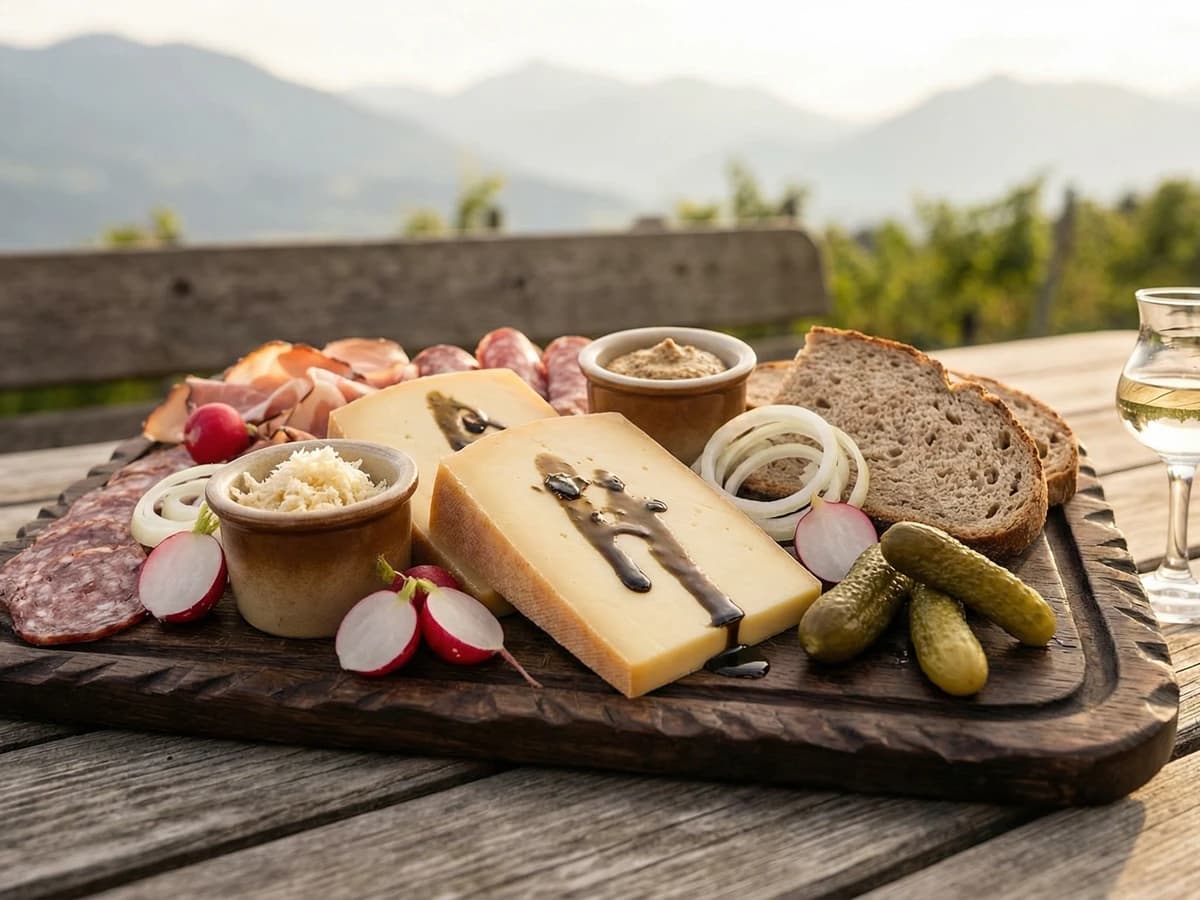
A proper Carinthian Brettljause built around PDO Gailtaler Almkäse, nutty raw-milk alpine cheese served with Speck, dark Bauernbrot, pickles, fresh horseradish, and everything you need for an afternoon on an Almhütte terrace.

Chef Elsa
Blood sausage rounds breaded and pan-fried until the crust shatters and the inside goes creamy and dark, served on a wooden Brettl with sharp mustard and fresh Kren the way every Heuriger in the Wachau has done it for generations.