
Chef Graziella
Bruschetta al Pomodoro Fresco
Grilled bread rubbed with garlic, crowned with ripe tomatoes, anointed with your finest oil. This is bruschetta as it exists in Italy, not the soggy appetizer Americans invented.
A cooking platform built around craft, culture, and the stories behind what we eat.
Created by
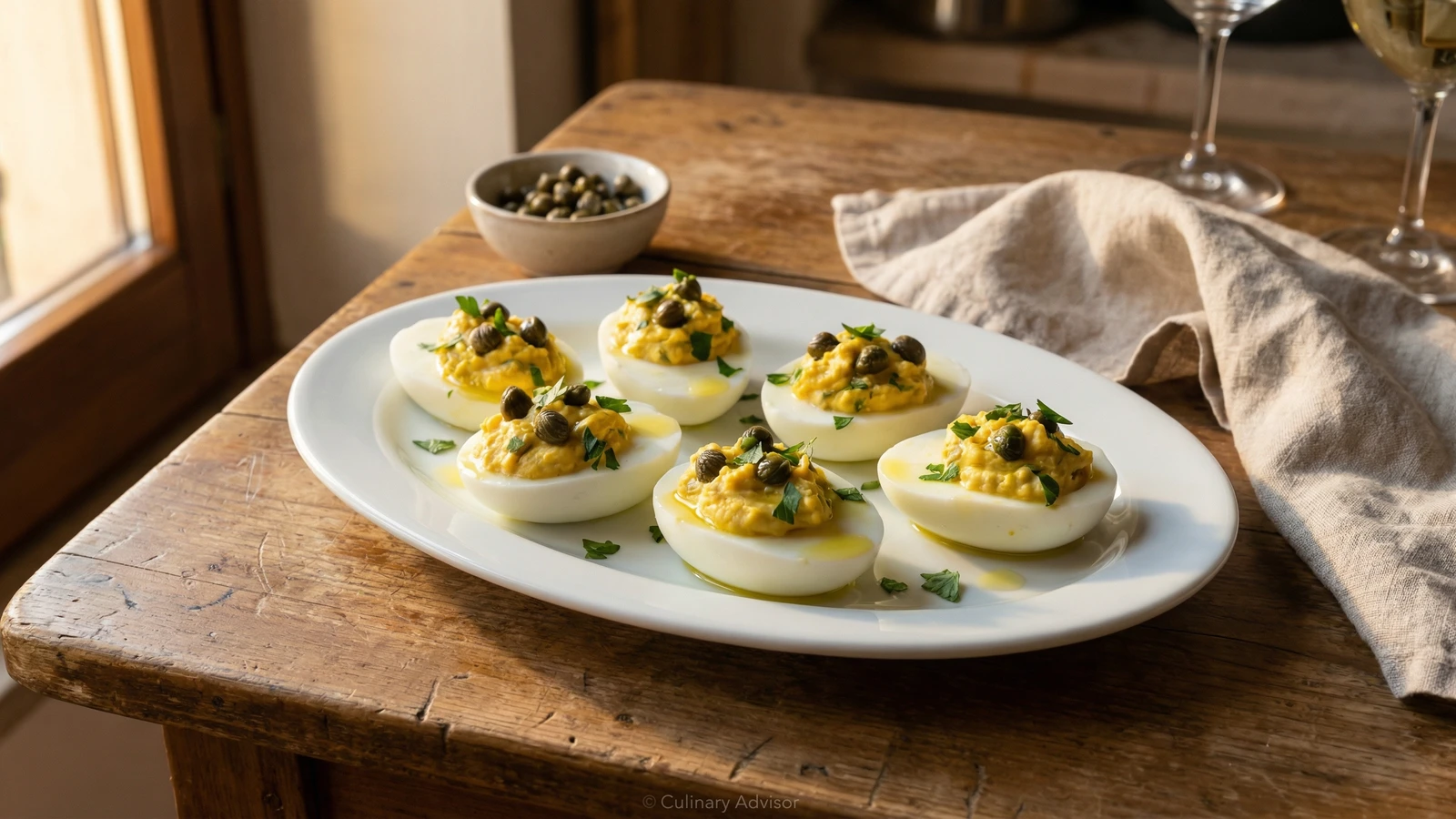
The Italian stuffed egg, where briny capers and salty anchovies replace the mayonnaise and mustard of American picnics. Simple ingredients, bold flavor, and eggs cooked properly.
Americans know deviled eggs as something sweet and creamy, mayonnaise and mustard whipped into submission. The Italian version is another animal entirely. These are briny, punchy, assertive. The yolks are enriched with olive oil, not mayonnaise. The capers and anchovies do the work that Americans ask mustard to do.
The egg itself must be cooked correctly, which most cooks fail to do. An overcooked egg announces itself with a gray-green ring around the yolk and the sulfurous smell of failure. The yolk should be golden throughout, tender, with no chalkiness at the center. This requires attention, not guesswork.
These are antipasti, meant to be eaten with wine before a meal, not as the meal itself. They should be briny enough to make you want another sip, savory enough to wake up the appetite. What you keep out is as significant as what you put in: no sweetness, no creaminess, nothing that obscures the fundamental egg.
Stuffed eggs appear in Italian cookery as far back as medieval banquet records, where they were gilded with saffron and served to nobility. By the 19th century, uova ripiene had become standard antipasti in trattorias across northern Italy, the filling varying by region: capers and anchovies along the coast, prosciutto in Emilia-Romagna, tuna in Liguria.
Quantity
6
at room temperature
Quantity
4
packed in olive oil, drained
Quantity
2 tablespoons
rinsed and drained
Quantity
3 tablespoons
Quantity
1 teaspoon
Quantity
to taste
freshly ground
Quantity
1 tablespoon
chopped fine
| Ingredient | Quantity |
|---|---|
| large eggsat room temperature | 6 |
| anchovy filletspacked in olive oil, drained | 4 |
| salt-packed capersrinsed and drained | 2 tablespoons |
| extra virgin olive oil | 3 tablespoons |
| fresh lemon juice | 1 teaspoon |
| black pepperfreshly ground | to taste |
| flat-leaf parsleychopped fine | 1 tablespoon |
Place eggs in a single layer in a saucepan and cover with cold water by one inch. Set over high heat. The moment the water reaches a full boil, remove the pan from heat, cover tightly, and let stand for exactly 10 minutes. Not 8, not 12. Ten minutes gives you a yolk that is fully set but still golden throughout, with no gray-green ring of shame.
Transfer eggs immediately to a bowl of ice water. Let them sit for at least 5 minutes. This stops the cooking and makes peeling easier. Eggs that are difficult to peel were not cooled quickly enough.
Tap each egg gently on the counter to crack the shell all over. Roll it under your palm to loosen the membrane. Peel under cold running water. The shells should slip off cleanly. Cut each egg in half lengthwise and carefully remove the yolks to a small bowl. Set the whites on a serving plate, hollow side up.
Mash the yolks with a fork until no large lumps remain. Mince the anchovies to a paste and add them to the yolks. Chop half the capers finely and add them as well, reserving the rest whole for garnish. Add the olive oil and lemon juice. Mash and stir until the mixture is smooth and holds together. It should be creamy from the oil, not dry and crumbly. Season with pepper. Taste before adding any salt. The anchovies and capers are already salty. You may need none.
Spoon the filling into the hollow of each egg white, mounding it slightly above the edge. You may use a piping bag if you want them to look like a restaurant made them, but a spoon is what Italian grandmothers use and it works perfectly well. The filling should be generous. Do not be stingy.
Top each stuffed egg with a few of the reserved whole capers and a light scattering of chopped parsley. Drizzle a thin thread of olive oil over all. Refrigerate for 30 minutes to allow the flavors to marry, then serve cold or at cool room temperature. These are antipasti. Serve them before the meal with wine, not as the meal itself.
1 serving (about 95g)
Culinary guides, cultural storytelling, and the editorial depth that makes cooking meaningful.
Discover Culinary ExplorerChef Graziella
Grilled bread rubbed with garlic, crowned with ripe tomatoes, anointed with your finest oil. This is bruschetta as it exists in Italy, not the soggy appetizer Americans invented.
Chef Graziella
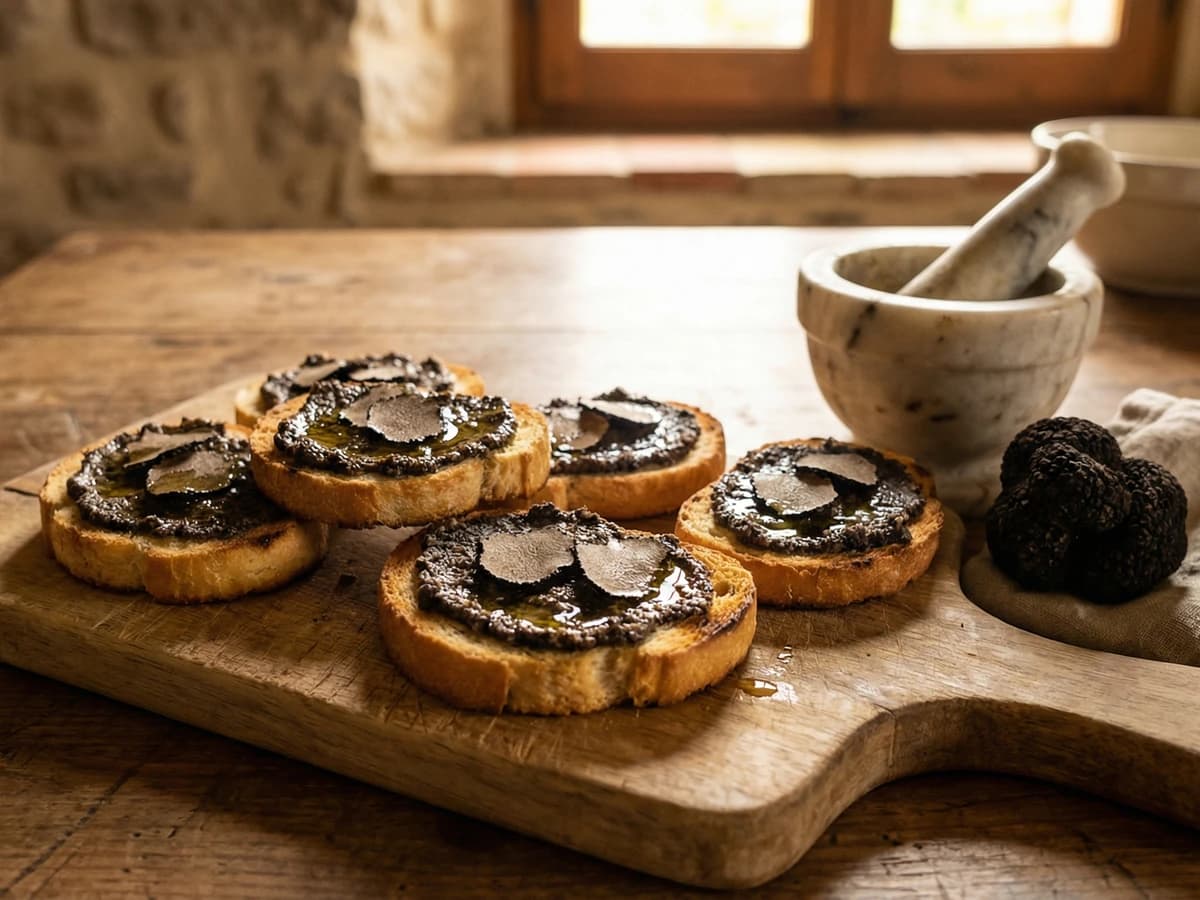
The black truffles of Norcia, pounded to a paste with nothing but olive oil and restraint, spread on warm bread. This is Umbrian luxury in its purest form.

Chef Graziella
Fire-charred peppers wrapped around a filling of tuna, capers, and anchovy. Made a day ahead, the flavors marry into something greater than their parts. This is antipasto as it should be.

Chef Graziella
Thin ribbons of summer zucchini, kissed by flame and wrapped around fresh goat cheese brightened with herbs. An antipasto that proves restraint creates elegance.