Culinary Explorer

A cooking platform built around craft, culture, and the stories behind what we eat.
Discover Culinary Explorer
Ueong-jorim (Soy-Braised Burdock)

Ueong-jorim (Soy-Braised Burdock)

Created by

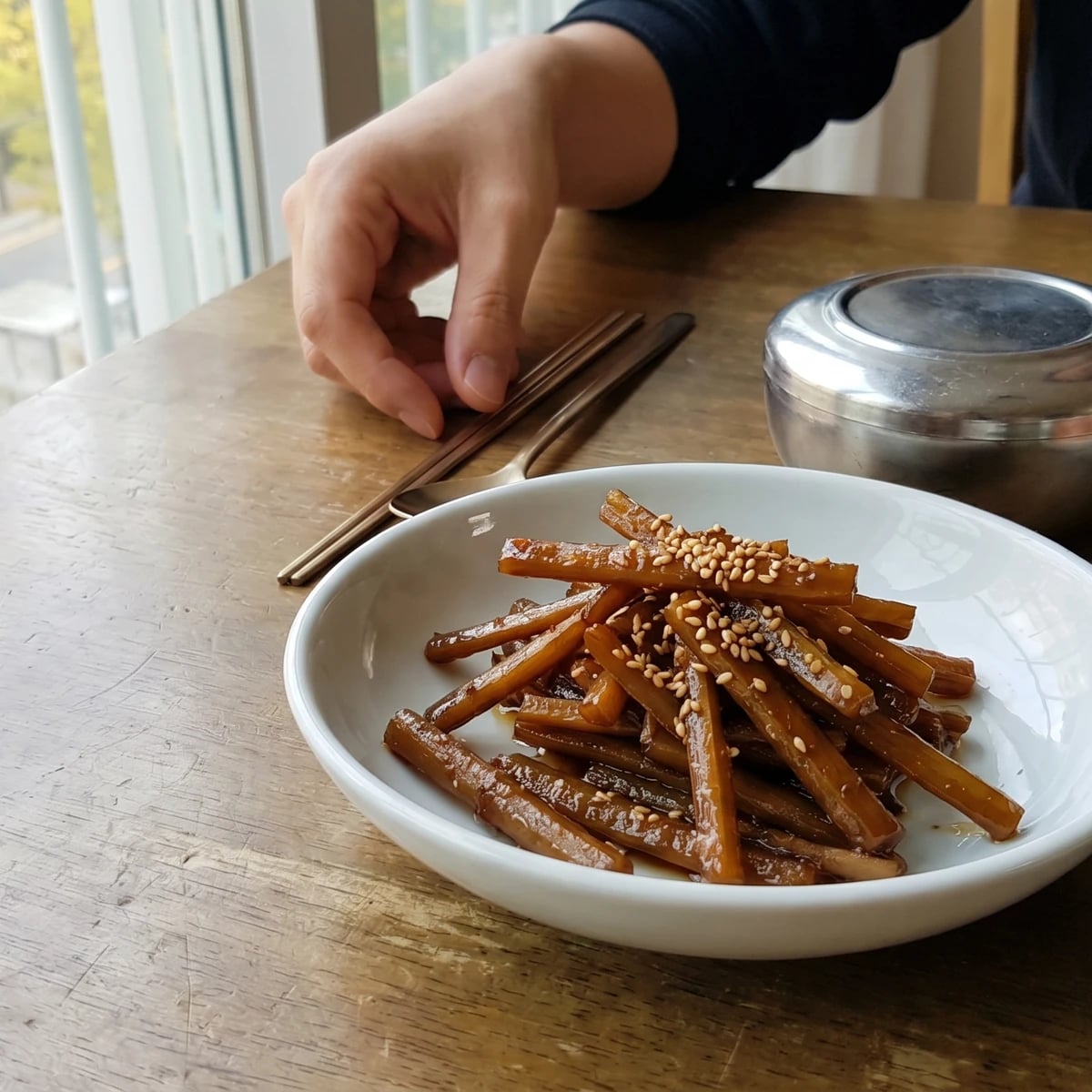
Autumn burdock cut into thin matchsticks, briefly soaked, then braised in soy, rice syrup, and sesame until each piece turns glossy, chewy, and ready for the week's rice bowls.

Side Dishes
Korean
Meal Prep
Make Ahead
Budget Friendly
25 min
Active Time
25 min cook50 min total
Yield6 to 8 banchan servings

Burdock comes into the market looking like something pulled from the edge of a field, long, dusty, and not trying to charm anyone. That is its honesty. Ueong-jorim is an autumn and winter banchan, the kind you make once and keep in the refrigerator so a plain bowl of rice has company all week.

The dish lives or dies by knife work and reduction. Cut the burdock too thick and it stays woody; cut it too thin and it collapses before the soy glaze clings. My teacher, Master Seong-nyeo, made us cut the sticks the width of a match, then measured them against one another without smiling. I thought it was severity. It was mercy for the finished dish.

Do not bury burdock under sugar. It has its own earthiness, almost like ginseng's quiet cousin, and the soy should deepen it while the syrup gives shine and chew. 손맛 is real; I measure it anyway, because this is how a small side dish survives one kitchen and reaches the next.

Burdock, called ueong in Korean, is a root vegetable long used across East Asia, and in Korea it became especially common as a home banchan and as one of the seasoned fillings in gimbap during the twentieth century. Jorim refers to the Korean technique of simmering ingredients in a seasoned liquid until the seasoning reduces and clings, a practical method for making sturdy side dishes that keep for several days. Ueong-jorim belongs to the everyday home table rather than court ceremony, which is exactly why it deserves a careful record.

The technique, the tradition, and the story behind every dish.

Discover Culinary Explorer

Ingredients

fresh burdock root (ueong)

Quantity

450g, about 2 long roots

scrubbed and cut into matchsticks

cold water

Quantity

5 cups

for soaking

rice vinegar

Quantity

2 tablespoons

for soaking

neutral oil

Quantity

1 tablespoon

water

Quantity

3/4 cup

for braising

soy sauce

Quantity

3 tablespoons

mirin or rice wine

Quantity

1 tablespoon

sugar

Quantity

1 tablespoon

rice syrup or corn syrup

Quantity

1 tablespoon

toasted sesame oil

Quantity

1 teaspoon

toasted sesame seeds

Quantity

1 tablespoon

Equipment Needed

  • Wide 10 to 12-inch skillet or saute pan
  • Sharp knife or julienne mandoline
  • Mixing bowl for vinegar water
  • Clean storage container with lid

Instructions

  1. 1

    Scrub and cut

    Scrub the burdock well under running water and scrape off rough patches with the back of a knife. Do not peel it down to a pale stick; much of the flavor sits near the skin. Cut it into 2 1/2-inch lengths, then into matchsticks about 1/8 inch thick. The even cut matters because every piece must soften and glaze at the same pace.

  2. 2

    Soak the burdock

    Put the cut burdock in 5 cups cold water mixed with 2 tablespoons rice vinegar for 10 minutes. This keeps it from darkening too quickly and pulls out a little harshness without washing away its earthiness. Drain and rinse once, then shake off as much water as you can.

  3. 3

    Stir-fry first

    Heat the neutral oil in a wide skillet over medium heat. Add the drained burdock and stir-fry for 3 to 4 minutes, until the pieces look slightly translucent at the edges and lose their raw stiffness. This short frying step wakes up the root before the soy goes in.

  4. 4

    Braise in soy

    Add 3/4 cup water, the soy sauce, mirin, and sugar. Stir well, then simmer uncovered over medium-low heat for 12 to 15 minutes, stirring now and then. The liquid should reduce slowly, not boil away in anger. Taste one piece: it should bend easily but still have a clean chew.

  5. 5

    Glaze and finish

    When only 2 to 3 tablespoons of liquid remain, stir in the rice syrup and cook 2 to 3 minutes more, tossing constantly, until the burdock is glossy and the seasoning clings to each stick. Turn off the heat, then add the sesame oil and sesame seeds. Sesame oil goes in off the heat so it stays fragrant instead of turning flat.

    If the pan dries before the burdock is tender, add 2 tablespoons water and keep cooking. If the burdock is tender but the pan is watery, raise the heat for the last minute and toss until the glaze tightens.
  6. 6

    Cool before storing

    Let the ueong-jorim cool to room temperature before packing it into a clean container. It tastes stronger after a few hours, once the soy has settled into the root. Serve a small mound beside rice, or tuck it into gimbap where its chew earns its place.

Chef Tips

  • Choose firm, slender burdock roots with tight skin and no soft spots. Very thick roots can be fibrous in the center, and no amount of soy will make woody burdock polite.
  • A mandoline with a julienne blade is a safe modern shortcut if your knife work is not steady yet. The corner you cannot cut is thickness: keep the sticks close to 1/8 inch so the texture comes out chewy, not hard.
  • Go light on the syrup. Ueong-jorim should be glossy and gently sweet, not candy. The root should still taste like burdock.
  • Stored cold in a covered container, this keeps 5 to 6 days. Use clean chopsticks each time, because banchan that keeps all week still deserves clean handling.

Advance Preparation

  • You can cut and soak the burdock up to 4 hours ahead. Keep it submerged in fresh cold water with a small splash of vinegar, then drain well before cooking.
  • Ueong-jorim is better after resting at least 2 hours in the refrigerator. Make it the night before for lunch boxes, gimbap, or a week of small rice-table meals.

Frequently Asked Questions

Nutrition Information

1 serving (about 75g)

Calories
100 calories
Total Fat
3 g
Saturated Fat
0 g
Trans Fat
0 g
Unsaturated Fat
3 g
Cholesterol
0 mg
Sodium
380 mg
Total Carbohydrates
17 g
Dietary Fiber
2 g
Sugars
6 g
Protein
2 g

Note: Chef personas and recipes are created with AI assistance. Cook with care: follow safe food-handling practices, check doneness with a thermometer when needed, and adapt for allergies and your kitchen.

Where cooking meets culture.

Culinary guides, cultural storytelling, and the editorial depth that makes cooking meaningful.

Discover Culinary Explorer

More from Mitbanchan: Jorim, Bokkeum & Egg

Browse the full collection