
Chef Jeong-sun
Aehobak-namul (Seasoned Korean Zucchini)
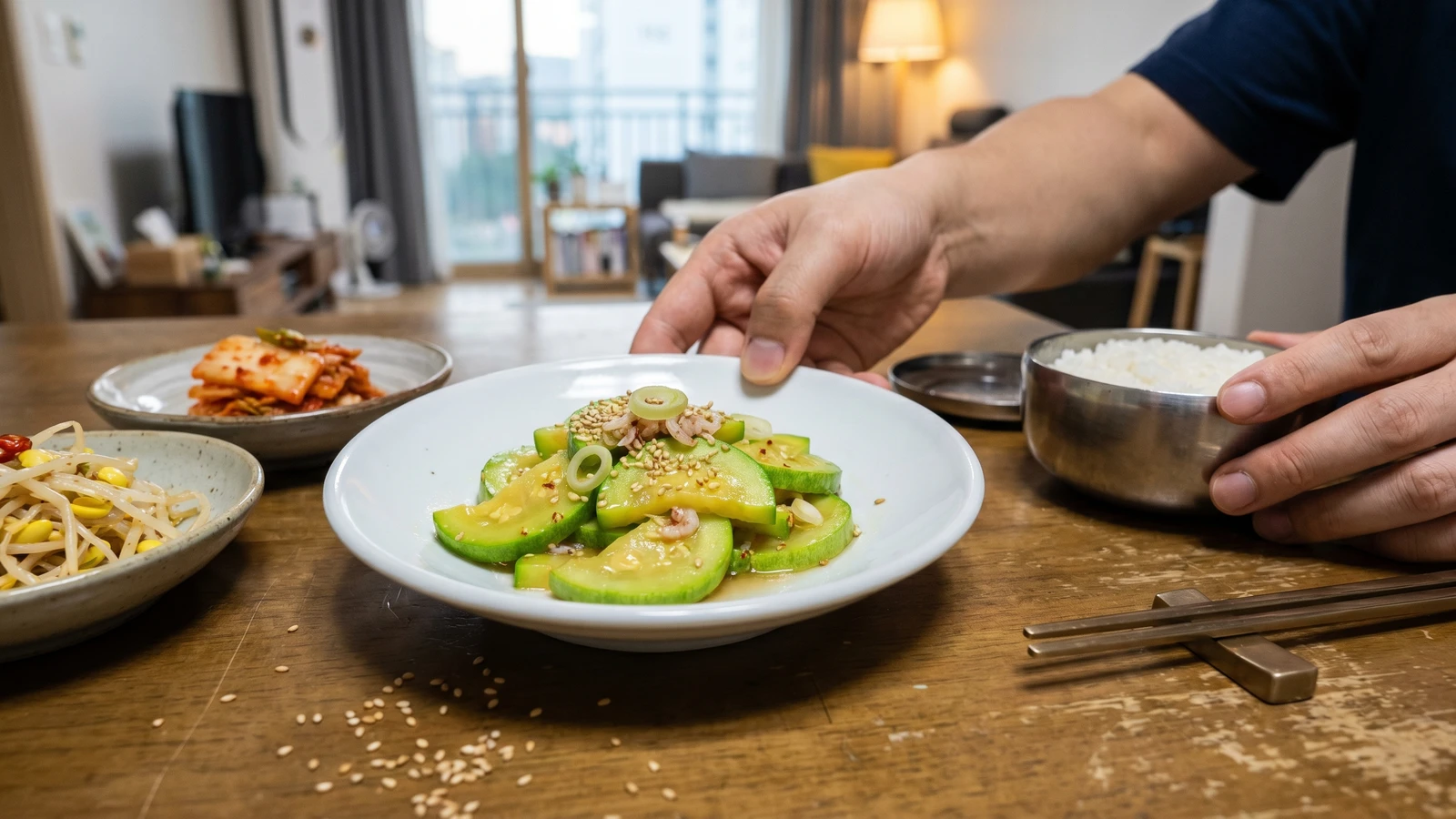
Tender Korean summer zucchini softened gently in the pan with saeujeot for salt and depth, finished with sesame so the vegetable stays sweet, green, and plainly itself.
A cooking platform built around craft, culture, and the stories behind what we eat.
Created by
Tender Korean zucchini half-moons cooked quickly over real heat, seasoned with salted shrimp so the squash tastes deeper than oil and still clean enough for a weeknight table.
Aehobak-bokkeum lives or dies in the pan. People treat zucchini as if it will forgive anything because it is cheap and soft. It doesn't. Cut it too thin and it collapses. Salt it too late and it weeps into the pan. Stir it timidly and you get pale wet squash, which is nobody's memory worth keeping.
My teacher Master Seong-nyeo made us cut every half-moon the same thickness before she let us touch the fire. Not for prettiness first. For timing. At 6 mm, the zucchini softens at the center while the green edge still holds, and the salted shrimp can season it before the flesh gives up its water. That is the whole dish.
This is weeknight banchan (side dish), the kind that sits beside rice, soup, kimchi, and two other small dishes without asking for attention. Buy firm Korean aehobak if you can, pale green and heavy for its size. If you have only dark Western zucchini, use it, but seed it if the center is spongy. 시대가 바뀌면 음식도 바뀌어야 해요. When times change, food must change too, but the knife work and the salt still have to be correct.
Cook it hot, cook it short, and stop before it looks finished, because carryover heat will finish the last step while it rests. Write that down. Memory is a borrowed bowl.
Hobak, the Korean word used broadly for squash and pumpkin, belongs to the family of New World crops that reached Korea during the Joseon period, with written references appearing by the seventeenth century. Aehobak means young squash, harvested immature and tender, and its quick stir-fries became part of the everyday banchan table because the vegetable grows abundantly in summer and takes well to small amounts of fermented seasoning. Saeujeot (salted shrimp), especially associated with coastal markets and kimchi making, gives this simple dish its savory depth without turning it into a heavy sauce.
Quantity
1 medium, about 300g
trimmed, halved lengthwise, cut into 6 mm half-moons
Quantity
1/2 teaspoon, divided
Quantity
1 tablespoon
Quantity
2 teaspoons
finely chopped
Quantity
2 cloves
minced
Quantity
2 tablespoons
Quantity
1
thinly sliced
Quantity
1 teaspoon
Quantity
1 teaspoon
Quantity
1/2 teaspoon
| Ingredient | Quantity |
|---|---|
| Korean zucchini (aehobak)trimmed, halved lengthwise, cut into 6 mm half-moons | 1 medium, about 300g |
| fine sea salt | 1/2 teaspoon, divided |
| neutral oil | 1 tablespoon |
| saeujeot (Korean salted shrimp)finely chopped | 2 teaspoons |
| garlicminced | 2 cloves |
| water or anchovy-kelp broth | 2 tablespoons |
| scallionthinly sliced | 1 |
| toasted sesame oil | 1 teaspoon |
| toasted sesame seeds | 1 teaspoon |
| gochugaru (Korean chili flakes) (optional) | 1/2 teaspoon |
Trim the aehobak, split it lengthwise, and cut it into half-moons about 6 mm thick. Keep the pieces even. Thin slices go limp before they season; thick slices stay raw at the center while the outside gives up water.
Toss the zucchini with 1/4 teaspoon of the salt and let it sit for 8 minutes, no longer. This draws out just enough surface moisture so the pan can fry instead of boil. Pat the pieces dry with a clean towel, but do not rinse them, or you wash away the first layer of seasoning.
Finely chop the saeujeot so the shrimp distributes through the pan instead of landing in salty bites. Stir it with the garlic, the remaining 1/4 teaspoon salt only if your saeujeot is mild, and 2 tablespoons water or anchovy-kelp broth. Taste the saeujeot first. Some jars are fierce, and the dish should taste of zucchini before it tastes of salt.
Set a wide skillet over medium-high heat for 1 minute, then add the neutral oil. Use a pan wide enough that the zucchini sits mostly in one layer. Crowding traps moisture, and this dish has no patience for a crowded pan.
Add the zucchini and stir-fry for 2 minutes, turning the pieces so the cut sides gloss with oil. Add the saeujeot mixture and cook 2 to 3 minutes more, stirring often, until the zucchini turns slightly translucent at the center but the green edges still hold. If the pan dries before the zucchini softens, add 1 tablespoon water, not more.
Turn off the heat while the zucchini still looks a little firmer than you want. Fold in the scallion, sesame oil, sesame seeds, and gochugaru if using. The last warmth in the pan finishes it. Taste one piece after 2 minutes of resting; it should be tender, lightly briny, and still clearly itself.
1 serving (about 85g)
Culinary guides, cultural storytelling, and the editorial depth that makes cooking meaningful.
Discover Culinary ExplorerChef Jeong-sun
Tender Korean summer zucchini softened gently in the pan with saeujeot for salt and depth, finished with sesame so the vegetable stays sweet, green, and plainly itself.

Chef Jeong-sun
A bittersweet spring green from the southern shore, blanched just until pliant, then seasoned lightly so its clean coastal bitterness stays alive on the rice table.

Chef Jeong-sun
Torn king oyster or shiitake mushrooms, browned until their own water disappears, then finished with soy, garlic, sesame oil, and onion for a quiet banchan that earns its place.

Chef Jeong-sun
A weeknight mushroom namul that needs no green, just careful tearing, a hot pan, and restrained soy-sesame seasoning so the mushrooms still taste like themselves.