Culinary Explorer

A cooking platform built around craft, culture, and the stories behind what we eat.
Discover Culinary Explorer
Tzotzil Three-Meat Bundle (Suban'ik)

Tzotzil Three-Meat Bundle (Suban'ik)

Created by

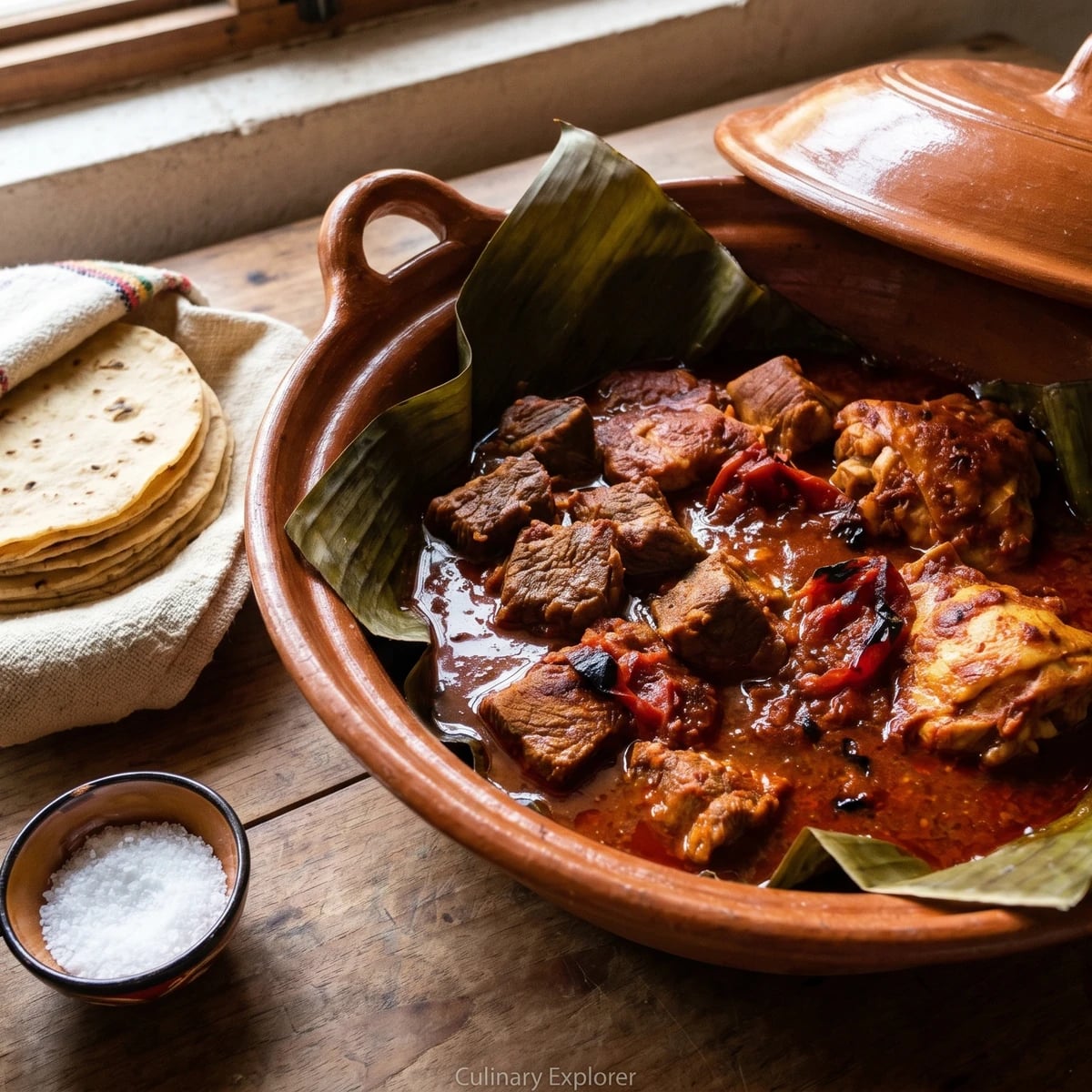
Chiapas highland Suban'ik wraps beef, pork, and chicken in banana leaf with chile simojovel, tomato, and garlic, then lets the bundle cook slowly until the meats share one ceremonial sauce.

Main Dishes
Mexican
Special Occasion
Celebration
Holiday
1 hr 15 min
Active Time
3 hr cook4 hr 15 min total
Yield8 to 10 servings

Chiapas, the Tzotzil highlands around San Juan Chamula, Zinacantán, and Chenalhó, this is where Suban'ik lives. Not in the north. Not in a border menu. In the cold mountain towns above San Cristóbal de las Casas, where a fiesta dish has to feed many hands and still taste like the place that made it.

The chile that gives this version its spine is chile simojovel, from Chiapas, small, dark, and serious. The tomato and miltomate give body and acid. The banana leaf, brought up from warmer valleys and sold in folded stacks at the market, becomes the pot inside the pot. Beef, pork, and chicken cook together until they stop being three separate meats and become one ceremonial sauce.

I learned this style from women who cooked for mayordomías, not from restaurant cooks. They did not measure the way a book measures. They watched the leaf soften, smelled the chile on the comal, and knew when the recado had lost its raw bite. La cocina no es decoración, es trabajo. If you understand that before you start, the recipe will behave for you. Recetas probadas y garantizadas.

Suban'ik belongs to the highland Maya cooking belt that joins Chiapas with Guatemala, where recados of chile, tomato, and miltomate are cooked inside leaves for fiestas, mayordomías, and weddings. Before the 16th century, related leaf-wrapped dishes used turkey, wild game, and native chiles; beef, pork, and chicken entered after Spanish livestock spread through the region. In Tzotzil Chiapas, chile simojovel and banana leaf mark the local version, while Guatemalan highland versions often use chile guaque, chile pasa, and maxán leaf.

The technique, the tradition, and the story behind every dish.

Discover Culinary Explorer

Ingredients

beef chuck or bone-in short ribs

Quantity

1 1/2 pounds

cut into 1 1/2-inch chunks

pork shoulder with its fat

Quantity

1 1/2 pounds

cut into 1 1/2-inch chunks

bone-in chicken thighs and drumsticks

Quantity

2 pounds

skin on

kosher salt

Quantity

1 tablespoon, plus 2 teaspoons

divided

dried chile simojovel

Quantity

6

stemmed and seeded

dried chile guajillo

Quantity

4

stemmed and seeded

dried chile ancho

Quantity

2

stemmed and seeded

ripe Roma tomatoes

Quantity

2 pounds

tomatillos (miltomate)

Quantity

8 ounces

husked and rinsed

white onion

Quantity

1 large

quartered

garlic cloves

Quantity

8

unpeeled

black peppercorns

Quantity

1 teaspoon

whole allspice berries (pimienta gorda)

Quantity

5

whole cloves

Quantity

3

cumin seeds

Quantity

1/2 teaspoon

achiote paste

Quantity

1 tablespoon

fresh nixtamal masa or masa harina slurry

Quantity

3 tablespoons fresh masa, or 2 tablespoons masa harina mixed with 3 tablespoons water

for thickening the recado

pork lard (manteca de cerdo)

Quantity

2 tablespoons

warm water or unsalted chicken broth

Quantity

1 1/2 cups

divided

banana leaves

Quantity

4 large

thawed if frozen and wiped clean

hoja santa leaves (momo) (optional)

Quantity

4 large

hand-pressed corn tortillas (optional)

Quantity

for serving

warmed

plain arroz blanco (optional)

Quantity

for serving

Equipment Needed

  • Cast iron comal or heavy skillet for chiles and vegetables
  • Large tamalera or 10-quart steamer with a tight lid
  • High-powered blender
  • Fine-mesh strainer
  • Kitchen twine or strips torn from softened banana leaf
  • Burnished clay cazuela from Amatenango del Valle for serving

Instructions

  1. 1

    Salt the meats

    Put the beef, pork, and chicken in a large bowl. Season with 1 tablespoon kosher salt and work it into every piece. Let the meat sit while you prepare the recado, at least 30 minutes. The salt needs time to enter the meat. If it only sits on the surface, the sauce will taste seasoned and the meat will taste forgotten.

  2. 2

    Soften the leaves

    Pass each banana leaf over a hot comal or directly over a low gas flame for a few seconds per side, just until the leaf turns glossy and flexible. Wipe again with a damp towel. Do not skip this. A raw leaf cracks when you fold it, and then your ceremonial bundle becomes a leaking pot. No me vengas con atajos.

    If the leaves are frozen, thaw them completely first. Frozen banana leaf is useful, but it is fragile until it has been warmed and handled with respect.
  3. 3

    Toast the chiles

    Heat a dry comal over medium. Toast the chile simojovel, guajillo, and ancho separately, turning each one with tongs. The simojovel is small and can burn fast, 10 to 15 seconds per side. The guajillo takes about 20 seconds. The ancho takes closer to 30. They should darken slightly, puff in spots, and smell deep, never scorched. Cover them with hot water and soak for 20 minutes.

    Burned chile turns the whole recado bitter. If one chile goes black, throw it out. A careful cook wastes one chile, not the whole fiesta pot.
  4. 4

    Char the vegetables

    On the same comal, roast the tomatoes, tomatillos, onion, and unpeeled garlic until the skins blister and blacken in spots. Turn them patiently. The tomatoes should slump and release juice, the tomatillos should turn olive green, and the garlic should soften inside its papery skin. Peel the garlic after roasting.

  5. 5

    Grind the recado

    Toast the black peppercorns, pimienta gorda, cloves, and cumin seeds for 30 seconds on the comal, just until fragrant. Drain the soaked chiles. Blend the chiles with the charred tomatoes, tomatillos, onion, peeled garlic, toasted spices, achiote paste, masa, 1 teaspoon salt, and 1 cup warm water or broth. Blend until completely smooth. Strain through a fine-mesh sieve if your blender leaves skins behind. The sauce should be brick red and thick enough to coat a spoon.

  6. 6

    Fry the recado

    Melt the manteca de cerdo in a wide cazuela or heavy skillet over medium heat. Pour in the recado carefully. It will sputter. Stir for 8 to 10 minutes, until the color deepens and small freckles of fat show at the surface. La manteca es el sabor. This step wakes up the chile and takes the raw edge off the tomato. Add the remaining 1/2 cup water or broth if the sauce becomes too stiff to pour.

  7. 7

    Build the bundle

    Set a rack inside a large tamalera or steamer and add water below the rack. Line the rack with two banana leaves crossed over each other, leaving enough overhang to fold back over the meat. Lay the hoja santa leaves on the banana leaf if using. Put the beef and pork in first, then the chicken. Pour the fried recado over everything and turn the pieces so each one is coated. Fold the banana leaves tightly over the meat and tie the bundle with kitchen twine or strips of banana leaf.

  8. 8

    Steam the bundle

    Cover the tamalera and cook over a steady medium-low simmer for 2 1/2 to 3 hours. Check the water level every 45 minutes and add hot water under the rack when needed. You are steaming a sealed parcel, not boiling meat. The Suban'ik is ready when the beef and pork yield to a fork and the chicken is fully cooked at the bone.

  9. 9

    Rest and open

    Turn off the heat and let the bundle rest, still closed, for 20 minutes. Resting matters. The sauce settles back around the meat instead of running across the table. Open the banana leaf carefully and spoon the red recado over the top. The leaf should smell green and smoky, and the sauce should cling to the meat.

  10. 10

    Serve with tortillas

    Lift the opened bundle into a warm clay cazuela or bring the whole steamer insert to the table if that is how your kitchen works. Serve with hand-pressed corn tortillas and plain arroz blanco if you want the sauce to go further. No flour tortillas here. This is Chiapas highland food. Cada estado, su propia cocina.

Chef Tips

  • Ask for chile simojovel from Chiapas. If your chile vendor has never heard of it, ask the women at the market, not the supermarket shelf. If you cannot find it, use 4 more chile guajillo and 2 chile de arbol. That is a compromise, not an upgrade.
  • The sauce should be deep and red, not a contest for heat. Not all Mexican food is about burning your mouth. Suban'ik is about chile flavor, tomato, leaf, and the juices of three meats sharing one pot.
  • Use pork shoulder with fat. Do not buy lean pork loin for this. The pork fat seasons the recado while the bundle cooks, and the sauce needs that body.
  • Hoja santa, called momo in Chiapas, is optional because not every version uses it and not every market outside Mexico carries it. If you find real momo, use it. Do not replace it with basil. That is another plant and another flavor.
  • Banana leaf is not decoration. It protects the meat, perfumes the sauce, and holds the bundle together. Foil can go outside the leaf if your pot is difficult, but the food must touch banana leaf first. Así se hace y punto.

Advance Preparation

  • Salt the meats up to 24 hours ahead and keep them covered in the refrigerator. The seasoning will be better and the cooking day will be calmer.
  • The recado can be made 2 days ahead. Cool it, refrigerate it, and fry it in manteca on the day you build the bundle.
  • Banana leaves can be softened, wiped, folded, and refrigerated one day ahead. Keep them wrapped so they do not dry out.
  • If you cook the Suban'ik ahead, cool the meat and sauce promptly in shallow containers and refrigerate. Reheat covered in a steamer until the chicken reaches 165F again.

Frequently Asked Questions

Nutrition Information

1 serving (about 410g)

Calories
720 calories
Total Fat
43 g
Saturated Fat
14 g
Trans Fat
0 g
Unsaturated Fat
28 g
Cholesterol
175 mg
Sodium
1510 mg
Total Carbohydrates
40 g
Dietary Fiber
8 g
Sugars
6 g
Protein
44 g

Note: Chef personas and recipes are created with AI assistance. Cook with care: follow safe food-handling practices, check doneness with a thermometer when needed, and adapt for allergies and your kitchen.

Where cooking meets culture.

Culinary guides, cultural storytelling, and the editorial depth that makes cooking meaningful.

Discover Culinary Explorer

More from Chiapas & Tabasco Main Dishes

Browse the full collection