
Chef Elsa
Bosna (Salzburg Spiced Sausage Roll)
Salzburg's legendary spiced sausage roll, two Bratwürstel tucked into a sliced white roll with fried onions, curry mustard, and a spice mix that every Würstelstand in town guards like a state secret.
A cooking platform built around craft, culture, and the stories behind what we eat.

Created by
Tiny rectangles of dark rye bread piled with five classic Viennese spreads, the way they've been served at Trześniewski since 1902. Two bites each, a Pfiff of beer on the side, and a whole city's worth of Gemütlichkeit.
Every visit Gretel and Eva made to Vienna included a stop at Trześniewski. I was maybe eight or nine the first time they took me, and I remember being confused by the size of the sandwiches. They were tiny, barely three fingers wide, lined up on trays behind a glass counter like jewels in a case. Gretel ordered six of them without looking at the menu and handed me one topped with something creamy and flecked with paprika. Liptauer, she said. Try it. I ate it in two bites and wanted four more.
Trześniewski Brötchen are not sandwiches the way most people think of sandwiches. They're closer to a ritual. You stand at the counter, you choose your spreads from a dozen or more options, you eat them with your fingers, and you wash each one down with a Pfiff, a tiny glass of beer that holds barely more than a few swallows. Nobody sits down. Nobody lingers over a single sandwich. You eat three, five, seven, standing shoulder to shoulder with everyone from law students to opera singers to postal workers on their lunch break.
The bread is always dark rye, sliced thin and cut into rectangles. The spreads are the real work. Each one is made fresh, ground or minced until it holds together on the bread without sliding off, seasoned with the kind of precision that comes from making the same thing every day for a hundred years. I serve a version of these at my restaurant in Salzburg when we host standing receptions, and they disappear faster than anything else on the table. Five spreads is what I'm giving you here. Make all five. Line them up on a wooden board. Invite people over. This is good Austrian home cooking at its most sociable.
Franciszek Trzesniewski, a Polish immigrant from Krakow, opened his sandwich shop on Vienna's Dorotheergasse in 1902. He brought the idea of small open-faced sandwiches with finely prepared spreads, and within a decade his tiny shop had become a Viennese institution. Franz Kafka reportedly ate there during his visits to Vienna. The shop is still family-run on the same street, still serves the same-sized Brötchen on the same dark bread, and still pours Pfiff-sized beers from the same small glasses. Over a hundred years and the recipe cards haven't changed.
Quantity
1 loaf
unsliced if possible
Quantity
6 large
Quantity
3 tablespoons
Quantity
1 tablespoon
Quantity
1 small
very finely minced
Quantity
2 tablespoons
finely cut
Quantity
to taste
Quantity
250g
softened
Quantity
60g
softened
Quantity
1 tablespoon
Quantity
1 teaspoon
Quantity
1 tablespoon
finely chopped
Quantity
1 teaspoon
lightly crushed
Quantity
1 small
very finely minced
Quantity
200g
Quantity
80g
softened
Quantity
1 tablespoon
Quantity
1 small
very finely minced
Quantity
1 teaspoon
Quantity
for garnish
Quantity
150g
Quantity
100g
Quantity
2 tablespoons
Quantity
1 tablespoon
finely grated
Quantity
1 small
very finely diced
Quantity
200g
Quantity
80g
Quantity
2 tablespoons
Quantity
1 tablespoon
Quantity
1 tablespoon
finely chopped
Quantity
to taste
Quantity
for garnish
halved lengthwise
Quantity
for garnish
Quantity
for garnish
Quantity
for dusting
| Ingredient | Quantity |
|---|---|
| dense dark rye bread (Schwarzbrot)unsliced if possible | 1 loaf |
| eggs (for Eiaufstrich) | 6 large |
| mayonnaise | 3 tablespoons |
| Dijon mustard | 1 tablespoon |
| white onion (for Eiaufstrich)very finely minced | 1 small |
| fresh chivesfinely cut | 2 tablespoons |
| salt and white pepper | to taste |
| cream cheese, full fat (for Liptauer)softened | 250g |
| unsalted butter (for Liptauer)softened | 60g |
| sweet Hungarian paprika | 1 tablespoon |
| sharp paprika (optional) | 1 teaspoon |
| capersfinely chopped | 1 tablespoon |
| caraway seedslightly crushed | 1 teaspoon |
| white onion (for Liptauer)very finely minced | 1 small |
| matjes herring fillets | 200g |
| unsalted butter (for herring spread)softened | 80g |
| sour cream (for herring spread) | 1 tablespoon |
| shallotvery finely minced | 1 small |
| lemon juice (for herring spread) | 1 teaspoon |
| fresh dill | for garnish |
| smoked Speck or smoked bacon | 150g |
| cream cheese (for Speck spread) | 100g |
| sour cream (for Speck spread) | 2 tablespoons |
| fresh horseradishfinely grated | 1 tablespoon |
| Essiggurke (gherkin)very finely diced | 1 small |
| smoked trout fillet | 200g |
| cream cheese (for trout spread) | 80g |
| sour cream (for trout spread) | 2 tablespoons |
| lemon juice (for trout spread) | 1 tablespoon |
| fresh dill (for trout spread)finely chopped | 1 tablespoon |
| freshly ground black pepper | to taste |
| cornichons (optional)halved lengthwise | for garnish |
| radish slices (optional) | for garnish |
| small dill sprigs (optional) | for garnish |
| paprika (optional) | for dusting |
Slice the dark rye bread about seven millimeters thick. You want it thin enough to eat in two bites but sturdy enough to hold a spread without bending. Cut each slice into rectangles roughly eight centimeters by four. If your loaf is round, trim the crusts to get clean edges and eat the offcuts yourself. Line the rectangles up on a board and cover with a damp cloth while you work on the spreads. Schwarzbrot dries out fast and a dry Brötchen is a sad thing.
Lower the eggs into boiling water and cook for exactly ten minutes. Transfer to ice water immediately. This gives you a yolk that's fully set but still bright and creamy, not chalky with that grey-green ring. Peel and chop the eggs finely. You want a mince, not a mash. Mix with the mayonnaise, mustard, minced onion, and half the chives. Season with salt and white pepper. White pepper because you don't want black specks in a golden spread. The consistency should hold its shape on a spoon. If it's too loose, you've added too much mayonnaise.
Beat the softened cream cheese and butter together until completely smooth. This is the base, and it needs to be silky. Add the sweet paprika, sharp paprika if you want warmth, chopped capers, crushed caraway seeds, and finely minced onion. Mix thoroughly. The color should be a warm, earthy orange from the paprika, not a timid peach. Taste it. Liptauer wants to be assertive. Add salt if needed. Let it rest in the fridge for at least thirty minutes so the flavors have time to find each other.
Pat the herring fillets dry with kitchen paper. Chop them finely, then mash with a fork until they break down into a rough paste. Work in the softened butter, sour cream, minced shallot, and lemon juice. You're looking for a spread that's smooth enough to hold on bread but still has texture. Season with white pepper. Go easy on salt because the herring brings its own. The finished spread should taste of the sea, not of salt.
If using Speck, trim any rind and cut into small pieces. If using smoked bacon, cook it in a dry pan over medium heat until the fat renders and the edges crisp, then drain on kitchen paper and let it cool. Either way, chop the meat as finely as you can manage, then blend or mash it with the cream cheese, sour cream, grated horseradish, and diced gherkin. The spread should be chunky and smoky, with a sharp kick from the horseradish that clears the back of your nose.
Flake the smoked trout into a bowl, running your fingers through it to check for any small bones. Mash it with a fork, then work in the cream cheese, sour cream, lemon juice, and chopped dill. Season with black pepper. This spread should be the lightest of the five, pink and flecked with green, with a clean smoky flavor that finishes with citrus. Don't over-process it. A few visible flakes of trout are a good thing.
Uncover the bread rectangles. Spread each one generously with your chosen Aufstrich, using a small palette knife or butter knife to create a smooth, slightly domed surface. The spread should cover the bread completely, edge to edge, with no bare patches showing. At Trześniewski, every Brötchen is a perfect little canvas. Top each one simply: a few chive tips on the Eiaufstrich, a light dusting of paprika on the Liptauer, a tiny dill sprig on the herring and the trout, a thin cornichon half laid lengthwise on the Speck. A single thin radish slice works on any of them. Don't overload the garnish. These are small bites. Restraint matters.
Serve the Brötchen at cool room temperature. Not fridge-cold, because the spreads seize up and lose their flavor. Set them out fifteen minutes before your guests arrive. If you want to do this properly, pour Pfiff-sized beers: fill small glasses about one-third full with a light Austrian lager. A Pfiff is an eighth of a liter, barely more than a few mouthfuls. The idea is one small beer per sandwich, so nobody's glass gets warm. Mahlzeit!
1 serving (about 280g)
Culinary guides, cultural storytelling, and the editorial depth that makes cooking meaningful.
Discover Culinary ExplorerChef Elsa
Salzburg's legendary spiced sausage roll, two Bratwürstel tucked into a sliced white roll with fried onions, curry mustard, and a spice mix that every Würstelstand in town guards like a state secret.
Chef Elsa
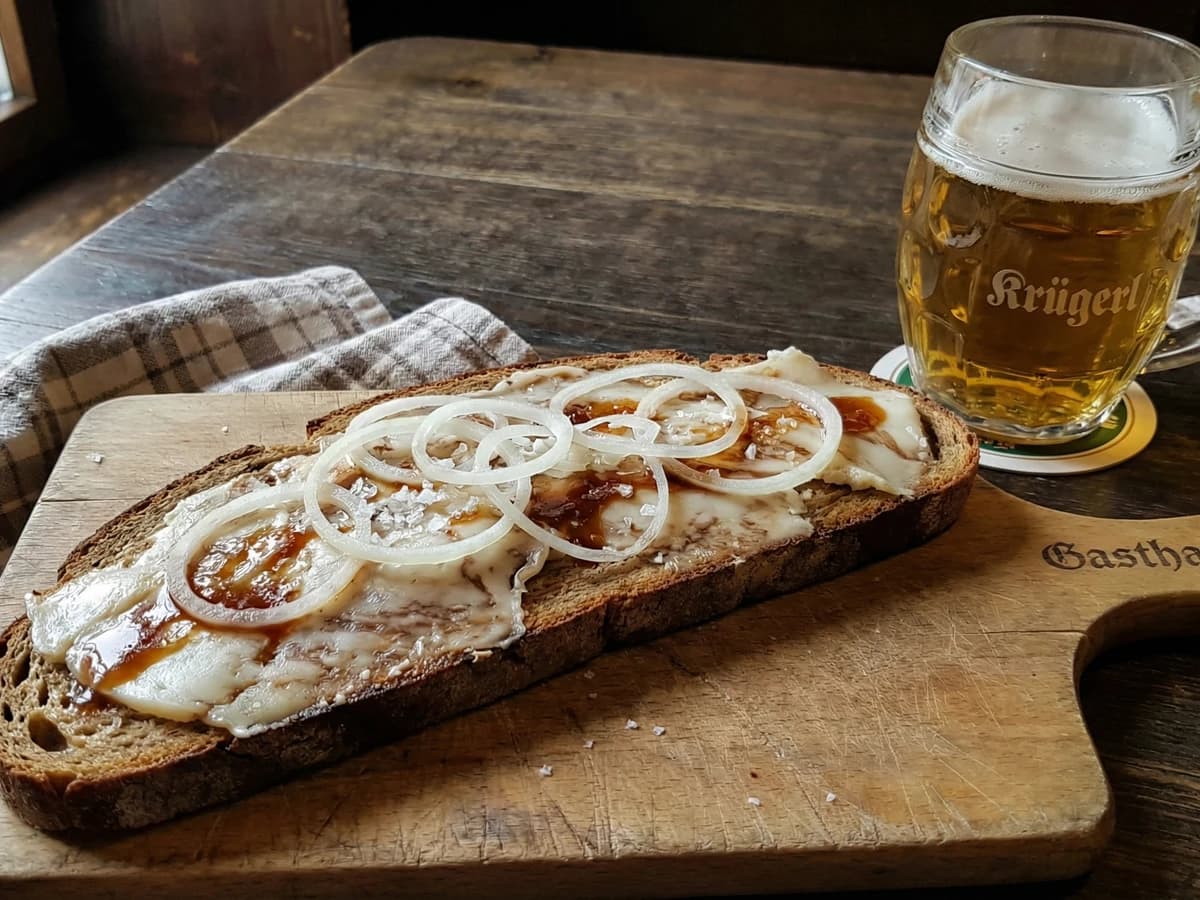
Cold roast pork drippings spread thick on dark farmhouse bread with raw onion rings and coarse salt. The best thing Austrians eat standing up, and they know it.
Chef Elsa
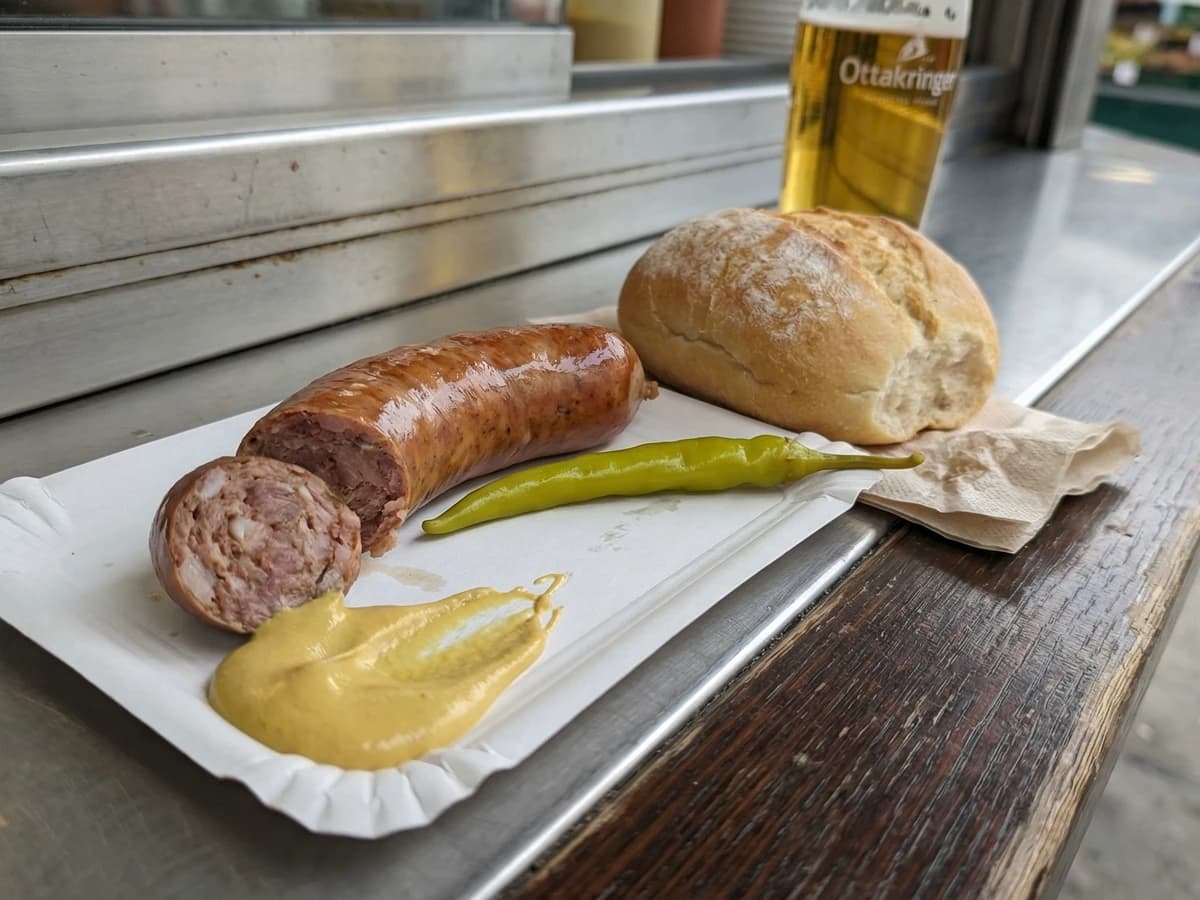
The Würstelstand's coarse, snappy pork sausage served the proper Viennese way: gently heated (never boiled), with sharp mustard, a fresh Semmel, and a Pfefferoni on the side.

Chef Elsa
The Würstelstand classic: bright red paprika sausage, scored and seared golden, served with sharp mustard, freshly grated Kren, and a warm Semmel the way Austrians have been eating it for generations.