Culinary Explorer

A cooking platform built around craft, culture, and the stories behind what we eat.
Discover Culinary Explorer
Bratlfettbrot

Bratlfettbrot

Created by

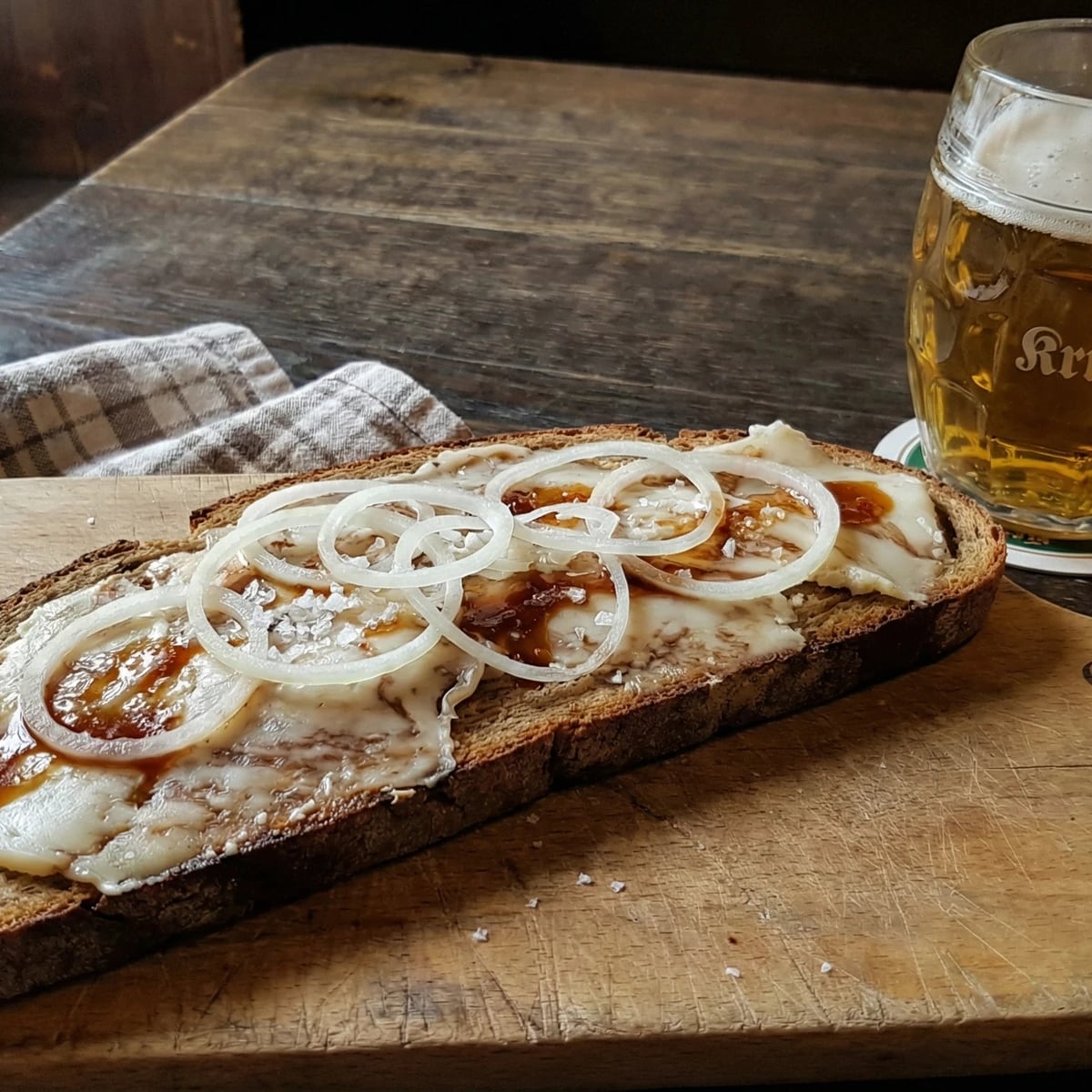
Cold roast pork drippings spread thick on dark farmhouse bread with raw onion rings and coarse salt. The best thing Austrians eat standing up, and they know it.

Sandwiches & Wraps
Austrian
Comfort Food
Outdoor Dining
20 min
Active Time
3 hr cook3 hr 20 min total
Yield6 servings (plus leftover Bratlfett)

On the childhood trips to Austria with Gretel and my grandmother Eva, nobody paid much attention to what I was eating at the Heuriger. The adults were busy with wine and conversation, and I was left to explore the cold buffet on my own. That's where I first met Bratlfettbrot. I didn't know what it was called. I just knew there was a woman behind a counter spreading something pale and savory onto dark bread, piling onion rings on top, and handing it over like it was nothing special. I took one bite and went back for a second piece before I'd finished the first.

Bratlfett is what happens when you roast a good piece of pork with caraway and garlic and then save what the pan gives you instead of washing it down the drain. The drippings cool and set into this extraordinary spread, half silky fat, half rich meaty jelly, carrying every bit of seasoning from the roast. You spread it on bread the way other people spread butter, only thicker. Then raw onion. Then salt. That's it. Three things on bread, and it's one of the most satisfying bites in all of Austrian cooking.

Gretel always said the simplest Austrian food is the hardest to get right, because there's nowhere to hide. With Bratlfettbrot, either your pork was good and your drippings are rich with caraway and garlic, or they're not. The bread is either proper dark farmhouse bread with backbone, or it's not. The onion is either sharp and fresh, or it's not. When everything is right, it tastes like Austria on a wooden board. When it isn't, you know immediately.

Bratlfettbrot comes from the Austrian tradition of using every part of a roast, especially common in Upper Austria and the Alpine regions where pork has been the dominant meat for centuries. The dish is inseparable from Heuriger culture, the seasonal wine taverns outside Vienna and across Lower Austria where vintners serve their new wine alongside cold buffets of bread, spreads, and cured meats. At Würstelstände across Austria, Bratlfettbrot sits alongside the sausages as a late-night staple, the kind of food that sustains people coming out of theaters and concert halls and needs nothing more than a beer beside it.

The technique, the tradition, and the story behind every dish.

Discover Culinary Explorer

Ingredients

pork shoulder or belly

Quantity

1 kg

bone-in, skin on

coarse sea salt

Quantity

1 tablespoon

caraway seeds

Quantity

1 tablespoon

lightly crushed

garlic

Quantity

4 cloves

smashed

dried marjoram

Quantity

1 teaspoon

freshly ground black pepper

Quantity

1/2 teaspoon

water or light beer

Quantity

250ml

for the roasting pan

dark Bauernbrot or Schwarzbrot (farmhouse rye bread)

Quantity

6 thick slices

white onion

Quantity

1 large

sliced into thin rings

flaky sea salt

Quantity

for finishing

Equipment Needed

  • Roasting tin large enough for the pork
  • Fine-mesh sieve
  • Sharp knife for scoring the skin
  • Wooden cutting board for serving

Instructions

  1. 1

    Season the pork

    Score the skin of the pork in a crosshatch pattern with a sharp knife, cutting through the fat but not into the meat. Rub the coarse salt, crushed caraway seeds, smashed garlic, marjoram, and pepper all over the meat, pressing the seasoning into the scored lines. The caraway and marjoram are not decoration. They're going to perfume the drippings as the pork roasts, and that's what you'll taste every time you spread this on bread. Let the pork sit at room temperature for thirty minutes while your oven heats.

    Crush the caraway seeds with the flat of a knife blade or a mortar and pestle. You want them cracked open, not powdered. Whole seeds slip off the meat. Cracked seeds stick and release their oils into the fat.
  2. 2

    Roast the pork

    Preheat your oven to 180°C (160°C fan). Place the pork skin-side up in a roasting tin and pour the water or beer into the bottom. The liquid keeps the drippings from burning on the pan and adds a gentle, rounded flavor to the fat as it renders. Roast for two and a half to three hours, basting every forty-five minutes with the juices that collect in the pan. The skin should crackle and turn deep golden brown. The fat beneath will have melted into the roasting liquid, carrying all that garlic and caraway with it.

    If you want extra-crisp crackling on the meat itself, raise the heat to 220°C for the last fifteen minutes. But watch it closely. The line between golden crackling and charcoal is about three minutes.
  3. 3

    Collect the Bratlfett

    When the pork is done, lift it out of the tin and set it aside to rest. It's going to make wonderful eating on its own, but right now we're after what it left behind. Pour all the pan juices through a fine-mesh sieve into a bowl. Use a spoon to scrape up any caramelized bits stuck to the roasting tin and press them through the sieve too. Those browned, sticky bits are concentrated flavor. Don't leave them behind.

  4. 4

    Set the drippings

    Let the strained drippings cool to room temperature, then refrigerate until they set into a soft, spreadable paste. This takes at least four hours, overnight is better. The fat will firm up on top with the meatier jelly settled underneath. Some people separate the layers. I don't. Stir them together with a fork so you get streaks of rich, savory jelly running through the pale fat. That contrast is part of what makes Bratlfett so good. It should be spreadable but not liquid, something like soft butter on a cool morning.

    Taste the set Bratlfett before you serve it. If it needs more salt or a touch more marjoram, work it in with a fork. The seasoning can mellow as it cools, so adjust now.
  5. 5

    Assemble the Bratlfettbrot

    Take your bread out. This has to be proper dark bread, Bauernbrot or Schwarzbrot, the kind with a thick crust and a dense, sour crumb that can hold up under a heavy spread. Sliced white bread will buckle and go soggy. Spread the Bratlfett thick. Don't be polite about it. You want a layer as thick as the bread itself, with the marbled fat and jelly visible on the surface. Lay raw white onion rings across the top, then finish with a generous pinch of flaky sea salt.

  6. 6

    Serve as it's meant to be served

    Set the bread on a wooden board or a simple plate. No knife and fork. You pick this up with your hands. If you're doing it properly, have a Krügerl of Austrian beer beside it and eat standing up or sitting on a bench outside. This is not restaurant food. This is Heuriger food, Würstelstand food, the kind of eating that happens at the end of a long day when all you want is something honest and good. Mahlzeit!

Chef Tips

  • The pork cut matters. Shoulder gives you drippings with deep, meaty flavor. Belly gives you more fat and a silkier spread. Both work. If you can get a piece with the bone still in and the skin on, that's what you want. The skin renders slowly during roasting and enriches the drippings with body you can't get any other way.
  • Don't skip the caraway. I know it divides people, but caraway in pork drippings is as Austrian as it gets. If you leave it out, you've made flavored lard. Perfectly fine, but not Bratlfett.
  • Use a white onion, not red. Red onion is too sweet for this. You want that sharp, almost peppery bite that cuts through the richness of the fat. Slice the rings thin so they don't overwhelm the bread, but leave them raw. Cooked onion has no place here.
  • The bread must be sturdy. Austrian Bauernbrot or any dense, dark sourdough rye with a thick crust will hold the weight of the spread. If you can't find Bauernbrot, look for a good German-style Vollkornbrot at a bakery. Soft bread collapses under the Bratlfett and you end up eating it with a spoon, which rather defeats the purpose.

Advance Preparation

  • Bratlfett improves with a day in the fridge. Make the roast on Saturday, collect the drippings, and serve Bratlfettbrot on Sunday. The flavors deepen overnight as the caraway and garlic infuse further into the set fat.
  • Stored in a sealed jar in the fridge, Bratlfett keeps for two weeks. Press cling film directly against the surface to prevent oxidation.
  • Slice the onion just before serving. Cut onion rings go limp and lose their bite within an hour.

Frequently Asked Questions

Nutrition Information

1 serving (about 170g)

Calories
465 calories
Total Fat
28 g
Saturated Fat
10 g
Trans Fat
0 g
Unsaturated Fat
16 g
Cholesterol
30 mg
Sodium
1050 mg
Total Carbohydrates
47 g
Dietary Fiber
7 g
Sugars
4 g
Protein
9 g

Note: Chef personas and recipes are created with AI assistance. Cook with care: follow safe food-handling practices, check doneness with a thermometer when needed, and adapt for allergies and your kitchen.

Where cooking meets culture.

Culinary guides, cultural storytelling, and the editorial depth that makes cooking meaningful.

Discover Culinary Explorer

More from Austrian Würstelstand & Street Sandwiches

Browse the full collection