
Chef Juliette
Flan aux Carottes
A pale short-paste shell holds silken, lightly sweet carrot purée beneath neat glazed half-discs, their butter syrup catching the light: a classical tart poised between vegetable course and sweet.
A cooking platform built around craft, culture, and the stories behind what we eat.

Created by
The great crumbling cake of Mantua, where cornmeal and almonds meet in deliberate coarseness. You do not slice this. You break it with your hands, the way Mantuans have done for centuries.
Sbrisolona takes its name from briciola, the Italian word for crumb. This tells you everything about how it should be made and how it must be eaten. It is not a cake to be sliced with a knife and served in neat wedges. You break it with your hands. You let it crumble. The shards and fragments are the point.
Americans want refinement. They want cakes that cut cleanly and hold their shape on the plate. Sbrisolona refuses this. The texture is coarse, almost sandy. The almonds are left in rough pieces, not ground to powder. The cornmeal stays granular. When you bite into it, it shatters. What falls onto the plate, you eat with your fingers.
This is a cake born in the kitchens of Mantua, where cornmeal has been a staple for centuries. The original recipes used lard, which creates a particular tenderness, though butter has become acceptable. What cannot change is the method: you do not knead this dough, you do not press it smooth. You crumble it into the pan and leave it rough. What you keep out, the eggs, the leavening, the overworking, is as significant as what you put in.
Torta Sbrisolona appears in Mantuan records from the 17th century, when it was made with cheaper ingredients: lard, cornmeal, and whatever nuts were available. It was peasant food, a way to stretch almonds by padding them with polenta flour. The Gonzaga court eventually adopted it, proving again that the food of the poor becomes the food of everyone when it is good enough.
Quantity
150 grams
Quantity
150 grams
Quantity
150 grams
skin on, roughly chopped
Quantity
150 grams
Quantity
1
zested
Quantity
1/4 teaspoon
Quantity
150 grams
cut into small cubes
Quantity
2
Quantity
1/2 teaspoon
Quantity
30 grams
for topping
Quantity
for dusting
| Ingredient | Quantity |
|---|---|
| fine yellow cornmeal | 150 grams |
| all-purpose flour | 150 grams |
| whole almondsskin on, roughly chopped | 150 grams |
| granulated sugar | 150 grams |
| lemonzested | 1 |
| fine sea salt | 1/4 teaspoon |
| cold unsalted buttercut into small cubes | 150 grams |
| large egg yolks | 2 |
| pure vanilla extract | 1/2 teaspoon |
| sliced almondsfor topping | 30 grams |
| powdered sugar (optional) | for dusting |
Chop the whole almonds by hand into rough, uneven pieces. Some should be nearly halved, others in smaller fragments. Do not use a food processor, which creates too much almond dust and destroys the texture. The unevenness is deliberate. You want to bite into distinct pieces of nut.
In a large bowl, whisk together the cornmeal, flour, chopped almonds, sugar, lemon zest, and salt. The lemon zest should be very fine and distributed throughout. Rub it between your fingers with some of the sugar to release its oils.
Add the cold butter cubes to the dry ingredients. Using your fingertips only, work the butter into the flour mixture until it resembles very coarse breadcrumbs. Some pieces of butter should remain visible, the size of small peas. This takes 3 to 4 minutes. Do not overwork. The mixture should feel sandy and dry, not like a cohesive dough.
In a small bowl, whisk the egg yolks with the vanilla. Drizzle this over the crumb mixture and toss gently with a fork or your fingertips. The dough should clump when pressed but remain crumbly. It will not come together into a ball. This is correct. If it becomes a smooth dough, you have overworked it.
Preheat your oven to 350°F (180°C). Butter a 9 or 10-inch tart pan with a removable bottom. Crumble the dough into the pan in rough handfuls. Do not press it down. Do not smooth the surface. Let it fall where it falls, with peaks and valleys. Press only gently around the edges to secure the dough to the sides of the pan. Scatter the sliced almonds over the top.
Bake for 40 to 45 minutes, until the cake is a deep amber gold with darker patches on the peaks and around the almonds. The color should be confident, not pale. It should smell intensely of toasted nuts and browned butter. A toothpick is useless here because the cake is meant to be crumbly, not set. Trust the color.
Let the cake cool completely in the pan, at least one hour. Do not attempt to unmold it while warm or it will shatter entirely. Even when cool, handle it carefully. Remove the sides of the tart pan but leave the cake on the base for serving. The sbrisolona is fragile. This is not a flaw.
Dust very lightly with powdered sugar if desired, though Mantuans often omit this. Place the cake in the center of the table. Do not cut it. Break off rough pieces with your hands. Let the crumbs fall where they may. This is how sbrisolona has been eaten for four centuries, and there is no reason to change.
1 serving (about 65g)
Culinary guides, cultural storytelling, and the editorial depth that makes cooking meaningful.
Discover Culinary ExplorerChef Juliette
A pale short-paste shell holds silken, lightly sweet carrot purée beneath neat glazed half-discs, their butter syrup catching the light: a classical tart poised between vegetable course and sweet.
Chef Juliette
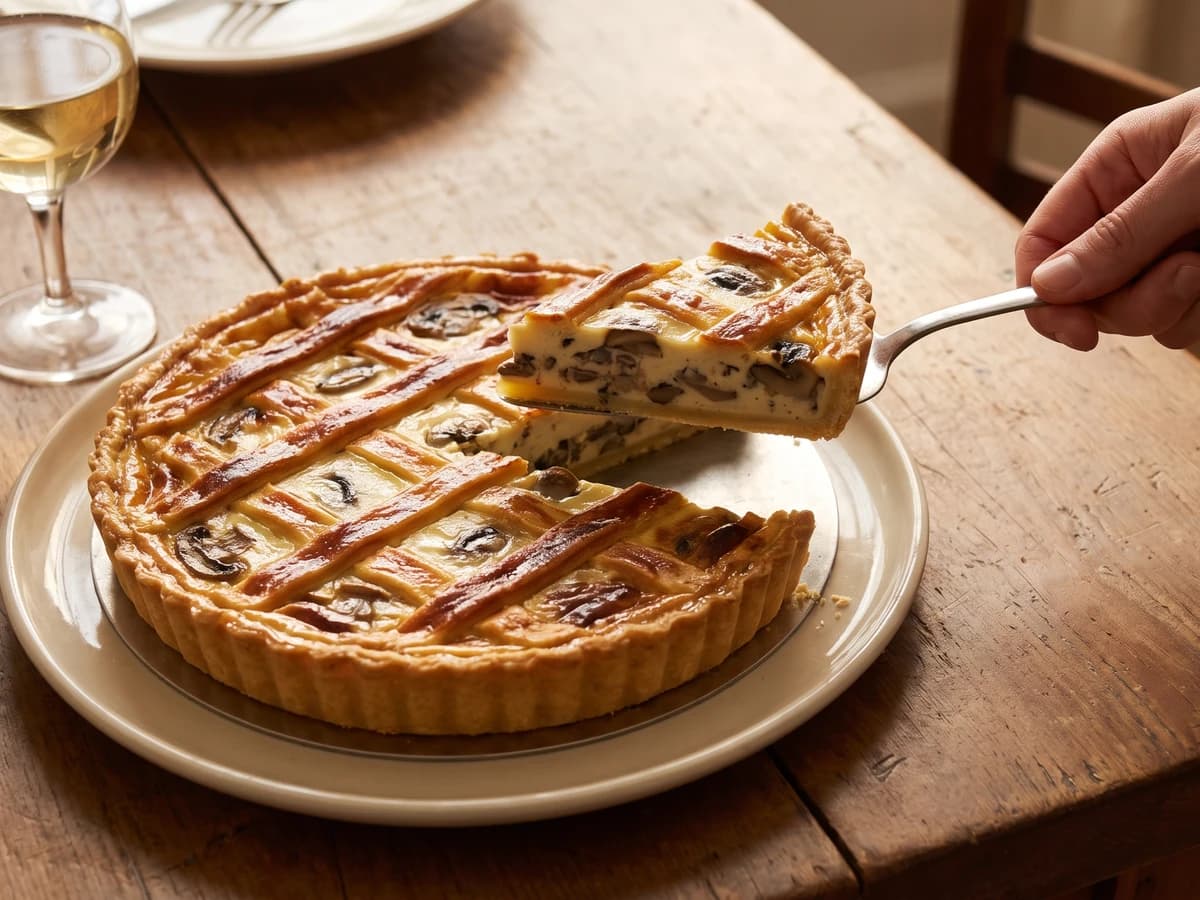
A hot mushroom flan under a butter-gold lattice, with cream reduced close around barely opened caps and a crisp short-paste base protected by one discipline: cool the filling completely.

Chef Juliette
Four little mushroom flans, latticed and gilded, baked hard and fast until butter-gold: a classical garnish scaled to the meat it accompanies and served before its crispness has time to fade.
Chef Juliette
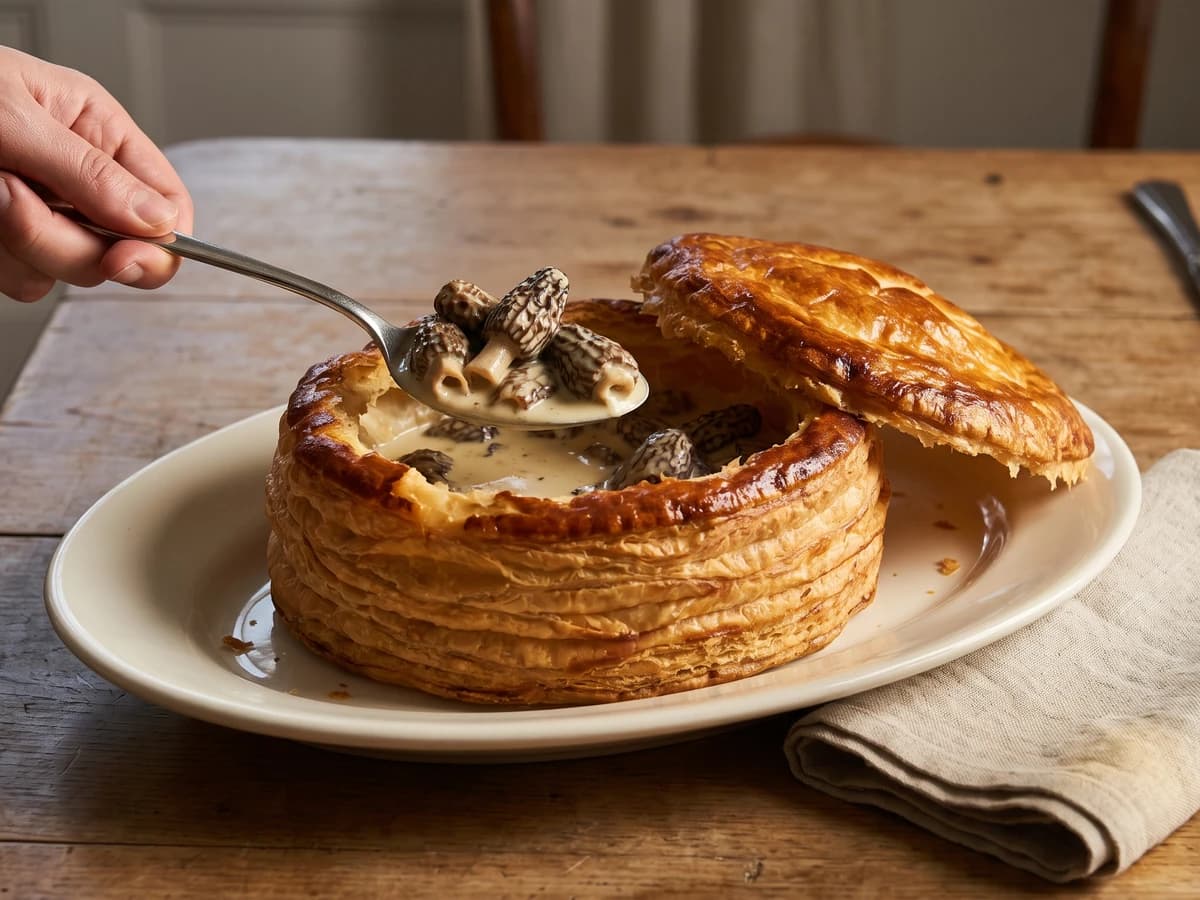
Morels surrender their liquor, then take it back as a glossy cream-and-butter sauce inside burnished puff pastry. The lesson is simple and absolute: reduce with patience, then heat gently and never boil.