Culinary Explorer

A cooking platform built around craft, culture, and the stories behind what we eat.
Discover Culinary Explorer
Topfenstrudel

Topfenstrudel

Created by

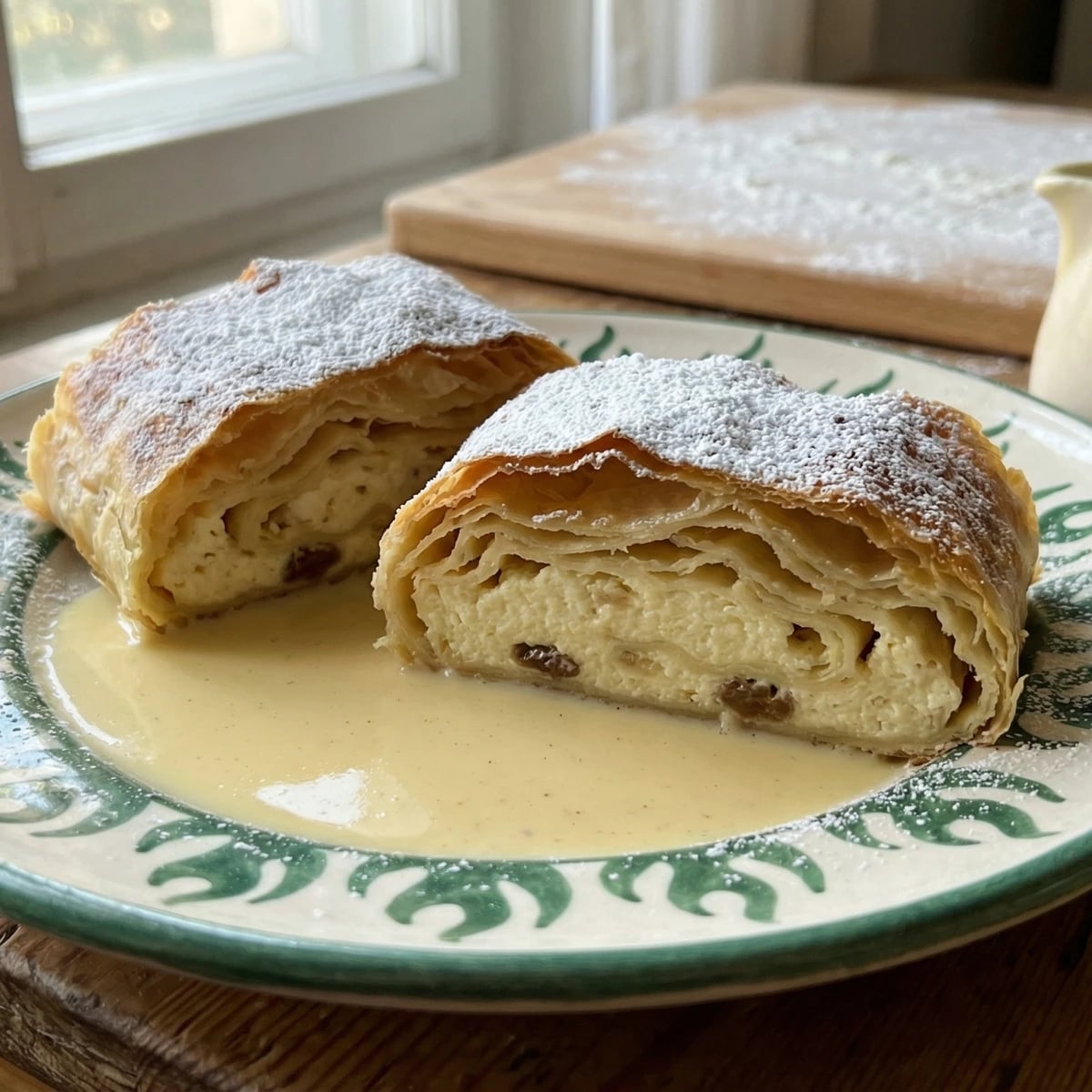
Hand-stretched strudel filled with tangy Topfen quark, sour cream, and rum-soaked raisins, baked golden and dusted with powdered sugar. Vienna's second favourite strudel, and some Viennese will tell you it's the first.

Pastries & Cookies
Austrian
Comfort Food
Weeknight
1 hr 15 min
Active Time
40 min cook1 hr 55 min total
Yield6 servings

In my grandmother Eva's kitchen in Kent, Gretel Beer made two kinds of strudel. The Apfelstrudel came out in autumn when the apples were good. The Topfenstrudel came out all year round, because Topfen doesn't care what month it is. I remember watching her stretch the dough across Eva's kitchen table, this small woman with strong hands pulling it thinner and thinner until I could see the tablecloth pattern underneath. She'd spread the filling across the dough and say, "Not too much. The Topfen needs room to breathe in there or it steams instead of sets."

Topfenstrudel is the quieter strudel. It doesn't have the drama of caramelized apples or the perfume of warm cinnamon. What it has is something better: that clean, tangy richness of good quark, softened with sour cream and eggs, barely sweet, with a few rum-soaked raisins hiding inside. When it bakes, the filling sets into something between a custard and a mousse while the dough turns golden and shatters when you press a fork through it. The contrast is everything. Crisp, paper-thin pastry against cool, creamy filling.

Austrians eat Topfenstrudel warm, not hot, with a dusting of powdered sugar and sometimes a pool of vanilla sauce alongside. In my restaurant in Salzburg, I serve it as a Mehlspeise, because in Austria a Mehlspeise isn't just dessert. It's the heart of the meal. Gretel always said that Austrians like to eat well, and what they like to eat best is dessert. Topfenstrudel is proof she was right.

Strudel dough arrived in the Habsburg lands through Ottoman influence, likely adapted from the layered pastry traditions of Turkey and the eastern Mediterranean. The earliest known Austrian strudel recipe dates to 1696, a handwritten manuscript now held in the Vienna City Library. Topfenstrudel became a Viennese staple in the 18th and 19th centuries as Topfen, the fresh curd cheese central to Austrian cooking, was produced across the empire's farms and sold cheaply at every market. While Apfelstrudel gets the international fame, Topfenstrudel remains the everyday favourite in Austrian homes and Konditoreien, the one bakers make when they want to feed people, not impress them.

The technique, the tradition, and the story behind every dish.

Discover Culinary Explorer

Ingredients

griffiges Mehl (coarse flour, or plain flour)

Quantity

200g

warm water

Quantity

120ml

neutral oil (sunflower or vegetable)

Quantity

2 tablespoons

white wine vinegar

Quantity

1 teaspoon

salt (for dough)

Quantity

pinch

Topfen or quark (20% fat)

Quantity

500g

sour cream

Quantity

100g

full fat

granulated sugar

Quantity

80g

Vanillezucker (vanilla sugar)

Quantity

1 packet (8g)

eggs

Quantity

2 large

separated

lemon

Quantity

1

zested

raisins

Quantity

50g

soaked in dark rum

fine semolina (Grieß)

Quantity

30g

unsalted butter

Quantity

60g

melted

fine dry breadcrumbs

Quantity

40g

powdered sugar

Quantity

for dusting

warm vanilla sauce or Schlagobers (whipped cream)

Quantity

for serving

Equipment Needed

  • Large clean tablecloth or tea towel for stretching
  • Rolling pin
  • Pastry brush
  • Large baking sheet, lined with parchment
  • Hand mixer or whisk for egg whites
  • Serrated knife for slicing

Instructions

  1. 1

    Make the strudel dough

    Mound the flour on a clean work surface and make a well in the centre. Add the warm water, oil, vinegar, and salt. Work everything together with your hands, pulling the flour in from the edges, then knead for a solid eight to ten minutes until the dough becomes smooth, elastic, and slightly tacky. It should feel alive under your hands. Slap it against the counter a few times if it's being stubborn. The vinegar and oil relax the gluten and make the dough stretchable later. Without them, you'll be fighting dough that keeps snapping back.

    Use griffiges Mehl if you can find it. Austrian coarse flour has less gluten than American all-purpose, which gives you a more tender, cooperative dough. If you're using regular plain flour, add a tiny splash more oil.
  2. 2

    Rest the dough

    Shape the dough into a smooth ball, brush the surface lightly with oil so it doesn't dry out, and cover it with a warm bowl turned upside down. Let it rest for at least thirty minutes, longer if you can manage it. The gluten needs to relax completely. If you try to stretch it too soon, it will tear and you'll curse and have to start over. Go make the filling while you wait.

    Gretel always said to warm the bowl first with hot water before placing it over the dough. The gentle warmth helps the gluten relax faster.
  3. 3

    Soak the raisins

    Put the raisins in a small bowl and pour dark rum over them, enough to cover. Let them sit for at least thirty minutes. They should plump up and turn glossy. If you skip this, the raisins will sit in the filling like dry little pebbles and absorb moisture from the Topfen instead of contributing flavour. The rum isn't about getting anyone drunk. It's about depth.

  4. 4

    Prepare the Topfen filling

    In a large bowl, combine the Topfen, sour cream, sugar, and Vanillezucker. Stir until smooth. Add the egg yolks and lemon zest and mix well. The filling should be creamy and just slightly tangy. Now stir in the semolina. This is important: the Grieß absorbs excess moisture during baking so the filling sets instead of turning soupy. Drain the raisins and fold them in gently. In a separate clean bowl, whisk the egg whites until they hold soft peaks, then fold them into the Topfen mixture in two additions. Light strokes. You want air in this filling. It should puff slightly in the oven, giving you that soft, almost mousse-like texture inside.

    If your Topfen or quark is very wet, press it through a sieve first or let it drain in muslin for twenty minutes. Too much liquid and the filling will weep through the dough.
  5. 5

    Toast the breadcrumbs

    Melt about a tablespoon of the butter in a small pan over medium heat. Add the breadcrumbs and stir constantly until they turn golden and fragrant, two to three minutes. Watch them closely. They go from golden to burnt in about ten seconds. Set aside. These create a barrier between the wet filling and the dough, keeping the bottom crisp instead of soggy.

  6. 6

    Stretch the dough

    Lay a clean tablecloth or large tea towel on your table and dust it lightly with flour. Place the rested dough in the centre and roll it out as far as it will go without resistance. Then put the rolling pin aside, because the rest happens with your hands. Slide your hands underneath the dough, palms down, and begin stretching it outward from the centre, using the backs of your hands and your knuckles. Walk around the table. Pull gently and evenly. The dough should stretch until it's paper-thin and nearly translucent. You should be able to read a newspaper through it, or at least see the pattern of your cloth. Trim any thick edges with scissors.

    Take off your rings and watch. The dough is forgiving but not invincible. A small tear isn't a disaster; just pinch it closed. A large tear means you rushed the resting time.
  7. 7

    Assemble the strudel

    Preheat your oven to 180°C (350°F). Brush the entire surface of the stretched dough generously with melted butter. Scatter the toasted breadcrumbs in a wide strip across the lower third of the dough, leaving a border on both sides. Spoon the Topfen filling over the breadcrumbs in an even layer. Don't spread it all the way to the edges. You need room to fold the sides in and seal the roll. Fold the side borders over the filling, then use the cloth underneath to help you roll the strudel away from you, gently and firmly, like rolling a sleeping bag. The cloth does the work. Trust it. Carefully transfer the strudel onto a lined baking sheet, seam side down, bending it into a slight crescent if your sheet isn't long enough.

  8. 8

    Bake until golden

    Brush the top and sides of the strudel with more melted butter. Bake for thirty-five to forty minutes, brushing with the remaining butter once more halfway through. The strudel is done when the pastry turns a deep, even gold and the layers look dry and flaky, not pale and soft. You'll see spots where butter has pooled and crisped at the edges. That's exactly right.

  9. 9

    Rest, slice, and serve

    Let the strudel cool for ten to fifteen minutes on the baking sheet. It needs this rest. Cut it too soon and the filling will spill out in a hot mess instead of holding together in a soft, creamy layer. Slice with a sharp serrated knife into generous portions. Dust with powdered sugar, and serve warm with vanilla sauce pooled alongside, or a spoonful of lightly sweetened Schlagobers. Mahlzeit!

Chef Tips

  • The quality of your Topfen determines everything. Use full-fat quark, at least 20%, from the best source you can find. Low-fat quark produces a filling that's grainy and dry instead of creamy and rich. If you're outside Austria and can't find Topfen, use full-fat quark from a European deli. Ricotta is not the same thing. Cream cheese is not the same thing.
  • Stretch the dough on a tablecloth, not directly on the table. The fabric gives you grip and helps you roll the strudel without tearing. Gretel used the same checkered cloth for forty years. A clean bed sheet works perfectly if you don't have a proper Strudeldecke.
  • Serve the strudel warm, not hot. At warm, the filling has set into something silky and the pastry is at its crispest. At hot, the filling is still loose and will pour out when you cut. At cold, the pastry loses its shatter. The sweet spot is about fifteen minutes out of the oven.
  • Vanilla sauce is traditional and worth making: heat 250ml milk with a split vanilla pod, whisk two egg yolks with a tablespoon of sugar and a teaspoon of cornflour, temper with the warm milk, and cook gently until it coats a spoon. It takes five minutes and it makes the whole dish sing.

Advance Preparation

  • Strudel dough can rest for up to two hours at room temperature under a warm bowl. It actually gets easier to stretch the longer it rests, within reason.
  • The Topfen filling can be prepared up to four hours ahead and refrigerated. Fold in the whipped egg whites just before assembling.
  • Raisins can be soaked in rum overnight. They only get better.
  • Topfenstrudel is best eaten the day it's baked. Leftover slices can be warmed in a 160°C oven for ten minutes the next day, but the pastry won't be quite as crisp.

Frequently Asked Questions

Nutrition Information

1 serving (about 200g)

Calories
515 calories
Total Fat
23 g
Saturated Fat
11 g
Trans Fat
0 g
Unsaturated Fat
12 g
Cholesterol
105 mg
Sodium
135 mg
Total Carbohydrates
60 g
Dietary Fiber
2 g
Sugars
25 g
Protein
18 g

Note: Chef personas and recipes are created with AI assistance. Cook with care: follow safe food-handling practices, check doneness with a thermometer when needed, and adapt for allergies and your kitchen.

Where cooking meets culture.

Culinary guides, cultural storytelling, and the editorial depth that makes cooking meaningful.

Discover Culinary Explorer

More from Austrian Strudels

Browse the full collection