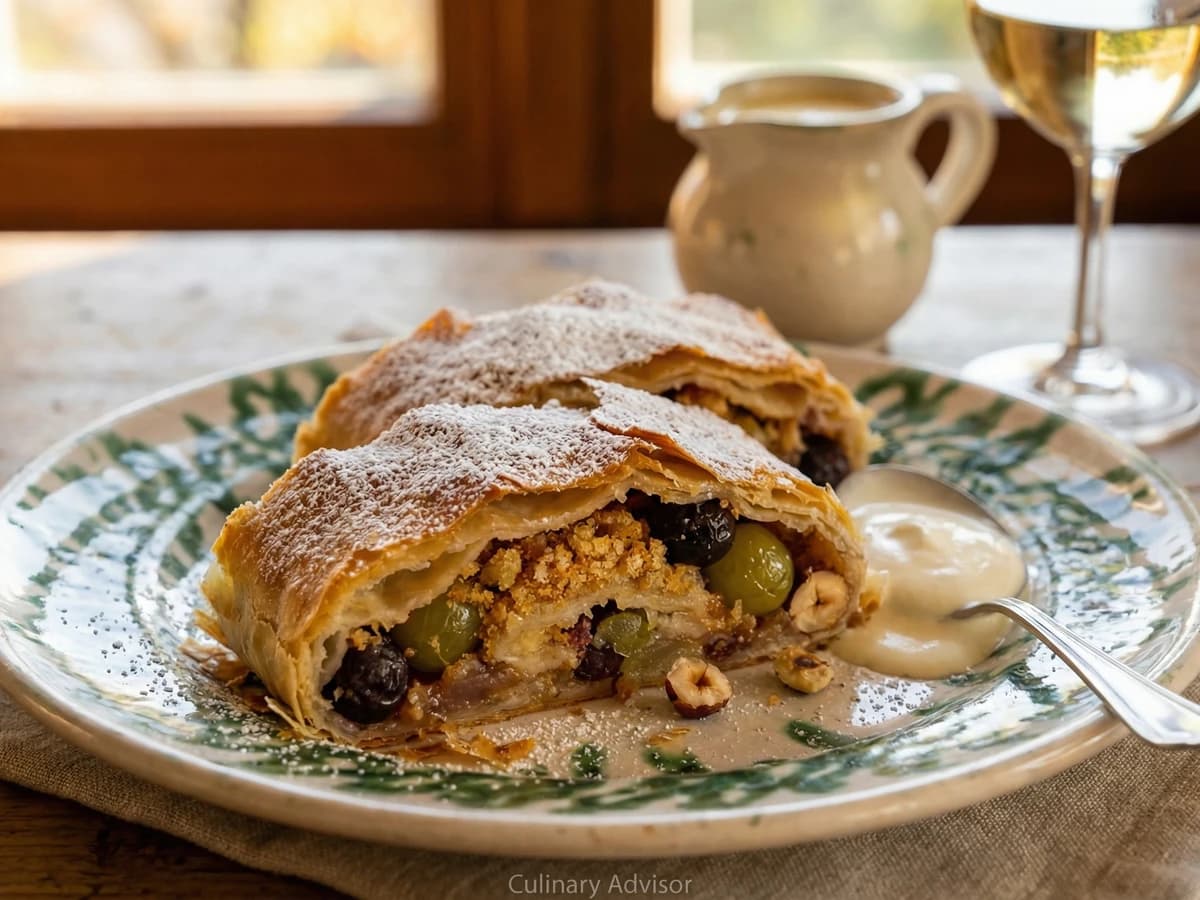
Hand-stretched strudel filled with cool, tangy Topfen and ripe Wachau apricots on a bed of buttery toasted breadcrumbs. Two of Austria's greatest fillings in one golden summer roll.
Pastries & Cookies
Austrian
Weeknight
Outdoor Dining
1 hr
Active Time
40 min cook•1 hr 40 min total
Yield6 servings
Every July, Gretel and my grandmother Eva would argue about which strudel was better: Topfenstrudel or Marillenstrudel. Gretel held firm for the Topfen, for that clean, tangy curd that bakes into something between a cheesecake and a cloud. Eva loved the Marillen, the Wachau apricots that turn almost jammy in the oven while keeping just enough bite to remind you they were fruit five minutes ago. They never resolved it. I grew up listening to this argument every summer in Eva's kitchen in Deal, with flour on the tablecloth and the smell of toasted breadcrumbs filling the room.
So I put them together. Topfen-Marillen-Strudel is not a compromise. It's the answer to a question two stubborn Viennese women spent thirty years debating. The Topfen filling is rich but sharp, brightened with lemon zest and Vanillezucker. The apricots nestle into it, their sweetness cutting through the tang so every bite moves between creamy and fruity without settling on either. Underneath both, a layer of buttered breadcrumbs keeps the pastry crisp and gives you that faint nutty crunch when you bite through the layers.
The dough is the heart of it, the same hand-stretched strudel dough used across every Austrian Mehlspeise that matters. Flour, water, oil, a splash of vinegar, kneaded hard and rested long. You stretch it on a floured cloth until it's translucent. This is the technique my grandmother taught me before I ever set foot in GAFA, and it's the one I still teach every new cook who walks into my kitchen in Salzburg. If you can stretch strudel dough, you can make a hundred Austrian desserts. Start here.
Topfenstrudel and Marillenstrudel are each pillars of the Austrian Mehlspeisen tradition, but combining them into a single strudel is a regional practice found in the Wachau Valley, where apricot orchards and dairy farms sit side by side along the Danube. The Wachau apricot (Wachauer Marille) has held EU Protected Geographical Indication status since 2003, reflecting its importance to Austrian identity. Strudel dough itself traces back to Ottoman and Byzantine layered pastry traditions, arriving in Vienna through Hungary during the Habsburg expansion. The oldest known strudel recipe in Austria dates to 1696, a handwritten manuscript held in the Vienna City Library.
The technique, the tradition, and the story behind every dish.
vanilla sauce (Vanillesauce) or Schlagobers (optional)
Quantity
for serving
Ingredient
Quantity
griffiges Mehl (coarse flour)
250g
lukewarm water
150ml
neutral oil (sunflower or rapeseed)
2 tablespoons
white wine vinegar
1 teaspoon
salt (for dough)
pinch
Topfen (quark, 20% fat)
500g
granulated sugar
100g
Vanillezucker (vanilla sugar)
2 packets
egg yolks
3 large
lemonzested
1
sour cream (Sauerrahm)
100g
semolina (Grieß)
40g
ripe Wachau apricotshalved and stoned
500g (about 10-12)
unsalted butter
80g
fine dry breadcrumbs
100g
granulated sugar (for breadcrumbs)
2 tablespoons
powdered sugar
for dusting
vanilla sauce (Vanillesauce) or Schlagobers (optional)
for serving
Equipment Needed
•Large clean cotton cloth or tablecloth (for stretching dough)
•Rolling pin
•Wide pan or skillet (for toasting breadcrumbs)
•Large baking sheet lined with parchment
•Pastry brush
•Fine-mesh sieve (for draining Topfen)
Instructions
1
Make the strudel dough
Mound the griffiges Mehl on a clean work surface and make a well in the center. Pour in the lukewarm water, oil, vinegar, and salt. Work it together with your hands, pulling the flour in from the edges, until you have a shaggy mass. Now knead. Really knead. Ten minutes, slamming the dough against the counter every so often, until it becomes completely smooth and elastic. It should feel alive under your hands, supple like an earlobe. The vinegar relaxes the gluten, which is what will let you stretch this paper-thin later. Shape it into a ball, brush the surface lightly with oil, cover with a warm bowl turned upside down, and let it rest for at least thirty minutes.
Griffiges Mehl has a coarser grind and lower protein than standard all-purpose flour, which gives strudel dough its pliability. If you can't find it, use all-purpose flour but add an extra splash of oil. The dough may fight you a little more when you stretch it.
2
Prepare the Topfen filling
While the dough rests, drain the Topfen in a fine sieve for ten minutes if it seems wet. You don't want excess liquid weeping into your strudel and making the dough soggy. In a large bowl, stir together the drained Topfen, sugar, both packets of Vanillezucker, egg yolks, lemon zest, and sour cream until smooth and creamy. Fold in the semolina last. The semolina absorbs moisture during baking and keeps the filling set rather than runny. Let this sit while you deal with the apricots.
Topfen and quark are the same thing. If you can't find either, use a full-fat ricotta drained overnight in muslin. It won't be identical but it comes close. Do not use cream cheese. Different animal entirely.
3
Prepare the apricots
Halve the apricots and remove the stones. If they're large, quarter them. You want pieces that will nestle into the Topfen filling without creating enormous pockets of fruit that collapse and leave gaps. Don't slice them too thin or they'll dissolve into jam during baking. A halved apricot that's about the size of a walnut half is what you're after. Taste one. If it makes you close your eyes, you've chosen well.
4
Toast the breadcrumbs
Melt 50g of the butter in a wide pan over medium heat. When it foams, add the breadcrumbs and stir constantly until they turn golden and smell nutty, about three to four minutes. Sprinkle in the two tablespoons of sugar and stir for another thirty seconds until the sugar melts into the crumbs. Tip them onto a plate to cool. These buttered breadcrumbs form a barrier between the wet filling and the stretched dough. Skip this step and your strudel bottom turns to paste.
Gretel always said the breadcrumbs are what separates a Strudel that holds together from one that falls apart on the plate. Toast them properly. If they're still pale, they're not done.
5
Stretch the dough
Preheat your oven to 190°C (375°F). Lay a clean cotton cloth or old tablecloth on your kitchen table and dust it lightly with flour. Roll the dough out with a rolling pin into a rough rectangle, then set the pin aside. Flour your hands, slide them under the dough palms down, and begin stretching from the center outward. Use the backs of your hands and let gravity help. Walk around the table, pulling gently, rotating your position. The dough should stretch to roughly 60 by 40 centimeters, thin enough to read a newspaper through. A few small tears are fine. They happen. If it tears badly, the dough didn't rest long enough or you pulled too hard in one spot.
Remove your rings and watch before stretching. The dough is delicate and any sharp edge will tear it. Work with the backs of your hands, not your fingertips.
6
Fill and roll the strudel
Melt the remaining 30g of butter and brush it generously over the stretched dough. Scatter the toasted breadcrumbs evenly across two-thirds of the surface, leaving the far third bare for sealing. Spread the Topfen filling over the breadcrumbs in a thick band along the edge closest to you, leaving a 5cm border on each side. Arrange the apricot halves cut-side down along the top of the Topfen, pressing them gently into the filling. They should be snug but not crowded. Using the cloth underneath, lift the near edge and begin rolling the strudel away from you, letting the cloth guide the roll. Tuck the side edges in as you go. The far edge of bare dough seals the roll shut. Carefully transfer the strudel seam-side down onto a parchment-lined baking sheet, curving it slightly if your sheet isn't long enough.
7
Bake the strudel
Brush the top and sides of the strudel with the remaining melted butter. Place it in the preheated oven and bake for 35 to 40 minutes, brushing with butter once more halfway through. The strudel is done when the pastry is deep golden brown and the layers look dry and flaky. You'll see the edges crisping and pulling away slightly from the filling. Let it cool on the baking sheet for ten minutes. It needs that time to set. If you cut it straight from the oven the filling will run.
8
Dust and serve
Dust the strudel generously with powdered sugar. Cut thick slices with a sharp serrated knife, angling through the layers so each piece shows the spiral of golden dough, white Topfen, and orange apricot. Serve warm with a spoonful of vanilla sauce pooling alongside, or with a generous dollop of unsweetened Schlagobers. This is a summer Mehlspeise. Eat it outside if you can. Mahlzeit!
Chef Tips
•Buy your apricots at peak season, late June through July. If you can find Wachauer Marillen, that's the gold standard, but any ripe, fragrant apricot will work. Press the fruit gently near the stem. If it gives slightly and smells like apricot from a foot away, it's ready. If it smells like nothing, it will taste like nothing.
•The Topfen filling must not be wet. If your quark came in a tub and looks loose, drain it in a muslin-lined sieve over a bowl for at least thirty minutes. An hour is better. Wet filling is the single most common reason a strudel goes soggy.
•Don't be afraid of the stretching. The dough wants to be stretched. If it keeps snapping back, it hasn't rested long enough. Cover it again and wait another fifteen minutes. Patience here saves you from tears in the dough and tears in your eyes.
•Serve this strudel warm, not hot. Straight from the oven the filling is molten and will pour out when you cut it. Ten minutes of resting lets the Topfen set just enough to hold its shape while still feeling warm and tender on the tongue.
Advance Preparation
•The strudel dough can rest for up to two hours at room temperature under its warm bowl. Longer than that and it begins to dry out, even under cover.
•The Topfen filling can be made up to four hours ahead and refrigerated. Stir it gently before using, as the semolina will have absorbed some liquid and thickened it.
•Toasted breadcrumbs can be prepared a day ahead and stored in an airtight container at room temperature.
•The assembled strudel is best baked immediately. Once filled, the moisture from the Topfen and fruit will soften the dough if it sits too long.
Frequently Asked Questions
Nutrition Information
1 serving (about 275g)
Calories
660 calories
Total Fat
27 g
Saturated Fat
13 g
Trans Fat
0 g
Unsaturated Fat
14 g
Cholesterol
140 mg
Sodium
220 mg
Total Carbohydrates
87 g
Dietary Fiber
4 g
Sugars
37 g
Protein
21 g
Where cooking meets culture.
Culinary guides, cultural storytelling, and the editorial depth that makes cooking meaningful.